


eSLOE 2.0: Examining Data From the First 2 Application Cycles of the Updated Emergency Medicine Electronic Standardized Letter of Evaluation
- PMID: 40417096
- PMCID: PMC12096113
- DOI: 10.4300/JGME-D-24-00501.1
eSLOE 2.0: Examining Data From the First 2 Application Cycles of the Updated Emergency Medicine Electronic Standardized Letter of Evaluation
Abstract
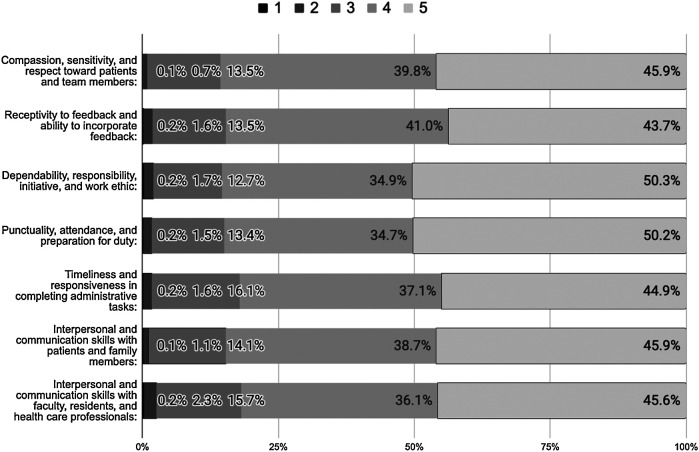
Background The emergency medicine (EM) Standardized Letter of Evaluation (SLOE) was created to provide a standardized, concise, and differentiated evaluation of EM residency applicants. It was revised in 2022 (eSLOE 2.0) to better align with the shift toward competency-based evaluations in undergraduate and graduate medical education. Objective To investigate how applicants were rated by evaluators on the new competency-based component and revised normative-based components of the eSLOE 2.0 and to establish preliminary validity for the new letter format. Methods Data from the first 2 application cycles utilizing the eSLOE 2.0 (2022-2023, 2023-2024) were accessed via a national EM database. The data specifically from parts A (core EM clinical skills), B (professionalism and interpersonal skills), and C (anticipated guidance during residency and rank list placement) were examined. Results Data from the 11 789 letters, representing 6543 unique applicants, revealed that 44.8% to 71.7% of applicants were designated as fully entrustable, and 27% to 50.7% as mostly entrustable on part A skills. Most applicants (81.7% to 85.7%) were placed as either 4 or 5 (1-5 Likert scale) in each part B skill. Nearly fifty-two percent (n=6076) were anticipated to need standard guidance in residency, while 32.8% (n=3872) were anticipated to need minimal guidance and 15.6% (n=1841) to need moderate or most guidance. In part C, 20.5% (n=2414) were designated as being in the top 10% on the rank list, 37.2% (n=4381) in the top third, 31.6% (n=3727) in the middle third, and 10.0% (n=1178) in the lower third. Conclusions The findings from the first 2 years of utilizing the eSLOE 2.0 format offer preliminary validity data on this new letter format.
Figures



References
-
- Coalition for Physician Accountability. The Coalition for Physician Accountability’s Undergraduate Medical Education-Graduate Medical Education Review Committee (UGRC). Recommendations for Comprehensive Improvement of the UME-GME Transition. Published 2021. Accessed February 3, 2025. https://physicianaccountability.org/wp-content/uploads/2021/08/UGRC-Coal....
MeSH terms
LinkOut - more resources
Full Text Sources
