


Effects of augmented reality cueing strategies on freezing of gait: The ELIMINATE FoG trial
- PMID: 40417228
- PMCID: PMC12099459
- DOI: 10.1016/j.prdoa.2025.100332
Effects of augmented reality cueing strategies on freezing of gait: The ELIMINATE FoG trial
Abstract
Background: Freezing of gait (FoG) is a treatment-resistant symptom of Parkinson disease (PD). Augmented reality (AR) cues have been investigated as a therapy for FoG, with inconclusive results from a limited array of AR constructs.
Objectives: Compare four modalities of a novel AR cue to physical and no-cue controls.
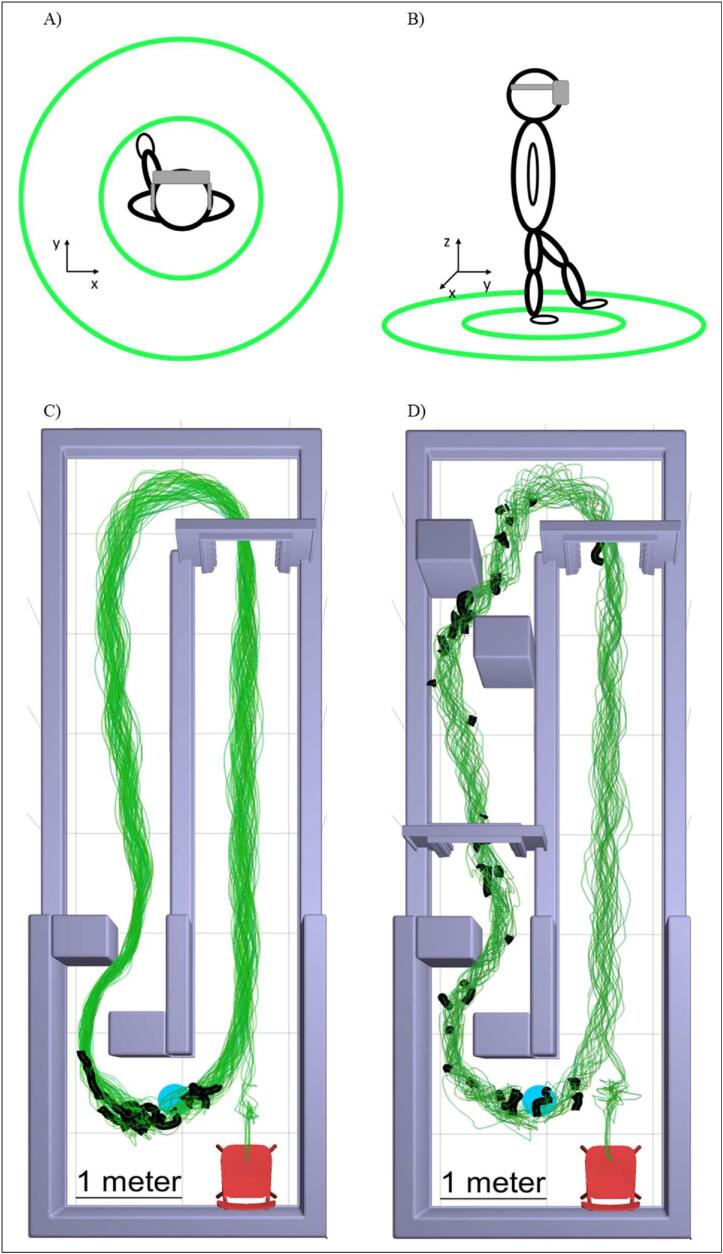
Methods: Presence of FoG in PD was required; exclusion criteria included dementia, severe vision loss, and significant gait-disrupting comorbidities. Participants completed six walking tasks, featuring different cueing conditions in a crossover fashion, in a holographic hallway displayed by an AR headset. A conventional physical cue was presented first, followed by other conditions in randomized order (hand-controlled AR cue, observer-controlled AR cue, eye-controlled AR cue, constant AR cue, no-cue control). Primary outcomes were FoG duration and incidence, manually annotated. Secondary outcomes included survey questions and gait parameters derived from IMUs.
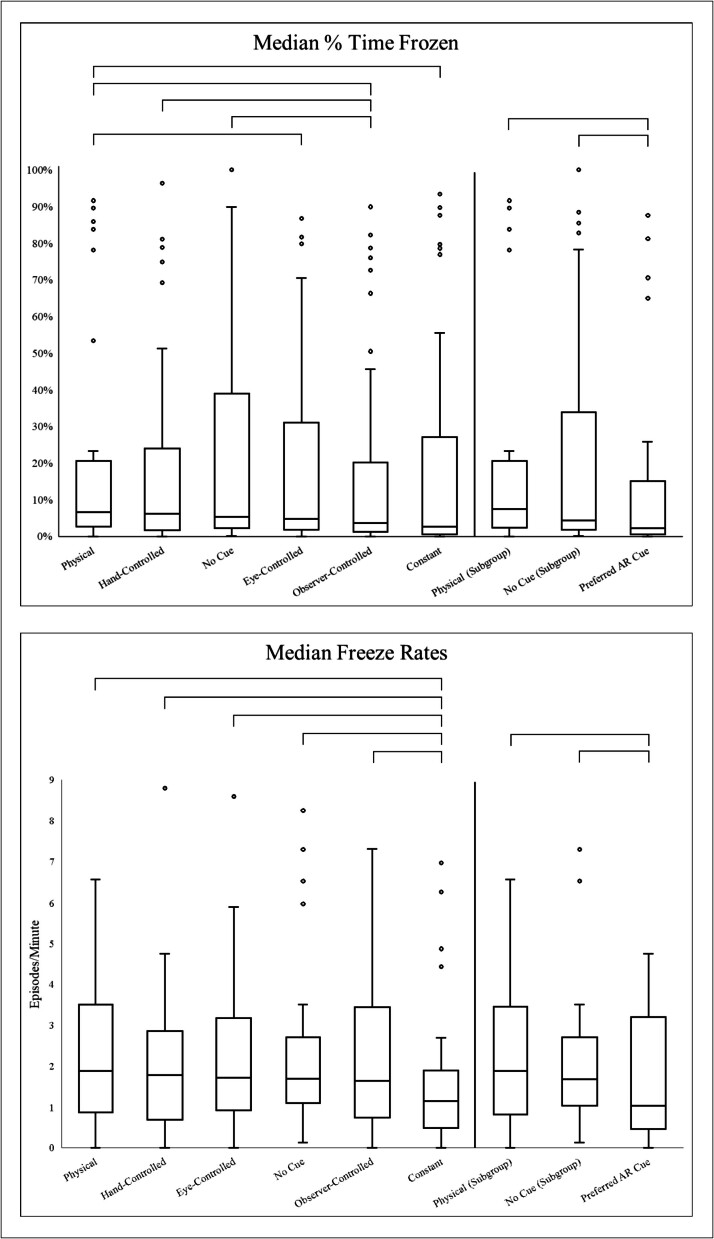
Results: Thirty-six participants completed testing. The observer-controlled AR cue produced lower FoG duration than the no-cue, physical, and hand-controlled AR cue conditions (N = 36, p ≤ 0.006, Wilcoxon effect size (WES) ≥ 0.46). The constant cue reduced FoG incidence compared to all other conditions (N = 36, p ≤ 0.016, WES ≥ 0.40). Participants' preferred AR cues decreased FoG duration (N = 28, p ≤ 0.004, WES ≥ 0.48) and incidence (N = 28, p ≤ 0.022, WES ≥ 0.38) compared to controls. Differences in kinematic outcomes were negligible. Survey results indicated receptiveness toward AR cueing, with diversity in preferred cue activation modalities. No significant adverse events occurred.
Conclusions: AR cueing decreased FoG incidence and duration compared to controls. Efficacy of discrete cueing modalities likely depends on user intrinsic factors, such as preference.
Keywords: Augmented reality; Cue; FoG; Gait freezing; Parkinson’s disease.
© 2025 The Author(s).
Conflict of interest statement
The authors declare the following financial interests/personal relationships which may be considered as potential competing interests: James Liao reports financial support was provided by American Parkinson Disease Association. Brendan Baugher reports financial support was provided by American Parkinson Disease Association. Brendan Baugher reports financial support was provided by Ohio University Russ College of Engineering and Technology. Brendan Baugher reports financial support was provided by Ohio University Graduate College. Active licensing agreement with Strolll Limited for the techniques described in the manuscript – BB, JL; Editor-in-chief of Parkinsonism and Related Disorders – HHF; Scientific advisory board member for Strolll Limited – JLA If there are other authors, they declare that they have no known competing financial interests or personal relationships that could have appeared to influence the work reported in this paper.
Figures
References
LinkOut - more resources
Full Text Sources
Research Materials
