


Changes in Health Information Exchange Use Behavior After Introduction of a Fast Healthcare Interoperability Resources (FHIR) Application
- PMID: 40417487
- PMCID: PMC12099321
Changes in Health Information Exchange Use Behavior After Introduction of a Fast Healthcare Interoperability Resources (FHIR) Application
Abstract
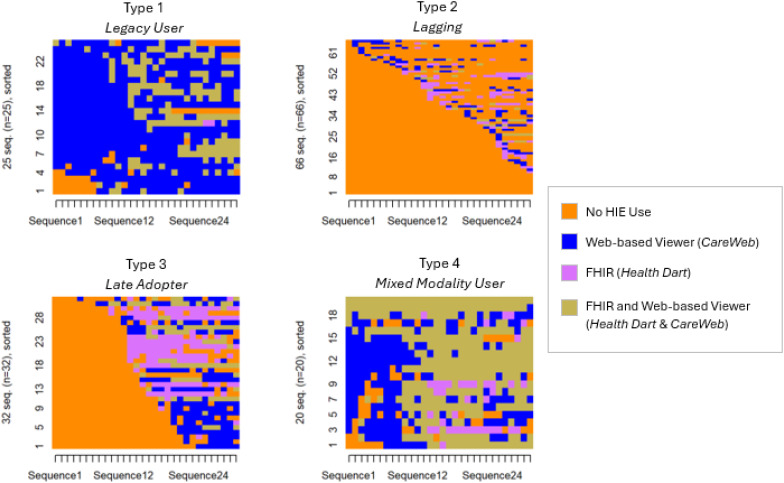
The aim of our study was to characterize emergency department clinicians' health information exchange (HIE) use patterns after the implementation of a Fast Healthcare Interoperability Resources (FHIR) application. Using longitudinal electronic health record log data, we categorized HIE use behavior as: no HIE use (0), Web-based viewer use only (1), FHIR application use only (2), or Web-based viewer and FHIR application use (3). We sequenced HIE use behavior from September 2019 to February 2023, then employed hierarchical agglomerative clustering to identify clinician characteristics associated with each HIE use pattern. Our results showed four usage patterns representing (1) clinicians who "lagged" in HIE use and continued as sporadic HIE users (n=66, 46.1%), (2) "late adopters" who had more consistent usage over time (n=32, 22.4%), (3) "legacy users" whose preferred modality was the Web-based viewer (n=25, 17.5%), and (4) "mixed modality users" who displayed frequent changes in HIE access modality (n=20, 14.0%).
Keywords: FHIR; Fast Healthcare Interoperability Resources; HIE; Health Information Exchange; Interoperability.
©2024 AMIA - All rights reserved.
Figures
References
-
- Vest JR. Health information exchange: national and international approaches. Adv Health Care Manag. 2012;12:3–24. - PubMed
-
- Congress. Medicare access and CHIP Reauthorization Act of 2015. 2015.
-
- HHS. Report to the office of the national coordinator for health information technology on defining key health information technology terms. 2008.
MeSH terms
Grants and funding
LinkOut - more resources
Full Text Sources