


Antimicrobial Resistance Patterns in an Urban County: a Spatiotemporal Exploration
- PMID: 40417497
- PMCID: PMC12099405
Antimicrobial Resistance Patterns in an Urban County: a Spatiotemporal Exploration
Abstract
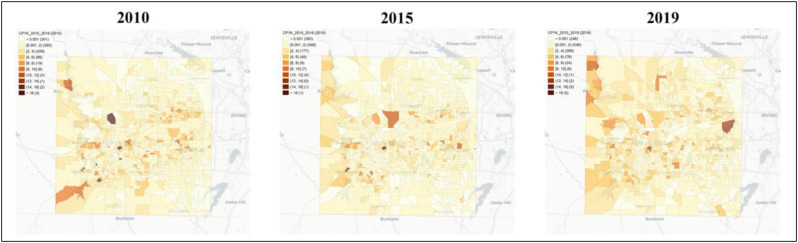
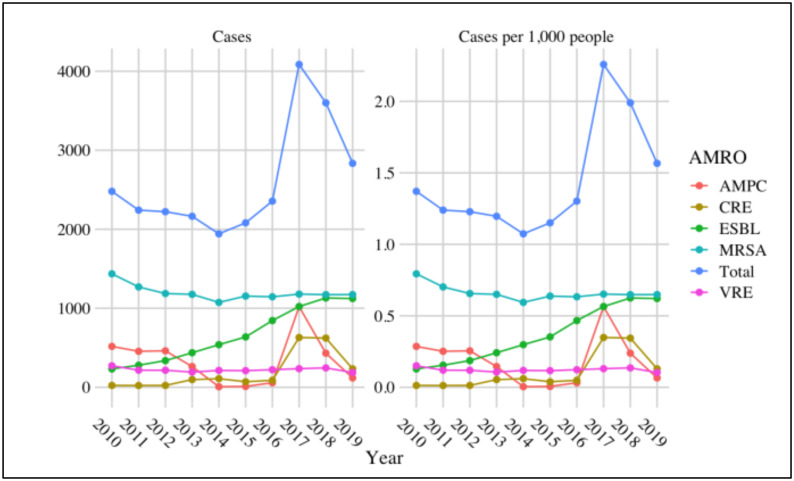
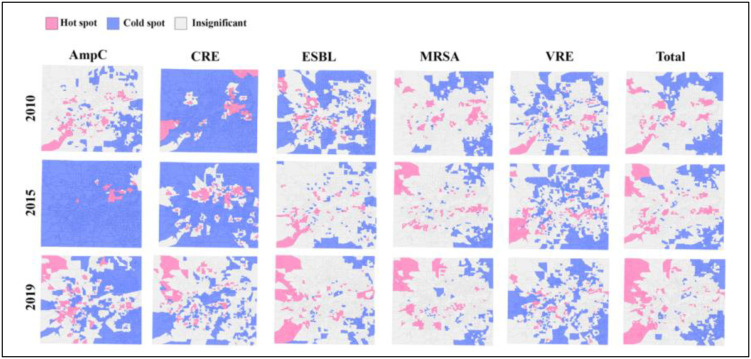
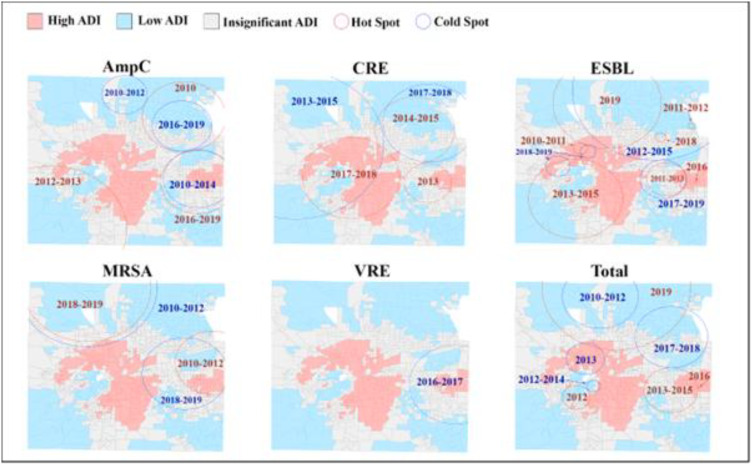
The Centers for Disease Control and Prevention has raised national alarm over five Antimicrobial Resistant Organisms (AMROs) considered urgent or serious threats to public safety. Understanding the prevalence and distribution of AMROs at a local level can inform the unique infection risks facing our communities. We conducted a retrospective, spatiotemporal analysis of AMRO prevalence across Tarrant County, Texas from 2010-2019. Using spatial autocorrelation tests, we identified that across five different AMRO subtypes, the Western half of Tarrant County experienced more hot spots than the Eastern half. Our Space-Time Permutation Models identified 35 unique AMRO clusters. Using logistic regression models, we found significant associations between Area Deprivation Index, a measure of socioeconomic disparity, and most AMRO clusters. These findings underscore the importance of residency location and temporal trends when treating and preventing AMRO infections.
©2024 AMIA - All rights reserved.
Figures
References
-
- 2019 antibiotic resistance threats report: Centers for Disease Control and Prevention. 2019. [Available from: https://www.cdc.gov/drugresistance/biggest-threats.html.
-
- Antibiotic resistance threats in the united states, 2019. 2019. [cited Centers for Disease Control and Prevention. Available from: https://stacks.cdc.gov/view/cdc/82532. - PubMed
MeSH terms
Substances
LinkOut - more resources
Full Text Sources
Medical