


The Effects of Acupoint Stimulation Combined With Transcutaneous Electrical Nerve Stimulation on Labor Pain: Protocol for a Stepped Wedge Cluster Randomized Controlled Trial
- PMID: 40418802
- PMCID: PMC12149766
- DOI: 10.2196/63050
The Effects of Acupoint Stimulation Combined With Transcutaneous Electrical Nerve Stimulation on Labor Pain: Protocol for a Stepped Wedge Cluster Randomized Controlled Trial
Abstract
Background: Pain experienced during childbirth can significantly impact the progress of labor and the well-being of both the mother and the fetus. Effective management of labor pain is a crucial component of childbirth care. Nonpharmacological methods of pain relief offer notable advantages over pharmacological approaches, including enhanced maternal and fetal safety, equitable access to health care, and greater availability. Among the nonpharmacological options, transcutaneous electrical nerve stimulation (TENS) and acupoint stimulation are two commonly used methods for alleviating pain during labor. However, the clinical efficacy of these methods remains inconsistent, which hinders the generation of high-quality evidence for clinical practice.
Objective: This study aims to assess the effects of acupoint stimulation combined with TENS on labor pain, delivery outcomes, and childbirth experience for women undergoing a trial of labor.
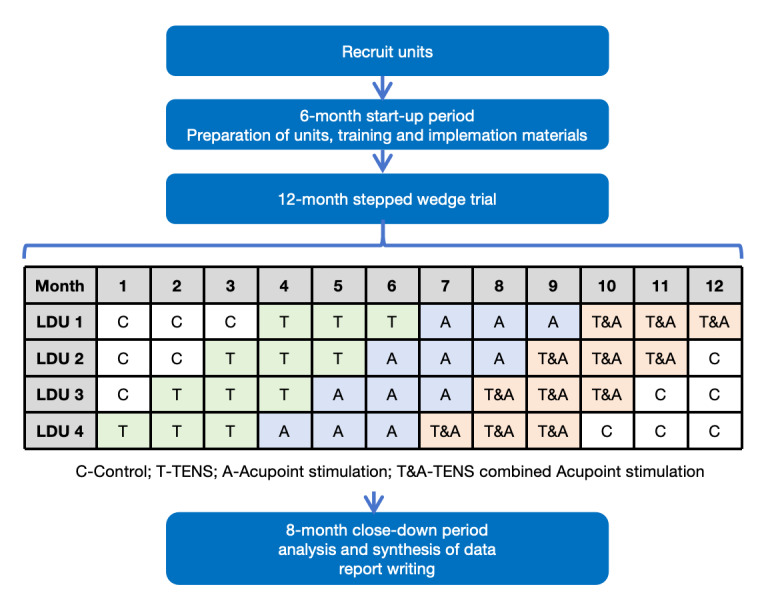
Methods: This is a 12-month stepped wedge cluster randomized trial to be conducted in 4 labor and delivery units (LDUs) at the Obstetrics and Gynecology Hospital of Fudan University. Each unit will implement 4 types of interventions: TENS, acupoint stimulation, TENS combined with acupoint stimulation, and a control group. We aim to recruit approximately 588 pregnant women. The project will be evaluated using both quantitative and qualitative data. Quantitative data will include visual analog scale (VAS) scores, the nonpharmacological to pharmacological pain management interval (NPI), the rate of epidural analgesia, and childbirth outcomes. Qualitative data will include interviews with the women and midwives.
Results: The study commenced on April 1, 2023, and as of March 29, 2024, a total of 600 eligible participants have been enrolled, surpassing the initial target of 588. Data collection has been completed, including quantitative assessments of labor pain intensity, analgesic use, and childbirth outcomes, alongside qualitative interviews with participating women. Currently, data analysis is in progress, with preliminary findings anticipated to be available by March 2025. We hypothesize that TENS combined with acupoint stimulation will demonstrate greater efficacy in managing labor pain compared with standard care. This effect may be observed in key outcome measures, including the VAS score and enhanced maternal childbirth experience.
Conclusions: This study protocol details the interventions of acupoint stimulation and TENS for women undergoing a trial of labor. We introduce a novel outcome indicator termed NPI, which monitors whether the application of nonpharmacological pain relief measures can delay or prevent the use of epidural analgesia. The integration of qualitative and quantitative methods will enrich the research on TENS and acupoint stimulation technology within the realm of nonpharmacological labor pain relief, providing high-quality evidence for the future establishment of industry standards and guidelines.
Trial registration: Chinese Clinical Trial Registry ChiCTR2300069705; https://tinyurl.com/2s3mkhr7.
International registered report identifier (irrid): DERR1-10.2196/63050.
Keywords: acupressure; acupuncture; acupuncture points; childbirth; complementary therapies; electrotherapy; labor pain; medicine, Chinese traditional; nerve; pain; pain management; pregnancy; pregnant women; protocol; pulsed electrotherapy; qualitative data; quantitative data; randomized controlled trial; transcutaneous electric nerve stimulation; women.
©Yiyun Gu, Xiaojiao Wang, Chunxiang Zhu, Hui Min, Jialu Zhang, Liping Mao, Hua Gao, Hangyun Sun, Xinli Zhu, Chunyi Gu. Originally published in JMIR Research Protocols (https://www.researchprotocols.org), 26.05.2025.
Conflict of interest statement
Conflicts of Interest: None declared.
Figures

References
-
- Czech I, Fuchs P, Fuchs A, Lorek M, Tobolska-Lorek D, Drosdzol-Cop A, Sikora J. Pharmacological and non-pharmacological methods of labour pain relief-establishment of effectiveness and comparison. Int J Environ Res Public Health. 2018;15(12):2792. doi: 10.3390/ijerph15122792. https://www.mdpi.com/resolver?pii=ijerph15122792 ijerph15122792 - DOI - PMC - PubMed
-
- Wu PP, Wu YH, Yang XH, Pan ZQ, Lu Y, Li H. Factors influencing labor pain and its correlation with maternal delivery outcomes. Chin. J. Matern. Child Health. 2021;36(18):4195–4197. https://chn.oversea.cnki.net/KCMS/detail/detail.aspx?dbcode=CJFD&dbname=...
-
- Thomson G, Feeley C, Moran VH, Downe S, Oladapo OT. Women's experiences of pharmacological and non-pharmacological pain relief methods for labour and childbirth: a qualitative systematic review. Reprod Health. 2019;16(1):71. doi: 10.1186/s12978-019-0735-4. https://reproductive-health-journal.biomedcentral.com/articles/10.1186/s... 10.1186/s12978-019-0735-4 - DOI - PMC - PubMed
Publication types
MeSH terms
LinkOut - more resources
Full Text Sources
Medical
Miscellaneous
