


Psychological factors and obesity, not thyroid biomarkers, predict thyroid-dependent quality of life in treated hypothyroidism: a cross-sectional study
- PMID: 40420021
- PMCID: PMC12105179
- DOI: 10.1186/s12902-025-01962-9
Psychological factors and obesity, not thyroid biomarkers, predict thyroid-dependent quality of life in treated hypothyroidism: a cross-sectional study
Abstract
Background: A significant number of patients with primary hypothyroidism report persistent symptoms and decreased quality of life (QoL) despite biochemically adequate levothyroxine replacement. Individual variations in thyroxine conversion, autoimmune inflammation, and psychological factors have all been implicated as a potential cause.
Methods: In this cross-sectional study we have examined the association of numerous demographic, disease-specific, and laboratory parameters as well as three patient reported outcome measures with thyroid-dependent QoL as measured by the Underactive Thyroid-Dependent Quality of Life Questionnaire. Patients were stringently selected to minimize the confounding effect of comorbidities or inadequate hormone replacement. We used validated questionnaires to assess somatosensory amplification, depression, and symptom number. Determinants of QoL were evaluated using uni- and multivariable linear modeling, and mediation analysis.
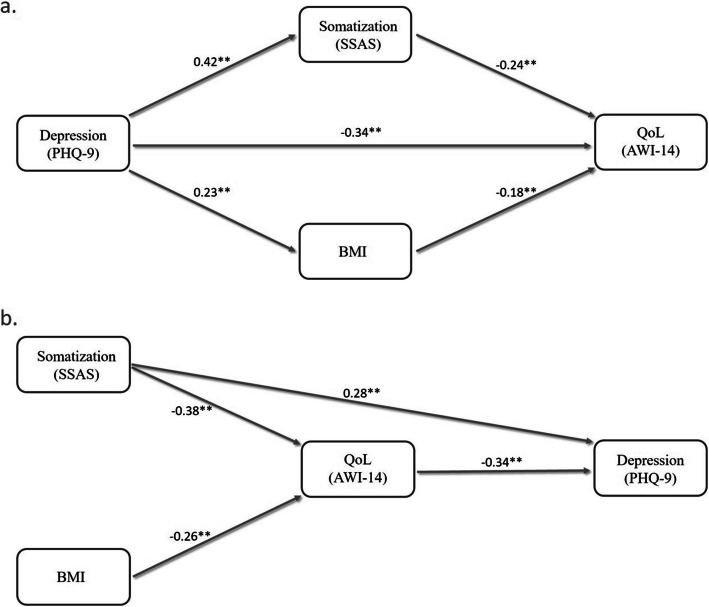
Results: Our final sample consisted of 157 patients. 70.7% had Hashimoto's, whereas 29.3% had iatrogenic hypothyroidism. Mean age was 49.5 ± 14.5 years, disease duration: 11.2 ± 8.2 years, thyroxine dose: 1.2 ug/kg bodyweight, TSH: 1.8 ± 0.9 mIU/L. Thyroid-specific biomarkers including TSH, FT3, FT4, rT3, SPINA-GD, anti-TPO, and SHBG had no association with thyroid-dependent QoL. Somatosensory amplification was a strong predictor of the presence and perceived bother of the most common hypothyroidism-associated symptoms. In our final multivariable model (r2 = 0.31) the factors associated with thyroid-dependent QoL were somatosensory amplification (p = 0.002), BMI (p = 0.021), and depression (p < 0.001).
Conclusion: These results suggest that psychological factors, particularly somatosensory amplification, might play a major role in influencing QoL in hypothyroid individuals on adequate levothyroxine replacement. Our findings do not corroborate a significant role for autoimmune inflammation or tissue-level hypothyroidism.
Keywords: Depression; Hypothyroidism; Obesity; Quality of life; Reverse-T3; Somatosensory amplification.
© 2025. The Author(s).
Conflict of interest statement
Declarations. Ethics approval and consent to participate: The study was approved by the National Scientific and Ethical Committee of the Hungarian Medical Research Council (No.: 38233–1/2019/EKU) and was conducted in accordance with the World Medical Association’s Declaration of Helsinki. Written informed consent was obtained from all participants before entering and prior to all study-related procedures. Consent for publication: Not applicable. Competing interests: The authors declare no competing interests.
Figures
References
-
- Bianco AC, Salvatore D, Gereben B, Berry MJ, Larsen PR. Biochemistry, cellular and molecular biology, and physiological roles of the iodothyronine selenodeiodinases. Endocr Rev. 2002;23(1):38–89. - PubMed
MeSH terms
Substances
LinkOut - more resources
Full Text Sources
Medical
Miscellaneous
