


Effect of differentiated service delivery models for HIV treatment on healthcare providers' job satisfaction and workloads in sub-Saharan Africa: a mixed methods study from Malawi, Zambia, and South Africa
- PMID: 40420127
- PMCID: PMC12105310
- DOI: 10.1186/s12960-025-00993-6
Effect of differentiated service delivery models for HIV treatment on healthcare providers' job satisfaction and workloads in sub-Saharan Africa: a mixed methods study from Malawi, Zambia, and South Africa
Abstract
Introduction: HIV care providers are often overworked and suffer from burnout and low job satisfaction. Differentiated service delivery (DSD) models for HIV treatment aim to decongest clinics and improve providers' quality of professional life by reducing the client/provider ratio and allowing for more time with clients in need. We investigated current job satisfaction and perceived changes in job satisfaction among HIV care providers in Malawi, South Africa, and Zambia after the adoption of DSD models of care in each country.
Methods: We conducted a concurrent, cross-sectional mixed methods survey with clinical and non-clinical HIV care providers between April 2021 and January 2022 at public sector clinics in Malawi (n = 12), South Africa (n = 21), and Zambia (n = 12). Questions investigated the effect of DSD models on provider responsibilities, work burden, time allocation, and job satisfaction. We conducted a principal components analysis of survey responses to create a job satisfaction index and estimated odds ratios (OR) using logistic regression for associations between key variables and low reported job satisfaction. We reported emerging qualitative themes. We used Herzberg's two-factor theory to organize and interpret results, identifying motivating factors (which lead to job satisfaction) and hygiene factors (which we refer to as maintenance factors, that lead to dissatisfaction if lacking).
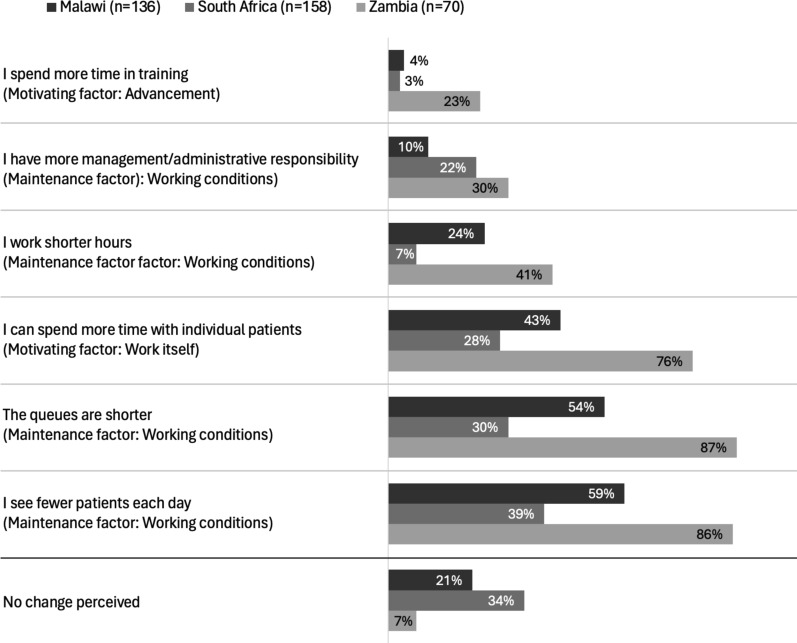
Results: Providers had generally high job satisfaction. Providers from Malawi were more likely to report lower job satisfaction than those from South Africa or Zambia (adjusted OR (aOR) 4.56; 95% confidence interval (CI) [2.12-9.80]). Providers who believed that their jobs became harder after the introduction of DSD models (2.82; [1.14-6.96]) or that their jobs did not change (6.50; [2.50-16.89]) were more likely to report lower job satisfaction than those who believed their jobs became easier. Qualitatively, providers felt DSD models improved their working conditions by easing clinic congestion and allowing them to spend more time on other tasks. Providers were particularly motivated when they could spend more time with clients.
Conclusion: Findings highlight the importance of DSD models in maintaining or improving healthcare providers' quality of professional life and underscore the need for continued monitoring of the impact of these models on job satisfaction among HIV care providers in resource-constrained settings.
Keywords: Differentiated service delivery; HIV; Job satisfaction; Malawi; South Africa; Treatment providers; Zambia.
© 2025. The Author(s).
Conflict of interest statement
Declarations. Ethics approval and consent to participate: Ethical approval to conduct this study was granted by University of Witwatersrand (Medical) Human Research Ethics Committee in South Africa (Protocol M210241), the National Health Science Research Committee (NHSRC) in Malawi (protocol 21/03/2672), ERES Converge Institutional Review Board in Zambia (Protocol 2021-Mar-012), and by the Boston University Medical Campus Institutional Review Board in the United States (Protocol H-41402). Data collectors were trained in research ethics, the overarching study, and the specific survey instrument. Written informed consent was obtained from each participant before the survey commenced. Consent for publication: Not applicable. Competing interests: The authors declare no competing interests.
Figures

References
-
- Ehrenkranz P, Grimsrud A, Rabkin M. Differentiated service delivery: navigating the path to scale. Curr Opin HIV AIDS. 2019;14(1):60–5. - PubMed
-
- National Department of Health. Adherence guidelines for HIV, TB and NCDs. Pretoria; 2023.
-
- Uetela DAM, Augusto O, Hughes JP, Uetela OA, Gudo ES, Chicumbe SA, et al. Impact of differentiated service delivery models on 12-month retention in HIV treatment in Mozambique: an interrupted time-series analysis. Lancet HIV. 2023;10(10):e674–83. - PubMed
MeSH terms
Grants and funding
LinkOut - more resources
Full Text Sources
Medical
Miscellaneous
