. 2025 May 26;20(1):69.
doi: 10.1186/s13020-025-01125-x.

Yangke powder alleviates OVA-induced allergic asthma by inhibiting the PI3K/AKT/NF-κB signaling pathway

Affiliations

Yangke powder alleviates OVA-induced allergic asthma by inhibiting the PI3K/AKT/NF-κB signaling pathway

Xueyan Li et al. Chin Med. .

Abstract

Background: Asthma is a chronic inflammatory airway disease that remains inadequately controlled by existing conventional treatments. A traditional Chinese medicine (TCM) formula of Yangke powder (yǎng ké sǎn-YKS) has demonstrated potential in alleviating asthma symptoms and reducing its acute exacerbation. Despite clinical evidence supporting its benefit, there is still insufficient understanding of the active compounds in YKS and their underlying mechanisms, which limits its broader clinical application.

Objective: This study aims to identify the key active ingredients in YKS and explore their mechanisms, particularly through the PI3K/AKT/NF-κB pathways, to provide a scientific basis for its application in asthma treatment.

Methods: We employed UPLC-Q-Exactive Orbitrap-MS to analyze YKS constituents, identified key ingredients, and explored asthma treatment mechanisms through bioinformatics, network pharmacology, Mendelian randomization, and molecular docking. The asthma model was evaluated using ovalbumin (OVA) and pulmonary function tests, while pathological examination was conducted using hematoxylin and eosin (HE), periodic acid-Schiff (PAS), and Masson trichrome stains. Concentrations of IgE, IL-4, and IL-5 were measured by ELISA, and protein and mRNA expressions were confirmed via qPCR, immunohistochemistry, and Western blot analysis.

Results: A total of 174 compounds were identified in YKS by UPLC-MS, with 49 detected in the bloodstream, indicating their role as active ingredients. Bioinformatics analysis revealed 353 asthma-related targets and 972 potential targets for YKS. Key targets such as AKT1, TNF, and IL1B were validated by molecular docking. Our studies indicated that YKS modulates asthma primarily through the PI3K/Akt and NF-κB pathways, improving airway resistance, reducing inflammation, mucus production, and airway remodeling, and decreasing Th2 cytokines and IgE levels.

Conclusion: This investigation identifies Kaempferol, Norephedrine, Cynaroside, Genistein, and Rutin as critical active ingredients in YKS, impacting key biomarkers such as AKT1, TNF, and IL1B. These substances effectively modulate the PI3K/AKT/NF-κB pathway, enhancing the management of allergic asthma.

Keywords: Asthma; Inflammation; Molecular Docking; Network Pharmacology; UPLC-Q-exactive orbitrap-MS; Yangke powder.


Conflict of interest statement

Declarations. Ethics approval and consent to participate: All animal experiments were approved by the Experimental Animal Administration Committee of Changchun University of Chinese Medicine (Approval No. 2024836) and carried out in accordance with the institutional guidelines. Consent for publication: No applicable. Competing interests: The authors declare that they have no competing interests.

Figures
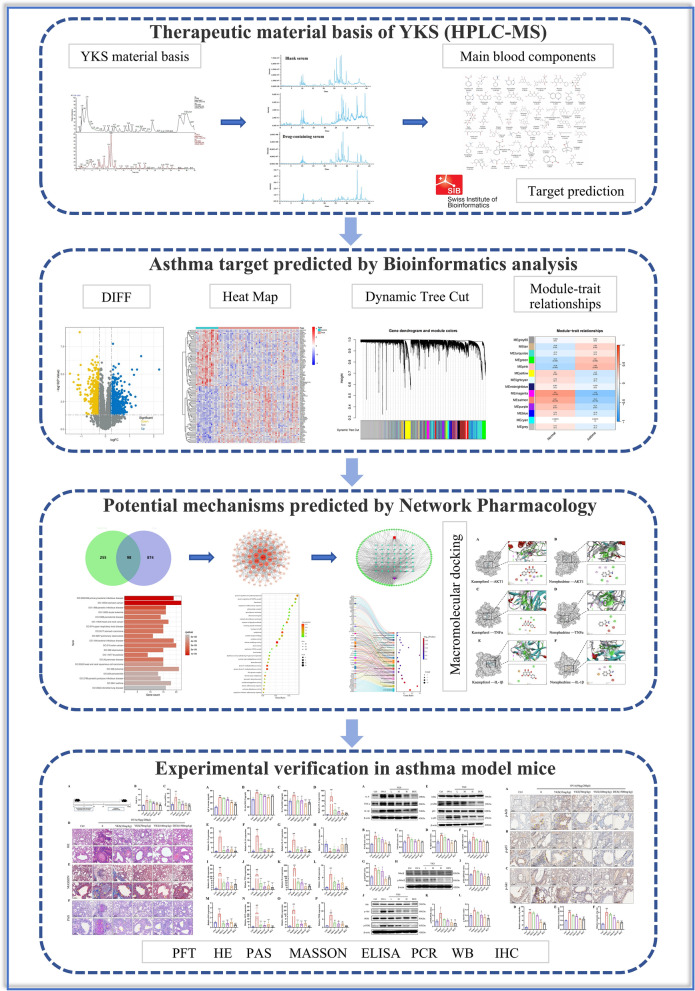
Fig. 1
Fig. 1
Research process
Fig. 2
Fig. 2
Analysis of the in vitro material basis and blood-absorbed components of YKS: A Total ionogram of the In Vitro Material Basis of YKS; B Total ionogram of Blank Serum; C Total ionogram of Drug-Containing Serum; D The 49 Blood-Absorbed Active Components of YKS
Fig. 3
Fig. 3
Prediction of asthma-associated targets. A Sample standardization of the GSE137268 dataset; BD Differential analysis of the GSE137268 dataset, including differential gene volcano maps, differential gene heatmaps, and differential gene GSEA enrichment analysis; EI WGCNA analysis of the GSE137268 dataset, including threshold selection, module visualization, correlations across modules and groups, module heatmaps, and module vs. trait heatmaps; J Intersection of differential analysis and WGCNA analysis for the identification of asthma-related targets
Fig. 4
Fig. 4
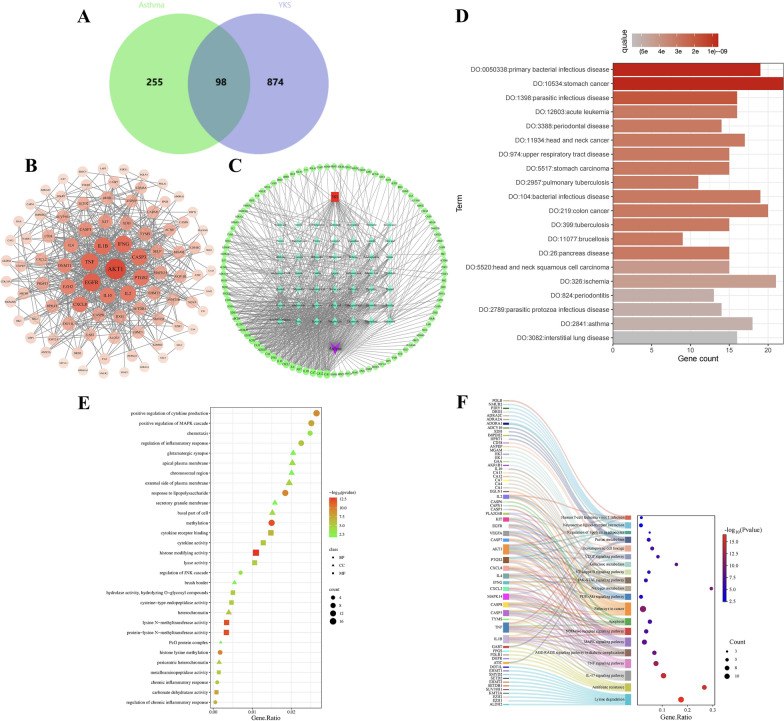
Mechanism prediction of YKS in treating asthma: A Core targets of YKS in asthma treatment; B PPI network diagram; C Construction of the network diagram; D DO enrichment analysis; E GO enrichment analysis; F KEGG enrichment analysis
Fig. 5
Fig. 5
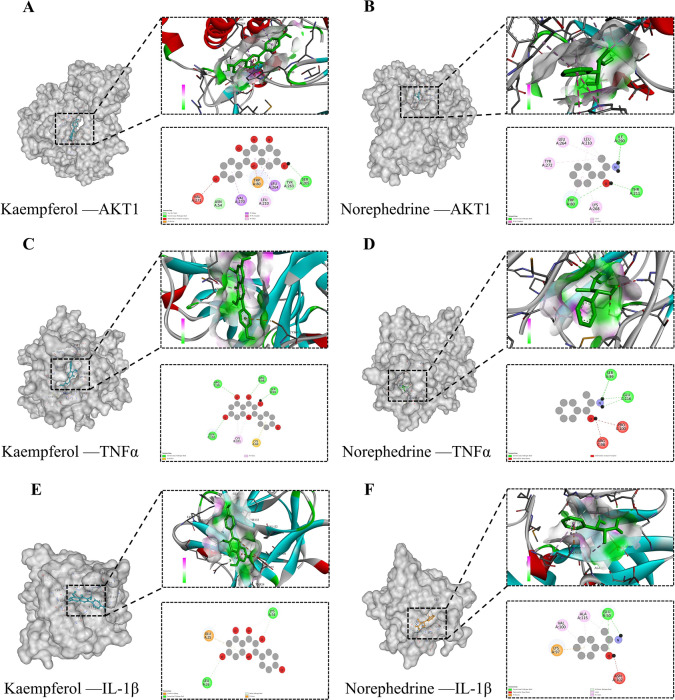
Molecular docking diagram. Results are shown as 3D and 2D plots. A Molecular docking model of Kaempferol with AKT1. B Norephedrine with AKT1 molecular docking model. C Docking model of Kaempferol with TNFα molecule. D Norephedrine with TNFα molecular docking model. E Kaempferol with IL-1β molecular docking model. F Norephedrine with IL-1β molecular docking model
Fig. 6
Fig. 6
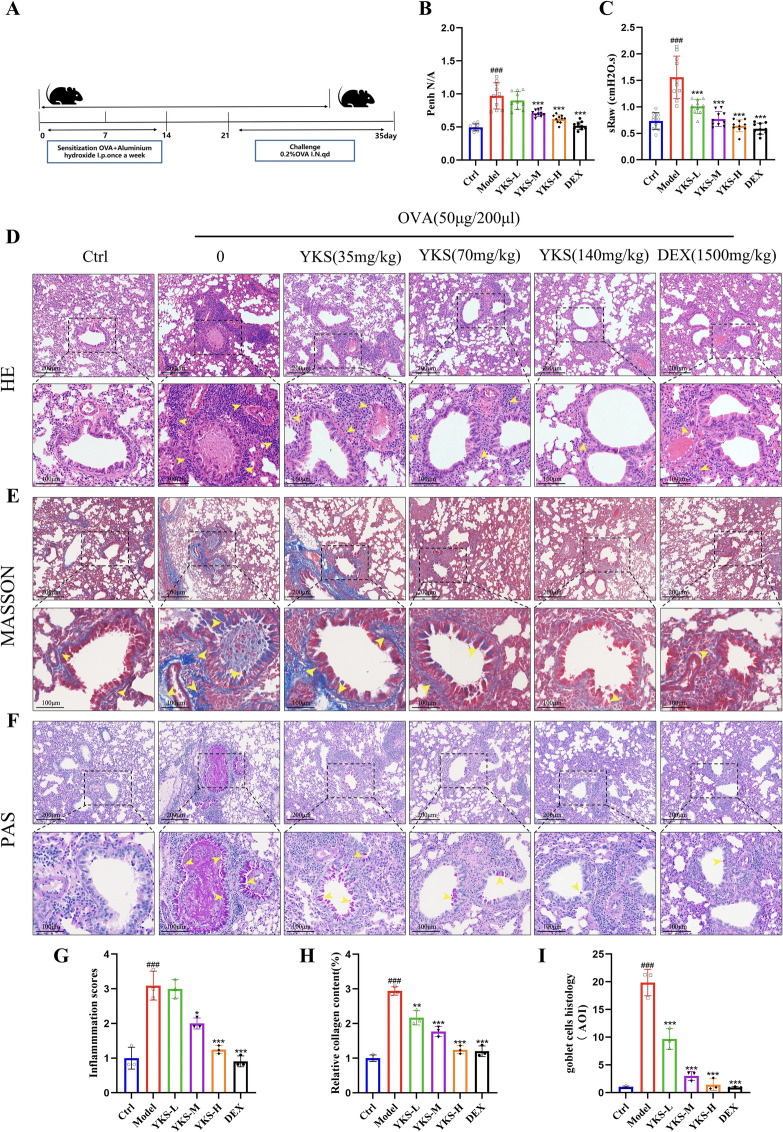
YKS mitigates pulmonary dysfunction, airway inflammation, remodeling, and excessive mucus production in an ovalbumin-induced asthma model in mice: A Schematic depiction of the OVA-induced asthma model in mice; B Evaluation of bronchial constriction through the PenH index in mice; C Measurement of airway resistance in mice, indicated as sRAW; D Histological evaluation of lung tissues with Hematoxylin and Eosin stain at 200× magnification; E Analysis of lung tissues using Masson’s trichrome staining technique at 200× magnification; F Detection of mucus secretion in lung tissues using Periodic Acid-Schiff stain at 200 × magnification; GI Detailed quantitative histopathological assessments of lung tissues. Data are presented as mean ± standard deviation, with three samples per group. Statistical significance relative to the blank group is indicated as follows: #P < 0.05, ##P < 0.01, ###P < 0.001; significance relative to the control group is denoted by *P < 0.05, **P < 0.01, ***P < 0.001
Fig. 7
Fig. 7
YKS’s influence on asthma-related markers in mice: this figure illustrates the effectiveness of YKS in reducing key inflammatory and signaling molecules in asthma-induced mice. A Utilization of ELISA to measure total serum IgE levels; B, C Determination of IL-4 and IL-5 in BALF via ELISA; DG Real-time PCR analyses reveal the mRNA expressions of IL-4, IL-5, IL-10, and IL-13 in lung tissues, respectively; H IFNγ mRNA levels assessed by qPCR in lung tissue; IK Quantification of pro-inflammatory cytokines IL-1β, TNFα, and IL-6 mRNA in lung tissues via qPCR; L, M Expression levels of NF-κB pathway components IκBα and P65 evaluated through qPCR; N, O Assessment of AKT and IKK mRNA expressions in lung tissues; P Measurement of PI3K mRNA levels using qPCR. All data are represented as mean ± SD for five specimens per group. Statistical significance is denoted as follows: compared with the blank group, #P < 0.05, ##P < 0.01, ###P < 0.001; compared with the control group, *P < 0.05, **P < 0.01, ***P < 0.001
Fig. 8
Fig. 8
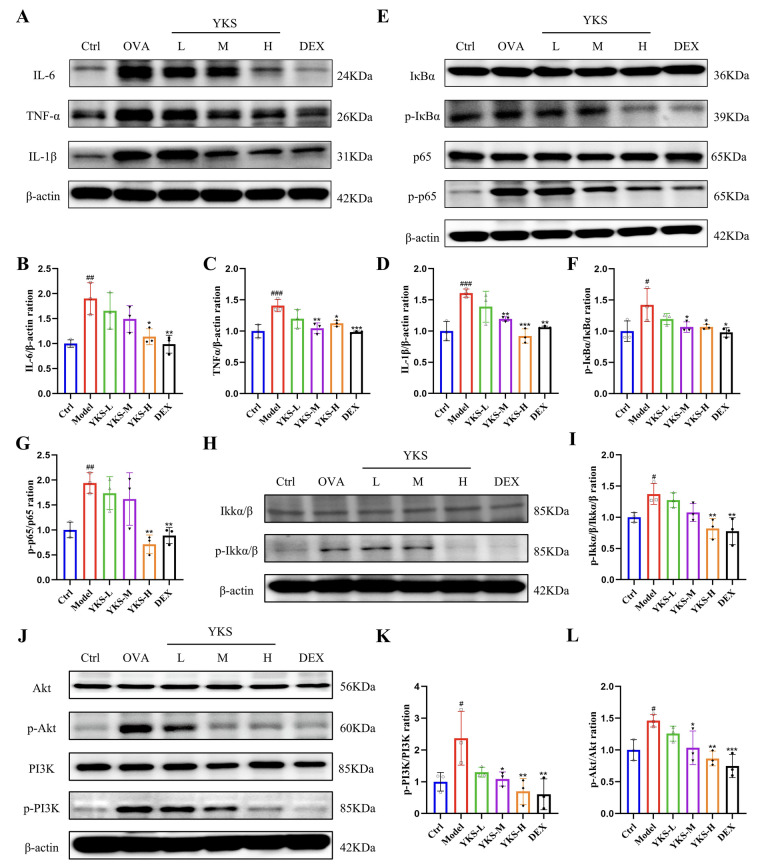
YKS Modulation of the PI3 K/AKT/NF-κB Signaling pathway in OVA-challenged asthma model mice: A Western blot analysis reveals protein levels of IL-6, TNFα, IL-1β, and β-actin as internal control; BD Densitometric analysis of the bands was performed to quantify the relative protein levels of IL-6, TNFα, and IL-1β, normalized to β-actin; E Detection of phosphorylated and total IκBα, P65 via Western blot, with β-actin as a loading control; FG Quantitative analysis of p-IκBα and p-P65; H Western blot identification of phosphorylated and total IKK, with β-actin serving as the control; I Quantitative analysis of IKK phosphorylation levels; J Western blotting analysis of phosphorylated and total forms of PI3 K and AKT, with β-actin as a loading control; KL Relative phosphorylation levels of PI3K and AKT are quantified. All values are expressed as mean ± SD for three samples per group. Significance of differences: #P < 0.05, ##P < 0.01, ###P < 0.001 when compared with the blank group; *P < 0.05, **P < 0.01, ***P < 0.001 relative to the control group
Fig. 9
Fig. 9
Modulation of Phosphorylated Signaling Proteins by YKS in Lung Tissues of Asthmatic Mice: AC Immunohistochemical analysis was performed to detect the levels of phosphorylated IκBα, P65, and AKT in lung tissues from mice in the blank, OVA, YKS, and DEX groups, with images captured at 200 × magnification; DF Quantification of the immunohistochemical staining was achieved using ImageJ software, assessing the expression levels of these phosphorylated proteins. Statistical analysis shows that the values are presented as mean ± SD, with three animals per group. Relative to the blank group, changes in phosphorylation are significant, with #P < 0.05, ##P < 0.01, ###P < 0.001; and in comparison to the control group, significant alterations are noted at *P < 0.05, **P < 0.01, ***P < 0.001
Fig. 10
Fig. 10
Molecular mechanisms of YKS for asthma

References

    1. Reddel HK, Bacharier LB, Bateman ED, Brightling CE, Brusselle GG, Buhl R, et al. Global initiative for asthma strategy 2021: executive summary and rationale for key changes. Eur Respir J. 2022;59(1):2102730. 10.1183/13993003.02730-2021. - PMC - PubMed
    1. World Health Organization. Asthma. 2023. https://www.who.int/news-room/fact-sheets/detail/asthma. Accessed 6 May 2024.
    1. Papi A, Brightling C, Pedersen SE, Reddel HK. Asthma. Lancet. 2018;391(10122):783–800. 10.1016/s0140-6736(17)33311-1. - PubMed
    1. Global initiative for asthma. Global strategy for asthma management and prevention. Global initiative for asthma. 2024. https://ginasthma.org/reports/. Accessed 22 May 2024.
    1. Collaborators GCRD. Prevalence and attributable health burden of chronic respiratory diseases, 1990–2017: a systematic analysis for the Global burden of disease study 2017. Lancet Respir Med. 2020;8(6):585–96. 10.1016/s2213-2600(20)30105-3. - PMC - PubMed

LinkOut - more resources