


Educational interventions and contextual factors for optimising antibiotic prescription in paediatric uncomplicated acute respiratory tract infections in primary care: scoping review of reviews
- PMID: 40420306
- PMCID: PMC12105144
- DOI: 10.1186/s12887-025-05688-4
Educational interventions and contextual factors for optimising antibiotic prescription in paediatric uncomplicated acute respiratory tract infections in primary care: scoping review of reviews
Abstract
Background: Inappropriate antibiotic prescription in paediatric uncomplicated acute respiratory tract infections (ARTIs) in primary care (PC) settings contributes to antimicrobial resistance. We aimed (1) to identify and describe educational interventions and their components to optimise antibiotic prescription for paediatric uncomplicated ARTIs in PC, and (2) to map contextual factors that may influence antibiotic prescription and the implementation of interventions.
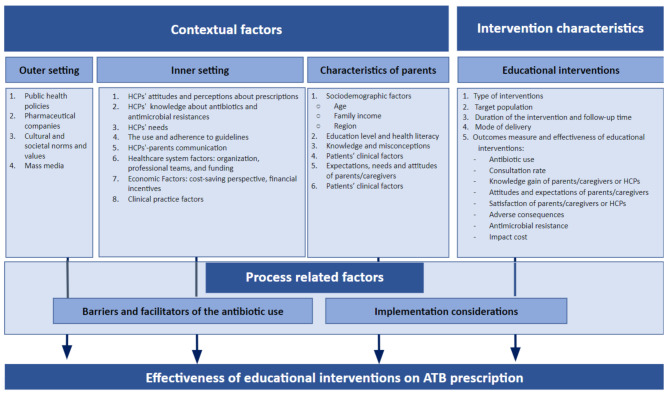
Methods: We searched three electronic databases (Medline, CINAHL and Epistemonikos) to identify reviews on the effectiveness of educational interventions and contextual factors, for optimising antibiotic prescription (Concept) in paediatric uncomplicated ARTIs (Population) in PC (Context). We included reviews that reported explicitly the search strategy used. Two previously calibrated reviewers independently screened the literature, extracted data, and assessed the methodological limitations. We applied the "best-fit framework synthesis approach", based on the main constructs of the Consolidated Framework for Implementation Research, and coded the data deductively by groups of analysis for reviews reporting effectiveness (e.g. antibiotic or consultation rate) or by thematic synthesis for reviews reporting contextual factors (e.g. healthcare professionals' knowledge) based on a logic model.
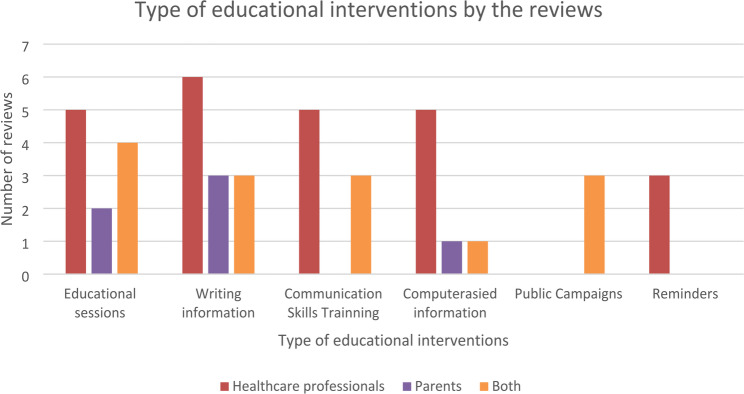
Results: We identified 11 reviews evaluating education intervention and their characteristics, including 182 interventions with at least one educational component (educational intervention plus another type, educational or non-educational), with 136 providing information on characteristics and effectiveness. Successful interventions' characteristics were related to the kind of intervention (e.g. communication skill training), mode of delivery (e.g. face to face), and target population (e.g. parents/caregivers). From the 22 reviews on contextual factors, healthcare professionals' attitudes and perceptions, knowledge, and health system and professionals' teams' organization (inner setting), were the most frequent themes; less information was available on individuals´ characteristics (parents/children) and on outer setting (e.g. policies).
Conclusion: We identified a large number of heterogeneous educational interventions. Combining educational interventions plus another type targeting both parents/caregivers and healthcare professionals, and considering their needs and their context may improve antibiotic prescribing in children. Further research is needed on consultation rate, knowledge, attitudes, and satisfaction outcomes and contextual factors, as well as on the cost-effectiveness of the interventions.
Registration: The protocol was published in OSF iRegistries in May 2021 (Elizondo-Alzola, U).
Keywords: Antibiotic prescription; Children; Educational interventions; Paediatrics; Primary care; Respiratory tract infections; Scoping review..
© 2025. The Author(s).
Conflict of interest statement
Declarations. Ethics approval and consent to participate: Research ethics approval is not required for this scoping review. However, the results of this review were used to develop the interventions of a clinical trial (OptimAP project) that has been approved by the IDIAP Jordi Gol Clinical Research Ethic Committee (reference number 19/019-P). Besides, the Ethic Committees of each of the participating Autonomous Communities in Spain have also approved the project. Consent for publication: Not applicable. Competing interests: The authors declare no competing interests.
Figures

References
-
- Jit M, Ng DHL, Luangasanatip N, Sandmann F, Atkins KE, Robotham JV, et al. Quantifying the economic cost of antibiotic resistance and the impact of related interventions: rapid methodological review, conceptual framework and recommendations for future studies. BMC Med. 2020;6:38. - DOI - PMC - PubMed
-
- European Centre for Disease Prevention and Control. Point prevalence survey of healthcare associated infections and antimicrobial use in European acute care hospitals. Stockholm: ECDC; 2013.
-
- Cassini A, Högberg LD, Plachouras D, Quattrocchi A, Hoxha A, Simonsen GS, et al. Attributable deaths and disability-adjusted life-years caused by infections with antibiotic-resistant bacteria in the EU and the European economic area in 2015: a population-level modelling analysis. Lancet Infect Dis. 2019;19(1):56–66. - DOI - PMC - PubMed
-
- O’Neill J. Tackling drug-resistant infections globally: final report and recommendations: the review on antimicrobial resistance. 2016.
Publication types
MeSH terms
Substances
Grants and funding
LinkOut - more resources
Full Text Sources
Medical
