An animal toxin-antidote system kills cells by creating a novel cation channel
- PMID: 40424258
- PMCID: PMC12136403
- DOI: 10.1371/journal.pbio.3003182
An animal toxin-antidote system kills cells by creating a novel cation channel
Abstract
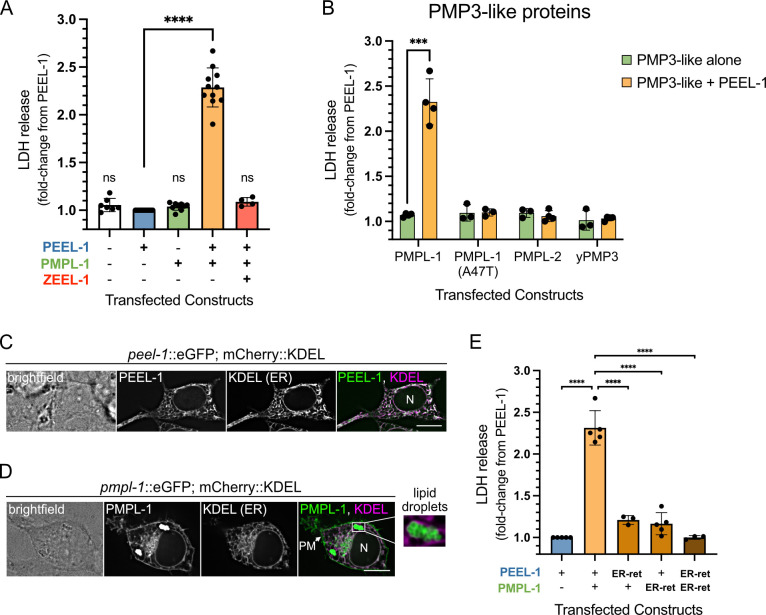
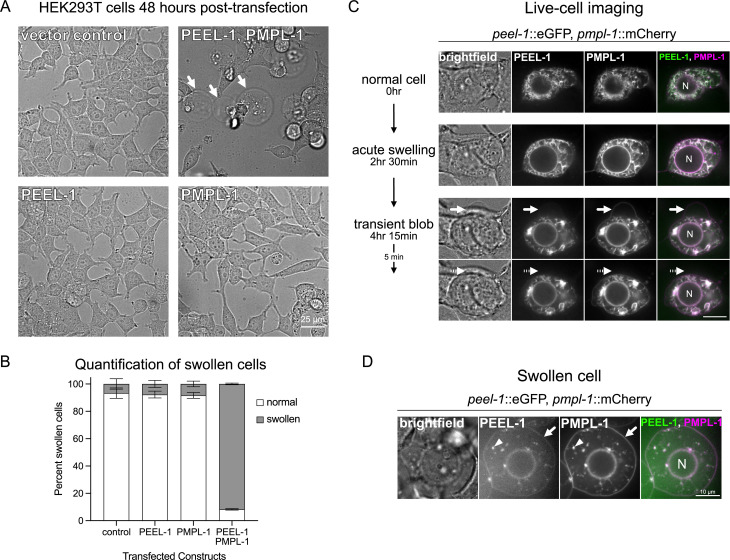
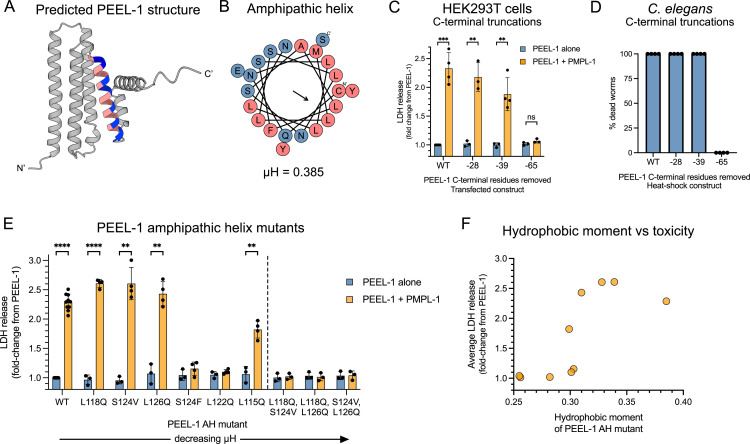
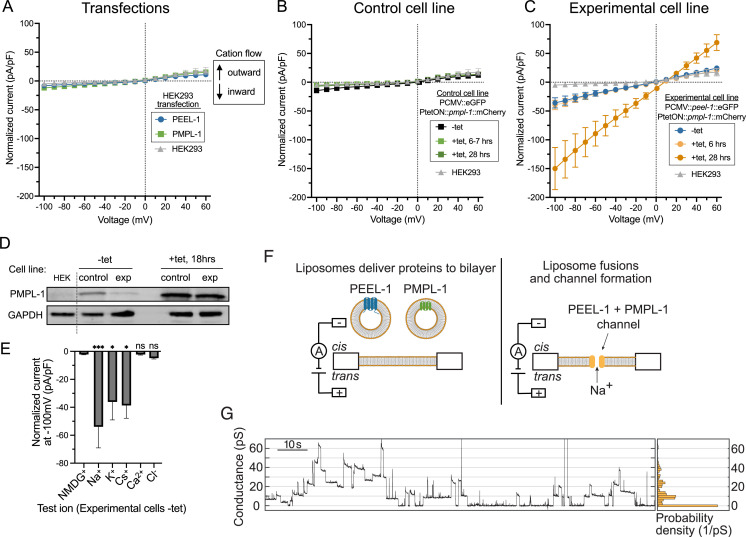
Toxin-antidote systems are selfish genetic elements composed of a linked toxin and antidote. The peel-1 zeel-1 toxin-antidote system in C. elegans consists of a transmembrane toxin protein PEEL-1 which acts cell autonomously to kill cells. Here we investigate the molecular mechanism of PEEL-1 toxicity. We find that PEEL-1 requires a small membrane protein, PMPL-1, for toxicity. Together, PEEL-1 and PMPL-1 are sufficient for toxicity in a heterologous system, HEK293T cells, and cause cell swelling and increased cell permeability to monovalent cations. Using purified proteins, we show that PEEL-1 and PMPL-1 allow ion flux through lipid bilayers and generate currents which resemble ion channel gating. Our work suggests that PEEL-1 kills cells by co-opting PMPL-1 and creating a cation channel.
Copyright: © 2025 Caro et al. This is an open access article distributed under the terms of the Creative Commons Attribution License, which permits unrestricted use, distribution, and reproduction in any medium, provided the original author and source are credited.
Conflict of interest statement
The authors have declared that no competing interests exist.
Figures

Update of
-
Mechanism of an animal toxin-antidote system.bioRxiv [Preprint]. 2024 Jun 13:2024.06.11.598564. doi: 10.1101/2024.06.11.598564. bioRxiv. 2024. Update in: PLoS Biol. 2025 May 27;23(5):e3003182. doi: 10.1371/journal.pbio.3003182. PMID: 38915716 Free PMC article. Updated. Preprint.
References
MeSH terms
Substances
Grants and funding
LinkOut - more resources
Full Text Sources