


Associations Between Emotional Resilience and Mental Health Among Chinese Adolescents in the School Context: The Mediating Role of Positive Emotions
- PMID: 40426345
- PMCID: PMC12108795
- DOI: 10.3390/bs15050567
Associations Between Emotional Resilience and Mental Health Among Chinese Adolescents in the School Context: The Mediating Role of Positive Emotions
Abstract
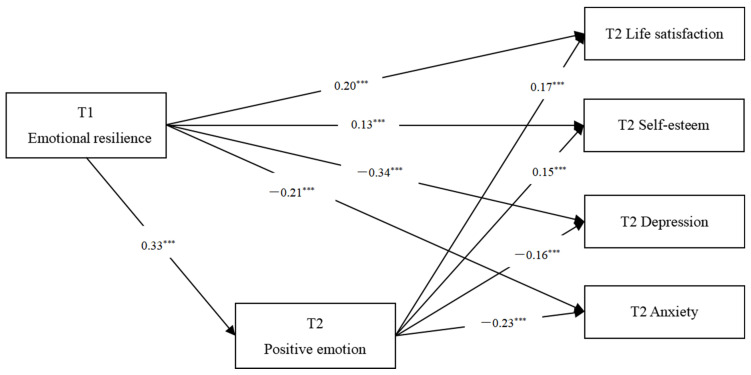
Positive emotions play an essential role in adolescent resilience and mental healthy development, yet whether it affects emotional resilience, mental health, and the internal mechanism remains unknown. Therefore, the current study aims to, using a two-wave panel design, examine the relationship between emotional resilience and mental health, as well as the mediating role of positive emotion. We conducted this longitudinal study in two waves with a 6-month interval, surveyed 266 Chinese adolescents (54.9% boys, Mage = 14.11 years, SD = 1.77), and constructed a mediation model. The participants completed the measures of demographic information, positive emotions, emotional resilience, and mental health at two times. The results revealed that after controlling for gender and age, Time 2 positive emotions partially mediated the relationship between Time 1 emotional resilience and Time 2 mental health. In detail, emotional resilience is positively correlated with life satisfaction and self-esteem. It shows a negative correlation with symptoms of depression and anxiety, partly mediated by positive emotions. The findings highlighted the role of emotional resilience in mitigating psychological problems and enhancing mental health in Chinese adolescents. The implications and limitations were discussed.
Keywords: adolescents; emotional resilience; mental health; positive emotions.
Conflict of interest statement
The authors declare no conflicts of interest.
Figures
References
-
- Aguirre Velasco A., Cruz I. S. S., Billings J., Jimenez M., Rowe S. What are the barriers, facilitators and interventions targeting help-seeking behaviours for common mental health problems in adolescents? A systematic review. BMC Psychiatry. 2020;20:1–22. doi: 10.1186/s12888-020-02659-0. - DOI - PMC - PubMed
-
- Alexander R., Aragón O. R., Bookwala J., Cherbuin N., Gatt J. M., Kahrilas I. J., Kästner N., Lawrence A., Lowe L., Morrison R. G., Mueller S. C., Nusslock R., Papadelis C., Polnaszek K. L., Helene Richter S., Silton R. L., Styliadis C. The neuroscience of positive emotions and affect: Implications for cultivating happiness and wellbeing. Neuroscience and Biobehavioral Reviews. 2021;121:220–249. doi: 10.1016/j.neubiorev.2020.12.002. - DOI - PubMed
-
- Arslan G., Allen K. A. Complete mental health in elementary school children: Understanding youth school functioning and adjustment. Current Psychology. 2022;41:1174–1183. doi: 10.1007/s12144-020-00628-0. - DOI
-
- Arslan G., Renshaw T. L. Student subjective wellbeing as a predictor of adolescent problem behaviors: A comparison of first-order and second-order factor effects. Child Indicators Research. 2018;11:507–521. doi: 10.1007/s12187-017-9444-0. - DOI
Grants and funding
LinkOut - more resources
Full Text Sources
