


Evidence for the Link Between Non-Motor Symptoms, Kinematic Gait Parameters, and Physical Function in People with Parkinson's Disease
- PMID: 40428170
- PMCID: PMC12109146
- DOI: 10.3390/bioengineering12050551
Evidence for the Link Between Non-Motor Symptoms, Kinematic Gait Parameters, and Physical Function in People with Parkinson's Disease
Abstract
Background: Parkinson's disease (PD) affects both motor and non-motor functions, but their interactions are understudied. This study aims to explore the relationships between non-motor and motor effects of PD, focusing on depression, fatigue, gait parameters, concentration, and physical function.
Methods: This is a secondary analysis of baseline data from a randomized feasibility study using a commercially available Heel2Toe™ sensor, providing auditory feedback for gait quality. The sample included PD patients with gait impairments who walked without aids. Non-motor measures were depression, fatigue, and concentration, while motor measures included gait quality (angular velocity and variability during heel strike, push-off, foot swing) and physical function (6MWT, Mini-BESTest, Neuro-QoL). Path analysis was used to assess direct and indirect effects.
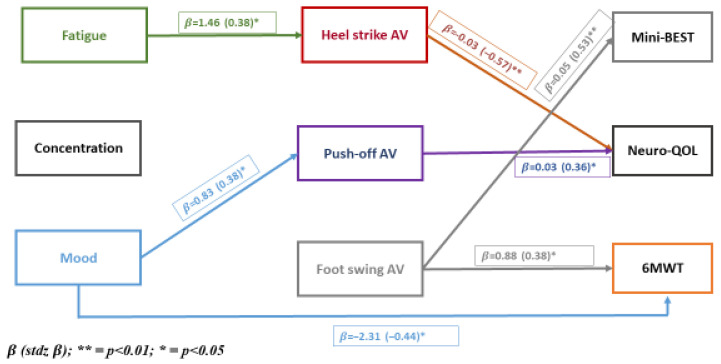
Results: Among 27 participants, fatigue impacted heel strike, which affected Neuro-QoL. Mood influenced push-off and Neuro-QoL, with a direct link to 6MWT. Foot swing affected Mini-BESTest and Neuro-QoL directly.
Conclusions: Non-motor PD effects directly influenced specific gait parameters and physical function indicators, highlighting potential digital biomarkers of fatigue and mood for targeted interventions.
Keywords: Parkinson’s disease; balance; gait; kinematics; physical function; walking.
Conflict of interest statement
A.-A.S.; discloses relationship with PhysioBiometrics Inc. for this work. K.K.V.M.; discloses relationship with PhysioBiometrics Inc. for this work. E.H.; discloses relationship with PhysioBiometrics Inc. for this work. H.D.; discloses relationship with PhysioBiometrics Inc. for this work. N.E.M.; discloses relationship with PhysioBiometrics Inc. for this work.
References
Grants and funding
LinkOut - more resources
Full Text Sources
