


Comparing the Outcomes of Cast Immobilization with and Without K-Wire Fixation for Displaced Distal Radius Fractures in the Pediatric Population: A Systematic Review and Meta-Analysis
- PMID: 40428810
- PMCID: PMC12112781
- DOI: 10.3390/medicina61050852
Comparing the Outcomes of Cast Immobilization with and Without K-Wire Fixation for Displaced Distal Radius Fractures in the Pediatric Population: A Systematic Review and Meta-Analysis
Abstract
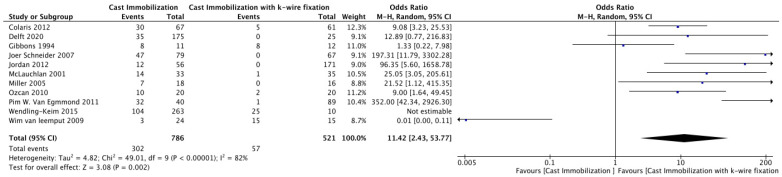
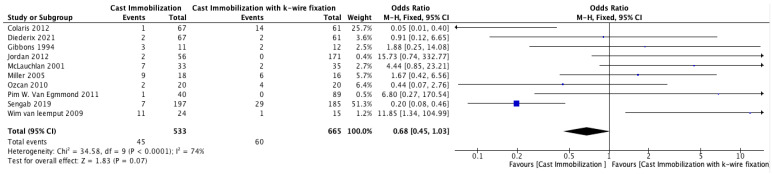
Background and Objectives: Distal radius fractures are among the most common pediatric injuries, accounting for approximately 25% of all fractures in children. Displaced fractures are prone to re-displacement, necessitating additional interventions. K-wire fixation is effective in reducing re-displacement risks, but no one has systematically assessed its use. This study aims to compare the outcomes of cast immobilization alone versus cast immobilization with K-wire fixation in pediatric patients with displaced distal radius fractures. Methods: A comprehensive search of PubMed, Web of Science, Cochrane CENTRAL, Scopus, and Embase databases for studies comparing these treatments. The quality assessment was conducted using the Cochrane Collaboration Risk of Bias for randomized studies and the Methodological Index for non-randomized studies. The meta-analysis was carried out using RevMan software V5.4. Results: Out of 267 initial records, 12 studies met the inclusion criteria, encompassing 1455 patients (853 treated with cast alone and 602 with K-wire fixation). Meta-analysis of 10 studies showed significantly higher re-displacement rates with cast immobilization compared to K-wire fixation (OR: 11.42, 95% CI: 2.43-53.77, p = 0.002, I2 = 82%). The risk of secondary surgery was also higher in the cast group (OR: 6.91, 95% CI: 1.5-31.72, p = 0.01, I2 = 75%). However, complications were lower with cast immobilization (OR: 0.68, 95% CI: 0.45-1.03, p = 0.07, I2 = 74%), though not statistically significant. Conclusions: K-wire fixation appears to offer superior fracture stability and reduces the need for secondary surgeries compared to cast immobilization for displaced distal radius fractures in pediatric patients. However, both treatment modalities are associated with comparable complication rates, emphasizing the importance of individualized treatment planning.
Keywords: K-wire fixation; cast immobilization; pediatric; radius fractures; systematic review.
Conflict of interest statement
The authors declare no conflicts of interest.
Figures


References
-
- Joeris A., Lutz N., Blumenthal A., Slongo T., Audigé L., The A.O. Pediatric Comprehensive Classification of Long Bone Fractures (PCCF) part I: Location and morphology of 2,292 upper extremity fractures in children and adolescents. Acta Orthop. 2017;88:129–132. doi: 10.1080/17453674.2016.1258533. - DOI - PMC - PubMed
Publication types
MeSH terms
LinkOut - more resources
Full Text Sources
Medical
Miscellaneous
