


Preoperative Central Sensitization Worsens Pain and Dissatisfaction Following Unicompartmental Knee Arthroplasty
- PMID: 40428870
- PMCID: PMC12113206
- DOI: 10.3390/medicina61050912
Preoperative Central Sensitization Worsens Pain and Dissatisfaction Following Unicompartmental Knee Arthroplasty
Abstract
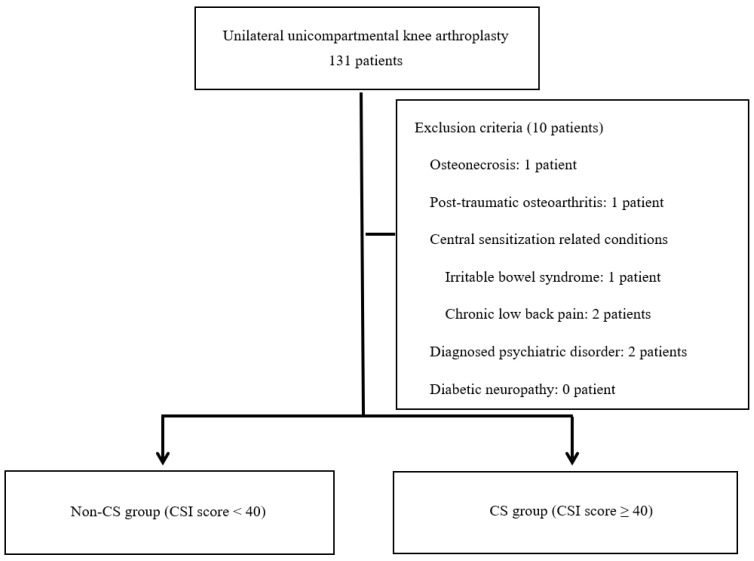
Background and Objectives: Central sensitization (CS) has been identified as a significant factor influencing persistent pain and dissatisfaction following total knee arthroplasty (TKA). However, its effect on unicompartmental knee arthroplasty (UKA) remains largely unexplored. Unlike TKA, UKA preserves most native knee structures, with less bone cut, leading to different postoperative pain mechanisms. Nevertheless, the revision rate for unexplained pain following UKA is higher than after TKA. This study investigates the influence of preoperative CS on pain and dissatisfaction after UKA. Materials and Methods: This retrospective cohort study included 121 patients who underwent primary UKA for medial compartment osteoarthritis of the knee. Patients were screened for CS preoperatively using the Central Sensitization Inventory (CSI) and categorized into a CS group (CSI ≥ 40; n = 26) and a non-CS group (CSI < 40; n = 95). Clinical outcomes, including the Western Ontario and McMaster Universities Osteoarthritis Index (WOMAC), Forgotten Joint Score (FJS), and patient satisfaction, were assessed at the 2-year postoperative follow-up visit. A multivariate regression analysis was used to determine the risk factors for postoperative dissatisfaction. Results: The CS group reported significantly worse postoperative WOMAC pain, function, and total scores than the non-CS group (all p < 0.05). FJS was also significantly worse in the CS group than in the non-CS group (64.4 vs. 72.7, respectively, p = 0.005). Patient satisfaction was significantly lower in the CS group than in the non-CS group (65.4% vs. 95.8%, respectively, p < 0.001). The multivariate logistic regression analysis demonstrated that patients with a CSI score ≥ 40 had an 11.349-fold increased likelihood of dissatisfaction after UKA (95% CI: 2.315-55.626, p = 0.003). Conclusions: This study underscores the importance of recognizing CS as a critical determinant of postoperative pain and functional recovery following UKA. Patients with high CSI scores experience greater pain, increased joint awareness, and overall poorer satisfaction despite technically successful surgeries.
Keywords: central sensitization; dissatisfaction; pain; unicomparmental knee arthroplasty.
Conflict of interest statement
The authors declare no conflict of interest.
Figures
References
-
- Digennaro V., Ferri R., Panciera A., Bordini B., Cecchin D., Benvenuti L., Traina F., Faldini C. Coronal plane alignment of the knee (CPAK) classification and its impact on medial unicompartmental knee arthroplasty: Exposing a unexpected external shift of limb mechanical axis in case of prearthritic constitutional valgus alignment: A retrospective radiographic study. Knee Surg. Relat. Res. 2024;36:14. doi: 10.1186/s43019-024-00217-6. - DOI - PMC - PubMed
MeSH terms
Grants and funding
LinkOut - more resources
Full Text Sources
Medical
