


Disproportionate vs. Proportionate Secondary Mitral Regurgitation: A Long-Term Pilot Analysis After Mitral Valve Surgery
- PMID: 40429466
- PMCID: PMC12112467
- DOI: 10.3390/jcm14103470
Disproportionate vs. Proportionate Secondary Mitral Regurgitation: A Long-Term Pilot Analysis After Mitral Valve Surgery
Abstract
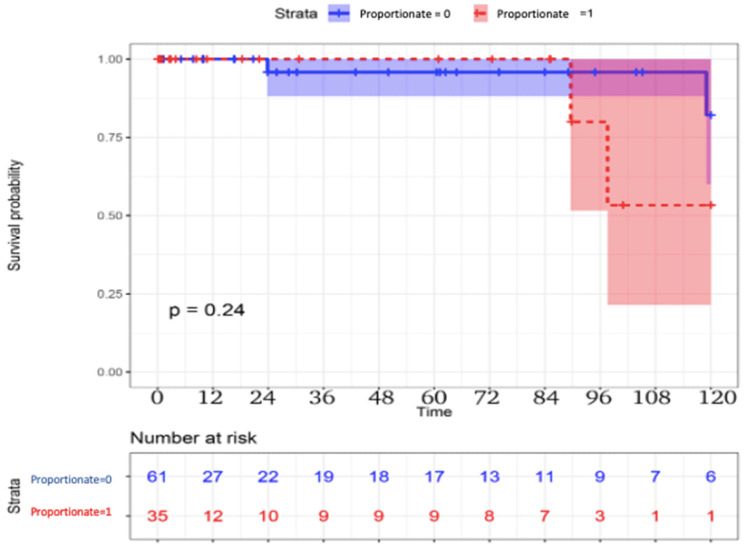
Objectives: The treatment of secondary mitral regurgitation (MR) is still controversial. In 2019, a new conceptual framework was introduced, distinguishing between patients with a degree of MR "proportionate" to the left ventricular (LV) dilatation and patients in whom the severity of MR is "disproportionate" to the LV dilatation. The aim of this study was to compare the long-term outcome of patients with disproportionate vs. proportionate secondary MR who underwent mitral valve (MV) surgery. Methods: From January 2012 to June 2022, 96 patients with a preoperative diagnosis of pure secondary MR and LV dysfunction underwent MV surgery. The patients were divided in two groups, disproportionate vs. proportionate MR, according to echocardiographic parameters. A 5.2 (3.5-7.5) years complete clinical and echocardiographic follow-up was performed. Results: In the study period, 61 patients with disproportionate and 35 patients with proportionate MR underwent surgical MV repair or MV replacement. The thirty-day outcome was comparable in the two groups. At long-term follow-up, mortality was 5% in the disproportionate group vs. 11% in the proportionate group (p = 0.2), and cardiovascular mortality was 3% vs. 9%, respectively (0.5). Rehospitalization for heart failure was 6% vs. 20% (p = 0.04), and the rate of patients with New York Heart Association (NYHA) functional class ≥ III was 8% vs. 26%, respectively (p = 0.01). LV volumes were significantly higher in the proportionate group, thus presenting a lower LV ejection fraction (p < 0.001 and p = 0.03, respectively). No cases of recurrent MR have been observed. Conclusions: In this first exploratory analysis, patients with disproportionate secondary MR seem to present a possible benefit in terms of mortality and cardiovascular mortality, although not ones reaching statistical significance. Nevertheless, significant advantages were observed in terms of rehospitalization for heart failure, clinical status and symptoms, LV volumes, and LV function. Among patients referred to cardiac surgery, identifying the subset of patients with functional MR, who may obtain more significant advantages from surgery, seems relevant for patient selection, risk stratification, and to predict long-term outcomes.
Keywords: disproportionate mitral regurgitation; functional mitral regurgitation; mitral valve surgery; proportionate mitral regurgitation.
Conflict of interest statement
The authors declare no conflicts of interest.
Figures
References
-
- Nagasaki M., Nishimura S., Ohtaki E., Kasegawa H., Matsumura T., Nagayama M., Koyanagi T., Tohbaru T., Misu K., Asano R., et al. The echocardiographic determinants of functional mitral regurgitation differ in ischemic and non-ischemic cardiomyopathy. Int. J. Cardiol. 2006;108:171–176. doi: 10.1016/j.ijcard.2005.04.028. - DOI - PubMed
-
- Acker M.A., Parides M.K., Perrault L.P., Moskowitz A.J., Gelijns A.C., Voisine P., Smith P.K., Hung J.W., Blackstone E.H., Puskas J.D., et al. Mitral-valve repair versus replacement for severe ischemic mitral regurgitation. N. Engl. J. Med. 2014;370:23–32. doi: 10.1056/NEJMoa1312808. - DOI - PMC - PubMed
LinkOut - more resources
Full Text Sources
