. 2025 May 20;17(10):1404.
doi: 10.3390/polym17101404.

Antimicrobial Properties of a Novel PEGylated Copper Nanoparticle-Embedded Silicone Rubber with Potential for Use in Biomedical Applications

Affiliations

Antimicrobial Properties of a Novel PEGylated Copper Nanoparticle-Embedded Silicone Rubber with Potential for Use in Biomedical Applications

Sara Ramírez Pastén et al. Polymers (Basel). .

Abstract

Background: Healthcare-associated infections (HAIs) significantly increase morbidity, mortality, and healthcare costs. Among HAIs, catheter-associated infections are particularly prevalent due to the susceptibility of catheters to microbial contamination and biofilm formation, especially with prolonged use. Biofilms act as infection reservoirs, complicating treatment and often requiring catheter removal, thus extending hospital stays and increasing costs. Recent technological advances in catheter design have focused on integrating antifouling and antimicrobial coatings to mitigate or prevent biofilm formation. Methods: We developed COPESIL®, a novel silicone rubber embedded with PEGylated copper nanoparticles designed to reduce microbial contamination on catheter surfaces. We conducted in vitro assays to evaluate the antimicrobial and antibiofilm efficacy of COPESIL® against pathogens commonly implicated in catheter-associated urinary tract infections. Additionally, the safety profile of the material was assessed through cytotoxicity evaluations using HepG2 cells. Results: COPESIL® demonstrated substantial antimicrobial activity, reducing contamination with Escherichia coli and Klebsiella pneumoniae by >99.9% and between 93.2% and 99.8%, respectively. Biofilm formation was reduced by 5.2- to 7.9-fold for E. coli and 2.7- to 2.8-fold for K. pneumoniae compared to controls. Cytotoxicity assays suggest the material is non-toxic, with cell viability remaining above 95% after 24 h of exposure. Conclusions: The integration of PEGylated copper nanoparticles into a silicone matrix in COPESIL® represents a promising strategy to enhance the antimicrobial properties of catheters. Future studies should rigorously evaluate the long-term antimicrobial efficacy and clinical safety of COPESIL®-coated catheters, with a focus on their impact on patient outcomes and infection rates in clinical settings.

Keywords: antibiofilm; antimicrobial polymers; biofilm catheter-associated pathogens.


Conflict of interest statement

Alejandro Escobar, David A. Montero, and Maria C. Paredes are inventors of the COPESIL® technology, for which a patent application has been submitted. Patent No. WO2023/122846A1. Sara Ramirez, Faustino Alonso, Javier Villarroel, and María C. Paredes are employees of the Wmas company, which is dedicated to technological innovation in health devices with applications in nanotechnology.

Figures

Figure 1
Figure 1
Characterization of COPESIL® films. (a) Macroscopic view of a modified silicone film. This image displays a silicone film modified with COPESIL® technology, showing that the film retains its original visual characteristics post-modification, which suggests that the essential physical properties such as color and transparency are preserved. (b) SEM micrograph of COPESIL®. The micrograph provides a detailed view at the nano-scale, highlighting the uniform distribution of cubic nanostructures, sized approximately 480.48 ± 112.07 nm, across the silicone surface. (c) Chemical mapping of COPESIL®. This panel illustrates a general chemical map of a representative area where the color intensity varies according to the concentration of different elements, providing insights into the elemental distribution within the material. The inset shows a specific map for copper, with red coloring indicating the presence and uniform distribution of copper nanoparticles. (d) EDS spectrum of COPESIL®. The EDS spectrum quantifies the elemental composition of the material, highlighting significant peaks for elements like copper, which corroborate the targeted incorporation of antimicrobial agents into the silicone matrix.
Figure 2
Figure 2
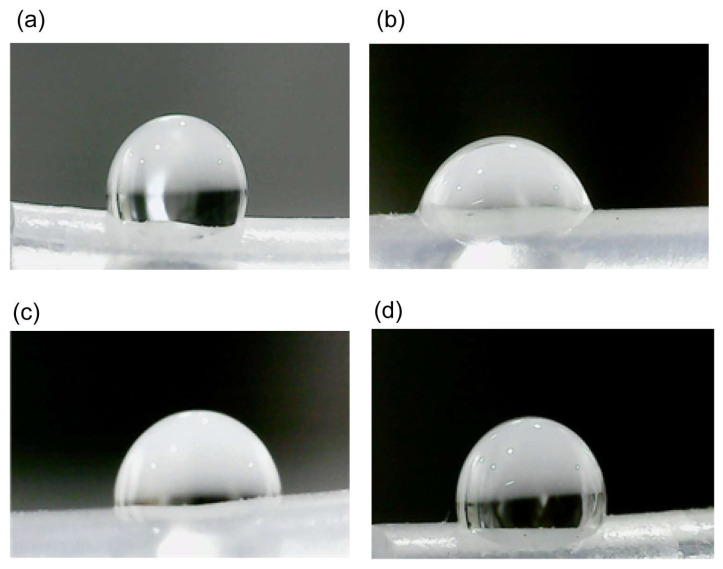
Sequential modifications of the PDMS surface illustrated by water contact angle measurements. (a) Baseline. The unmodified PDMS surface shows the original water contact angle. (b) Activation. The surface post-HCl treatment demonstrates a reduced contact angle due to the formation of silanol (Si-OH) groups. (c) Pegylation. After the incorporation of PEG-Silane, the contact angle slightly increases due to the presence of hydrocarbon chains. (d) Functionalization. in the final stage, with copper nanoparticles (CuNPs) embedded, the contact angle slightly increases further, indicating successful immobilization and stabilization of CuNPs on the hydrophobic surface.
Figure 3
Figure 3
Quantitative analysis of biofilm formation on the COPESIL® and control films. (a) Experimental setup showing the continuous flow system used for the biofilm formation assay. (b) Schematic drawing of the continuous flow system developed, indicating the flow of artificial urine medium (AUM) through chambers containing the tested materials, with the flow rate set at 3.3 mL/min and an incubation period of 24 h at 37 °C. (c) Optical density measurements at 595 nm (OD595) displaying the extent of biofilm formation by E. coli (left) and K. pneumoniae (right) on various film surfaces after 24 h. The tested films include silicone control films (Si), COPESIL®-1 films (C1), and COPESIL®-2 films (C2). The data points represent individual measurements, and the horizontal lines indicate the median values. For E. coli, biofilms formed significantly less on both COPESIL® films than the silicone control. Similarly, biofilm formation by K. pneumoniae was significantly lower on COPESIL® films. Statistical analysis using the Mann–Whitney test shows significant differences, with P-values indicated above the brackets to highlight comparisons between different film types.
Figure 4
Figure 4
Cytotoxicity assessment in HepG2 cells using resorufin fluorescence. Fluorescence measurements of resorufin, indicative of cellular metabolic activity, are shown for HepG2 cells exposed to different conditions. The fluorescence intensities, measured in arbitrary units (AUs), are shown for cells incubated in DMEM (control) and cells exposed to media conditioned with silicone control films (Si), COPESIL®-1 films (C1), and COPESIL®-2 films (C2). The data points denote mean fluorescence values obtained from triplicate experiments. The Mann–Whitney test was applied to analyze statistically significant differences. ns = not significant.

References

    1. Allegranzi B., Nejad S.B., Combescure C., Graafmans W., Attar H., Donaldson L., Pittet D. Burden of Endemic Health-Care-Associated Infection in Developing Countries: Systematic Review and Meta-Analysis. Lancet. 2011;377:228–241. doi: 10.1016/S0140-6736(10)61458-4. - DOI - PubMed
    1. Arendsen L.P., Thakar R., Sultan A.H. The Use of Copper as an Antimicrobial Agent in Health Care, Including Obstetrics and Gynecology. Clin. Microbiol. Rev. 2019;32:10–1128. doi: 10.1128/CMR.00125-18. - DOI - PMC - PubMed
    1. Umscheid C.A., Mitchell M.D., Doshi J.A., Agarwal R., Williams K., Brennan P.J. Estimating the Proportion of Healthcare-Associated Infections That Are Reasonably Preventable and the Related Mortality and Costs. Infect. Control Hosp. Epidemiol. 2011;32:101–114. doi: 10.1086/657912. - DOI - PubMed
    1. Sikora A., Zahra F. Nosocomial Infections. StatPearls Publishing; Treasure Island, FL, USA: 2022. - PubMed
    1. Shit S.C., Shah P. A Review on Silicone Rubber. Natl. Acad. Sci. Lett. 2013;36:355–365. doi: 10.1007/s40009-013-0150-2. - DOI

LinkOut - more resources