


Nifuroxazide and 4-Hydroxybenzhydrazone Derivatives as New Antiparasitic (Trypanosoma cruzi and Leishmania mexicana) and Anti- Mycobacterium tuberculosis Agents
- PMID: 40430911
- PMCID: PMC12114619
- DOI: 10.3390/pharmaceutics17050621
Nifuroxazide and 4-Hydroxybenzhydrazone Derivatives as New Antiparasitic (Trypanosoma cruzi and Leishmania mexicana) and Anti- Mycobacterium tuberculosis Agents
Abstract
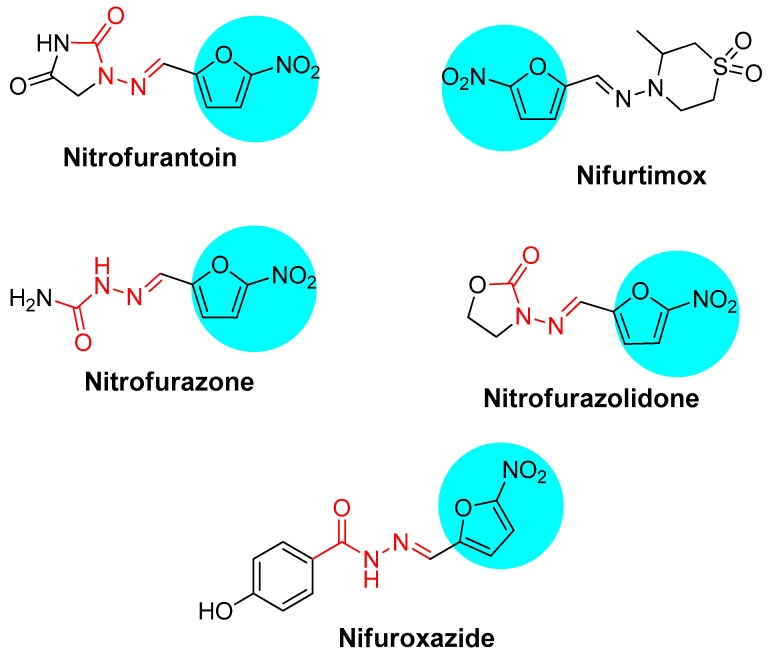
Background/Objectives: Nifuroxazide (Nfz) is a drug that has been used as a scaffold for designing antimicrobial and antiparasitic agents. This study aimed to synthesize and evaluate in vitro of Nfz and twenty-five 4-hydroxybenzhydrazone derivatives as potential anti-Trypanosoma cruzi, anti-Leishmania mexicana, and anti-Mycobacterium tuberculosis agents. Methods: The compounds were synthesized by condensing 4-hydroxybenzhydrazide with appropriate aldehydes in acidic conditions and structurally confirmed by spectroscopic techniques. All compounds were evaluated in vitro against T. cruzi strains (NINOA and A1), L. mexicana (M379 and FCQEPS strains), and M. tuberculosis (H37Rv strain), followed by enzymatic assays against T. cruzi cysteine proteases. Results: Compound Nfz-24 (IC50 = 6.8 μM) had better trypanocidal activity than the reference drugs benznidazole (IC50 > 30 μM) and nifurtimox (IC50 > 7 μM) against the NINOA strain, and Nfz-8 (IC50 = 7.2 μM) was the compound most active against the A1 strain with a high inhibition of T. cruzi cysteine proteases (IC50 = 4.6 μM) and low cytotoxic effects (CC50 >100 μM). On the other hand, compound Nfz-5 (IC50 = 5.2 μM) had a 25-fold better leishmanicidal effect than glucantime (IC50 > 125 μM) against the L. mexicana M379 strain, and compound Nfz-13 had the best leishmanicidal effects (IC50 = 10.2 μM) against the FCQEPS strain. Finally, Nfz, Nfz-1, and Nfz-2 had minimum inhibitory concentration (MIC) values of 12.3, 5.1, and 18.8 μg/mL against M. tuberculosis, respectively. Conclusions: In summary, these results suggest that the compounds Nfz-1, Nfz-2, Nfz-5, Nfz-8, Nfz-10, Nfz-15, Nfz-24, and Nfz-25 are candidates for further studies to develop new and more potent anti-T. cruzi, anti-leishmaniasis, and anti-M. tuberculosis agents.
Keywords: Leishmania mexicana; Trypanosoma cruzi; anti-Mycobacterium tuberculosis; cysteine protease inhibitors; hydrazone moiety; nifuroxazide.
Conflict of interest statement
The authors declare no conflicts of interest.
Figures


References
-
- Brune K. Chemistry and Pharmacology of Nitrofurans. J. Med. Chem. 2022;65:530–542.
-
- Gupta K., Hooton T.M., Naber K.G. Antimicrobial Use for Urinary Tract Infections: The Role of Nitrofurantoin. Clin. Infect. Dis. 2017;64:952–960.
-
- Sok D., Hwang Y.J., Yoon J. Safety and Efficacy of Nitrofurantoin in Clinical Practice. Therapeut. Clin. Risk Manag. 2020;16:509–517.
-
- Nicolas M., McEwan G., Brown J. Advances in Nitrofurans and Their Therapeutic Potential. Expert Rev. Anti-Infect. Ther. 2021;19:481–493.
-
- Roquini V., Mengarda A.C., Cajas R.A., Martins-da-Silva M.F., Godoy-Silva J., Santos G.A., Espírito-Santo M.C.C., Pavani T.F., Melo V.A., Salvadori M.C., et al. The Existing Drug Nifuroxazide as an Antischistosomal Agent: In Vitro, In Vivo, and In Silico Studies of Macromolecular Targets. Microbiol. Spectrum. 2023;11:e01393-23. doi: 10.1128/spectrum.01393-23. - DOI - PMC - PubMed
Grants and funding
LinkOut - more resources
Full Text Sources
