


Impact of pH-Responsive Cisplatin/Ribavirin-Loaded Monodispersed Magnetic Silica Nanocomposite on A549 Lung Cancer Cells
- PMID: 40430922
- PMCID: PMC12115125
- DOI: 10.3390/pharmaceutics17050631
Impact of pH-Responsive Cisplatin/Ribavirin-Loaded Monodispersed Magnetic Silica Nanocomposite on A549 Lung Cancer Cells
Abstract
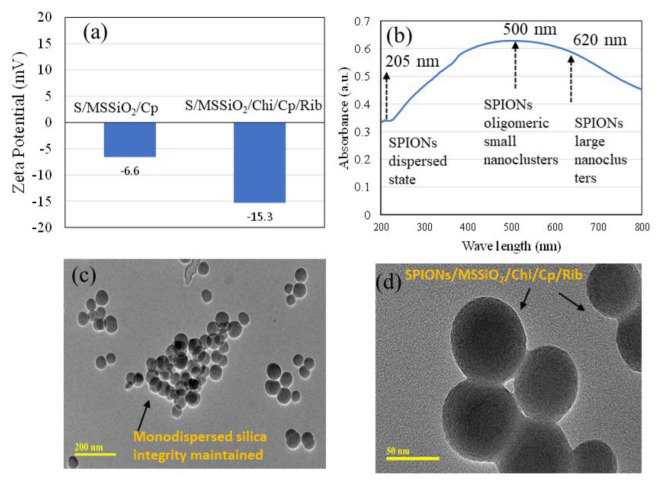
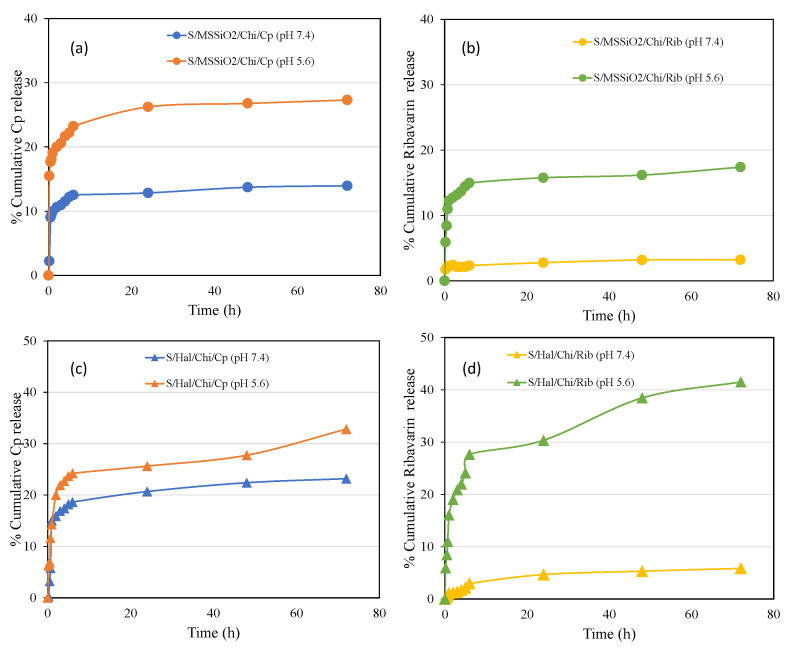
Background/Objectives: Nanocarrier particle design for treating chronic pulmonary diseases presents several challenges, including anatomical and physiological barriers. Drug-repurposing technology using monodispersed spherical silica is one of the innovative ways to deliver drugs. In the present study, the anticancer potential of combinational cisplatin/ribavirin was explored for targeted lung cancer therapeutics. Methods: Monodispersed spherical silica (80 nm) capable of diffusing into the tracheal mucus region was chosen and doped with 10 wt% superparamagnetic iron oxide nanoparticles (SPIONs). Subsequently, it was wrapped with chitosan (Chi, 0.6 wt/vol%), functionalized with 5% wt/wt cisplatin (Cp)/ribavarin (Rib) and angiotensin-converting enzyme 2 (ACE-2) (1.0 μL/mL). Formulations are based on monodispersed spherical silica or halloysite and are termed as (S/MSSiO2/Chi/Cp/Rib) or (S/Hal/Chi/Cp/Rib), respectively. Results: X-ray diffraction (XRD) and diffuse reflectance UV-visible spectroscopy (DRS-UV-vis) analysis of S/MSSiO2/Chi/Cp/Rib confirmed the presence of SPION nanoclusters on the silica surface (45% coverage). The wrapping of chitosan on the silica was confirmed with a Fourier transformed infrared (FTIR) stretching band at 670 cm-1 and ascribed to the amide group of the polymer. The surface charge by zetasizer and saturation magnetization by vibrating sample magnetometer (VSM) were found to be -15.3 mV and 8.4 emu/g. The dialysis membrane technique was used to study the Cp and Rib release between the tumor microenvironment and normal pH ranges from 5.5 to 7.4. S/MSSiO2/Chi formulation demonstrated pH-responsive Cp and Rib at acidic pH (5.6) and normal pH (7.4). Cp and Rib showed release of ~27% and ~17% at pH 5.6, which decreases to ~14% and ~3.2% at pH 7.4, respectively. To assess the compatibility and cytotoxic effect of our nanocomposites, the cell viability assay (MTT) was conducted on cancer lung cells A549 and normal HEK293 cells. Conclusions: The study shows that the designed nanoformulations with multifunctional capabilities are able to diffuse into the lung cells bound with dual drugs and the ACE-2 receptor.
Keywords: SPIONs; antiviral; cancer; monodispersed spherical silica; multifunctional; pulmonary drug delivery.
Conflict of interest statement
The authors declare no conflicts of interest.
Figures




References
-
- Allemani C., Matsuda T., Di Carlo V., Harewood R., Matz M., Nikšić M., Bonaventure A., Valkov M., Johnson C.J., Estève J., et al. Global surveillance of trends in cancer survival 2000–14 (CONCORD-3): Analysis of individual records for 37 513 025 patients diagnosed with one of 18 cancers from 322 population-based registries in 71 countries. Lancet. 2018;391:1023–1075. doi: 10.1016/S0140-6736(17)33326-3. - DOI - PMC - PubMed
Grants and funding
LinkOut - more resources
Full Text Sources
Miscellaneous
