


Phytosynthesis and Characterization of Silver Nanoparticles from Antigonon leptopus: Assessment of Antibacterial and Cytotoxic Properties
- PMID: 40430963
- PMCID: PMC12115336
- DOI: 10.3390/pharmaceutics17050672
Phytosynthesis and Characterization of Silver Nanoparticles from Antigonon leptopus: Assessment of Antibacterial and Cytotoxic Properties
Abstract
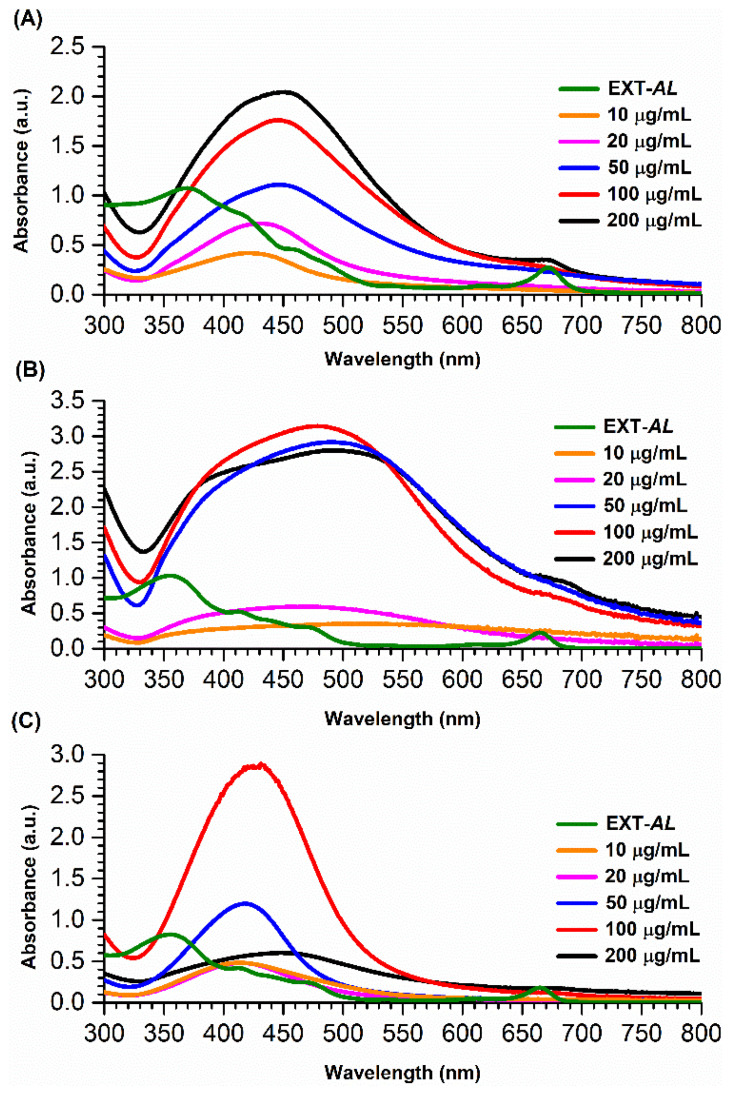
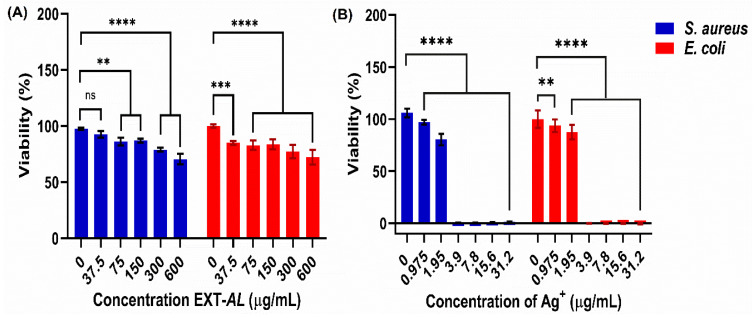
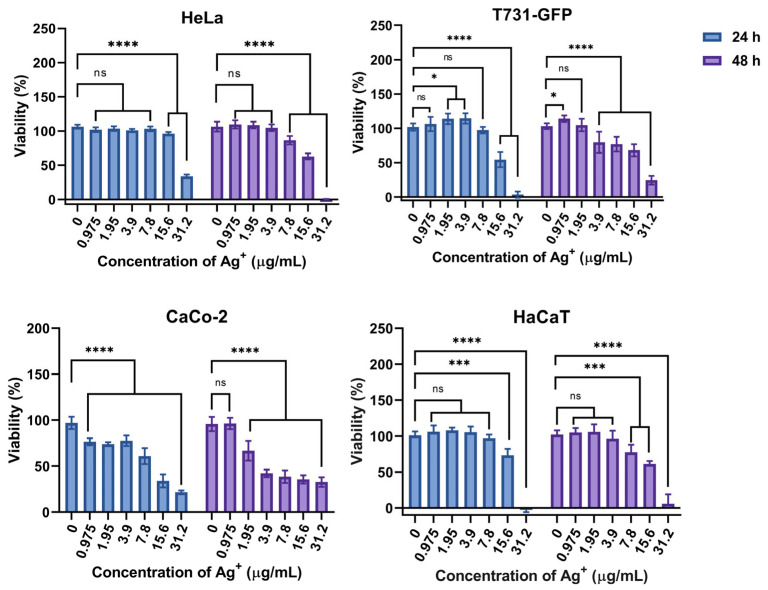
Background: Silver nanoparticles (AgNPs) show promises as antimicrobial biomaterials with use for combating multidrug-resistant microorganisms, and they are widely used in healthcare, medicine, and food industries. However, traditional physicochemical synthesis methods often require harsh conditions and toxic reagents, generating harmful waste. The synthesis of AgNPs using plant-derived bioactive compounds offers an eco-friendly alternative to conventional methods. Methods: In this study, a bio-green approach was employed to synthesize AgNPs using ethanolic extracts from Antigonon leptopus leaves (EXT-AL). The synthesis was optimized under different pH conditions (5.5, 8.0, 10.0) and EXT-AL concentrations (10-200 μg/mL). Antibacterial activity was evaluated against Escherichia coli and Staphylococcus aureus, and cytotoxicity was assessed in HeLa, CaCo-2, T731-GFP, and HaCaT cell lines. Results: UV-Vis spectroscopy confirmed nanoparticle formation, with a surface plasmon resonance peak at 410 nm. Alkaline conditions (pH 10.0) favored the formation of smaller, spherical AgNPs. Characterization by DLS, TEM, and AFM revealed uniform nanoparticles with a hydrodynamic diameter of 93.48 ± 1.88 nm and a zeta potential of -37.80 ± 1.28 mV. The AgNPs remained stable in Milli-Q water but tended to aggregate in PBS, DMEM, and MHB media. Antibacterial assays demonstrated significant bactericidal activity against Escherichia coli and Staphylococcus aureus at 3.9 μg/mL (Ag⁺ equivalent). Cytotoxicity tests showed no toxicity to HeLa, T731-GFP, CaCo-2, or HaCaT cells at concentrations ≥ 7.8 μg/mL after 24 h. Conclusions: These findings highlight Antigonon leptopus extract as a sustainable and cost-effective resource for AgNPs synthesis, with strong antimicrobial properties and potential biomedical applications.
Keywords: Antigonon leptopus; antibacterial activity; cytotoxic properties; phytosynthesis; silver nanoparticles.
Conflict of interest statement
The authors declare no conflict of interest.
Figures





References
-
- Owen R., Crane M., Grieger K., Handy R., Linkov I., Depledge M. Nanomaterials: Risks and Benefits. Springer; Berlin/Heidelberg, Germany: 2009. Strategic Approaches for the Management of Environmental Risk Uncertainties Posed by Nanomaterials.
-
- Ahire S.A., Bachhav A.A., Pawar T.B., Jagdale B.S., Patil A.V., Koli P.B. The Augmentation of nanotechnology era: A concise review on fundamental concepts of nanotechnology and applications in material science and technology. Results Chem. 2022;4:100633. doi: 10.1016/j.rechem.2022.100633. - DOI
-
- Haleem A., Javaid M., Singh R.P., Rab S., Suman R. Applications of nanotechnology in medical field: A brief review. Glob. Heal. J. 2023;7:70–77. doi: 10.1016/j.glohj.2023.02.008. - DOI
-
- Mohammed N., Nawar S., Etawy M., Nassar G., Hassabo A. Nanotechnology and its Applications in Industry and Product Design. J. Text. Color. Polym. Sci. 2024;21:273–284. doi: 10.21608/jtcps.2024.258215.1251. - DOI
-
- Sahoo M., Panigrahi C., Vishwakarma S., Kumar J. A Review on Nanotechnology: Applications in Food Industry, Future Opportunities, Challenges and Potential Risks. J. Nanotechnol. Nanomater. 2022;3:28–33. doi: 10.33696/nanotechnol.3.029. - DOI
LinkOut - more resources
Full Text Sources
Miscellaneous
