


Complex Signaling Networks Underlying Blue-Light-Mediated Floral Transition in Plants
- PMID: 40431098
- PMCID: PMC12115001
- DOI: 10.3390/plants14101533
Complex Signaling Networks Underlying Blue-Light-Mediated Floral Transition in Plants
Abstract
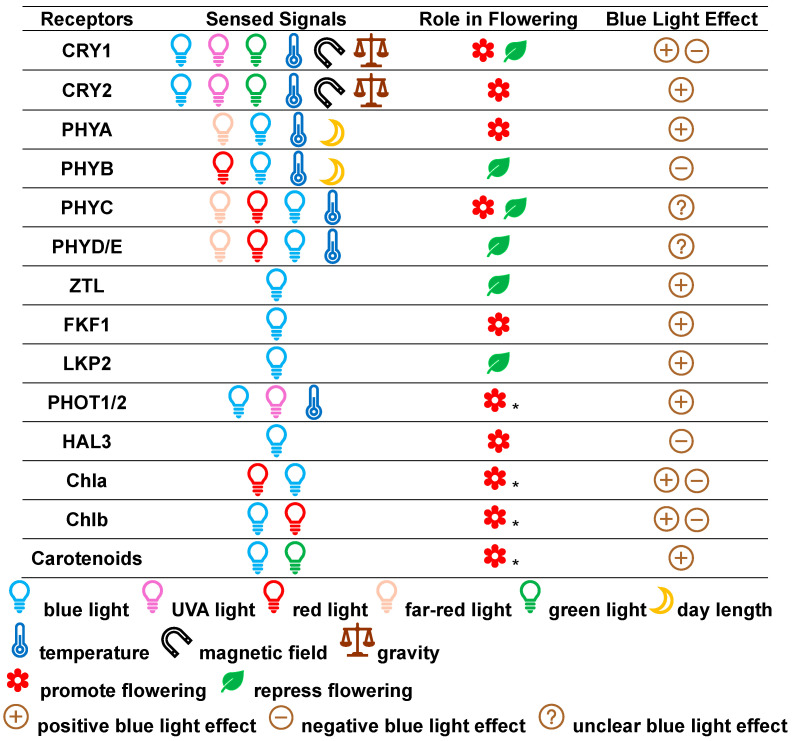
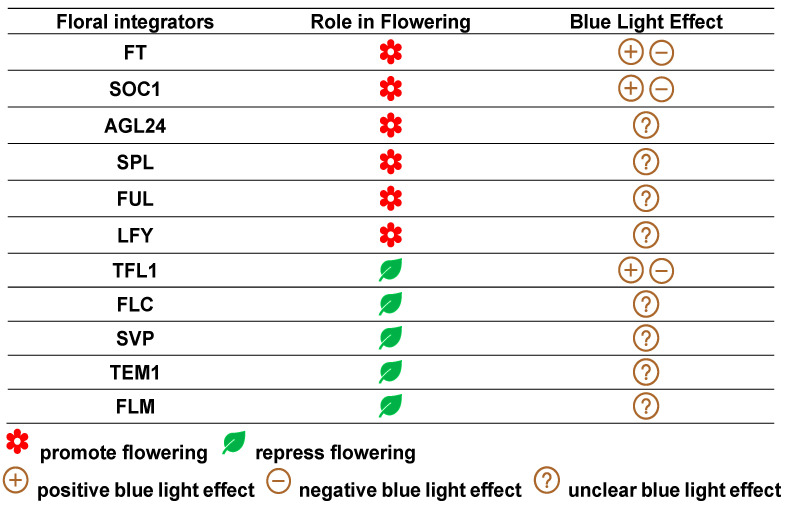
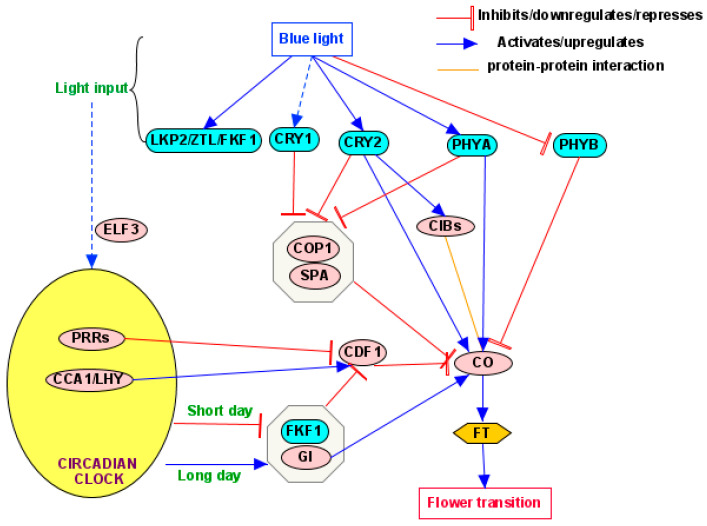
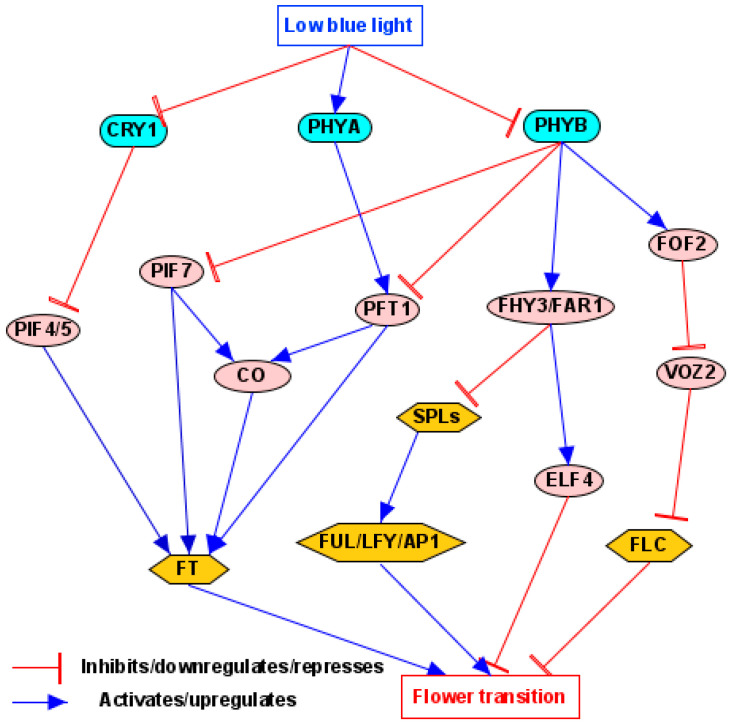
Blue light (BL) is important in regulating floral transition. In a controlled environment production system, BL can be manipulated easily and precisely in aspects like peak wavelength, intensity, duration, and co-action with other wavelengths. However, the results of previous studies about BL-mediated floral transition are inconsistent, which implies that an in-depth critical examination of the relevant physiological mechanisms is necessary. This review consolidates the recent findings on the role of BL in mediating floral transition not only in model plants, such as Arabidopsis thaliana, but also in crops, especially horticultural crops. The photoreceptors, floral integrator proteins, signal pathways, and key network components involved in BL-mediated floral transition are critically reviewed. This review provides possible explanations for the contrasting results of previous studies on BL-mediated flowering; it provides valuable information to explain and develop BL manipulation strategies for mediating flowering, especially in horticultural plants. The review also identifies the knowledge gaps and outlines future directions for research in related fields.
Keywords: flower induction; future directions; photoreceptors; physiological mechanisms; signal pathways.
Conflict of interest statement
The authors declare no conflicts of interest.
Figures
Similar articles
-
Flowering and Runnering of Seasonal Strawberry under Different Photoperiods Are Affected by Intensity of Supplemental or Night-Interrupting Blue Light.Plants (Basel). 2024 Jan 26;13(3):375. doi: 10.3390/plants13030375. Plants (Basel). 2024. PMID: 38337908 Free PMC article.
-
Floral Induction and Flower Development of Orchids.Front Plant Sci. 2019 Oct 10;10:1258. doi: 10.3389/fpls.2019.01258. eCollection 2019. Front Plant Sci. 2019. PMID: 31649713 Free PMC article. Review.
-
Mechanisms and function of flower and inflorescence reversion.J Exp Bot. 2005 Oct;56(420):2587-99. doi: 10.1093/jxb/eri254. Epub 2005 Aug 30. J Exp Bot. 2005. PMID: 16131510 Review.
-
Regulatory frameworks involved in the floral induction, formation and developmental programming of woody horticultural plants: a case study on blueberries.Front Plant Sci. 2024 Feb 12;15:1336892. doi: 10.3389/fpls.2024.1336892. eCollection 2024. Front Plant Sci. 2024. PMID: 38410737 Free PMC article. Review.
-
Antagonistic actions of Arabidopsis cryptochromes and phytochrome B in the regulation of floral induction.Development. 1999 May;126(10):2073-82. doi: 10.1242/dev.126.10.2073. Development. 1999. PMID: 10207133
References
-
- Peer L.A., Bhat M.Y., Ahmad N., Mir B.A. Floral induction pathways: Decision making and determination in plants to flower—A comprehensive review. J. Appl. Biol. Biotechnol. 2021;9:7–17.
-
- Demotes-Mainard S., Peron T., Corot A., Bertheloot J., Le Gourrierec J., Pelleschi-Travier S., Crespel L., Morel P., Huche-Thelier L., Boumaza R. Plant responses to red and far-red lights, applications in horticulture. Environ. Exp. Bot. 2016;121:4–21. doi: 10.1016/j.envexpbot.2015.05.010. - DOI
-
- Huche-Thelier L., Crespel L., Le Gourrierec J., Morel P., Sakr S., Leduc N. Light signaling and plant responses to blue and UV radiations—Perspectives for applications in horticulture. Environ. Exp. Bot. 2016;121:22–38. doi: 10.1016/j.envexpbot.2015.06.009. - DOI
Publication types
LinkOut - more resources
Full Text Sources
