


Associations of Academic Study- and Non-Study-Related Sedentary Behaviors with Incident Obesity in Children and Adolescents
- PMID: 40431373
- PMCID: PMC12114288
- DOI: 10.3390/nu17101633
Associations of Academic Study- and Non-Study-Related Sedentary Behaviors with Incident Obesity in Children and Adolescents
Abstract
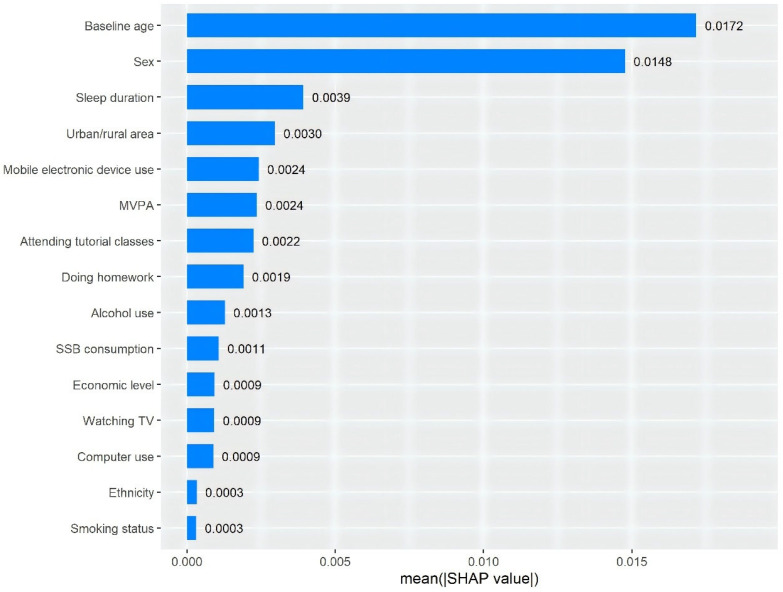
Objective: To assess the associations between academic study- and non-study-related sedentary behaviors and the risk of overweight/obesity in children and adolescents, as well as their joint association with sugar-sweetened beverage (SSB) consumption. Methods: Sedentary behaviors and SSB consumption were assessed using self-reported questionnaires. Overweight/obesity were defined by age- and sex-specific body mass index cut-off values according to the criteria of "Screening for overweight and obesity among school-age children and adolescents" in China. Poisson regression with robust error variance was used to assess the associations of sedentary behaviors and/or SSB consumption with the risk of overweight/obesity, yielding relative risks (RRs) and 95% confidence intervals (CIs). The Shapley additive explanations (SHAP) method was used to rank the contribution of five specific sedentary behaviors to obesity risk. Results: Among 47,148 participants with a 3-year follow-up, longer durations of screen-related, academic study-related, and total sedentary time were each associated with a higher risk of overweight/obesity (adjusted RR (95% CI) per hour increment: 1.01 (1.00-1.02), 1.03 (1.01-1.06), and 1.02 (1.01-1.03)). After mutual adjustment, the associations of engaging in homework, attending tutorial classes, and using mobile electronic devices remained significantly associated with higher overweight/obesity risk. The SHAP summary plot shows that using mobile electronic devices, attending tutorial classes, and doing homework were the three most important sedentary obesogenic contributors. A significant interaction of age with sedentary time was found (p for interaction < 0.05). No significant interaction was found between SSB consumption and sedentary time. Conclusions: Excessive sedentary behaviors were associated with a higher risk of overweight/obesity, particularly due to mobile electronic device use, attending tutorial classes, and doing homework.
Keywords: children and adolescents; obesity; overweight; sedentary behavior.
Conflict of interest statement
The authors declare that they have no competing interests.
Figures
References
-
- World Health Organization (WHO) Facts About Overweight and Obesity. [(accessed on 28 March 2024)]. Available online: https://www.who.int/news-room/fact-sheets/detail/obesity-and-overweight.
-
- Dobbie L.J., Pittam B., Zhao S.S., Alam U., Hydes T.J., Barber T.M., Cuthbertson D.J. Childhood, adolescent, and adulthood adiposity are associated with risk of PCOS: A Mendelian randomization study with meta-analysis. Hum. Reprod. 2023;38:1168–1182. doi: 10.1093/humrep/dead053. - DOI - PMC - PubMed
MeSH terms
Grants and funding
LinkOut - more resources
Full Text Sources
Medical
