


Predictors of Vitamin D Status in Religious and Intermittent Fasting: A Comparative Study in Orthodox Nuns and Women from the General Population
- PMID: 40431396
- PMCID: PMC12114524
- DOI: 10.3390/nu17101656
Predictors of Vitamin D Status in Religious and Intermittent Fasting: A Comparative Study in Orthodox Nuns and Women from the General Population
Abstract
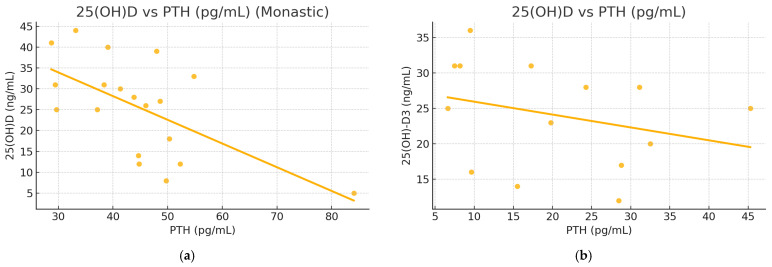
Background: Vitamin D plays a key role in bone metabolism and immune regulation. Populations with restricted sun exposure or limited dietary intake are particularly vulnerable to vitamin D deficiency. Orthodox Christian nuns represent a unique group in this regard, due to traditional clothing, limited outdoor activity, and prolonged religious fasting. However, few studies have compared them with lay individuals following similar dietary practices. Objective: This study aimed to investigate predictors of serum 25-hydroxyvitamin D [25(OH)D] concentrations in two female populations: Orthodox Christian nuns and women from the general population practicing intermittent (religious or non-religious) fasting. We also aimed to develop predictive models of vitamin D status for each group based on lifestyle and biochemical parameters. Methods: A total of 85 women (40 Orthodox nuns and 45 laywomen), aged 30-50 years, were enrolled. Serum 25(OH)D, parathyroid hormone (PTH), calcium levels, and anthropometric indices, including body mass index (BMI), total body fat, and visceral fat, were measured. Dietary calcium and vitamin D intake, as well as sun exposure, were assessed using validated questionnaires. Separate stepwise multiple regression models were constructed for each group to identify independent predictors of 25(OH)D concentrations. An additional combined model, including all participants, was also explored. Results: PTH was the most significant predictor, negatively correlating with 25(OH)D concentrations in both groups (p = 0.038), highlighting its regulatory role in vitamin D metabolism. When analyzed separately, the model for Orthodox nuns showed stronger explanatory power (adjusted R2 = 0.718; p = 0.013) compared with the control group (adjusted R2 = 0.362; p = 0.038), with PTH emerging as a key predictor in both. Conclusions: Distinct predictors of vitamin D status were identified in each group, reflecting the complex interplay between lifestyle and physiological factors. These findings suggest that targeted interventions, such as addressing PTH regulation in fasting populations or enhancing sun exposure in the general population, may be more effective in preventing vitamin D deficiency depending on the context.
Keywords: 25-hydroxyvitamin D; Orthodox monasticism; intermittent fasting; lifestyle factors; nutritional epidemiology; parathyroid hormone; religious practices; sun exposure; visceral fat; vitamin D.
Conflict of interest statement
The authors declare no conflicts of interest.
Figures


References
-
- Lips P., Cashman K.D., Lamberg-Allardt C., Bischoff-Ferrari H.A., Obermayer-Pietsch B., Bianchi M.L., Stepan J., El-Hajj Fuleihan G., Bouillon R. Management of endocrine disease: Current vitamin D status in European and Middle East countries and strategies to prevent vitamin D deficiency. Eur. J. Endocrinol. 2019;180:P23–P54. doi: 10.1530/EJE-18-0736. - DOI - PubMed
-
- Karras S.N., Koufakis T., Adamidou L., Antonopoulou V., Karalazou P., Thisiadou K., Mitrofanova E., Mulrooney H., Petróczi A., Zebekakis P., et al. Effects of orthodox religious fasting versus combined energy and time restricted eating on body weight, lipid concentrations and glycaemic profile. Int. J. Food Sci. Nutr. 2021;72:82–92. doi: 10.1080/09637486.2020.1760218. - DOI - PubMed
Publication types
MeSH terms
Substances
LinkOut - more resources
Full Text Sources
Medical
