


Uncovering the reciprocal effects of plant polyploidy and the microbiome: implications for understanding of polyploid success
- PMID: 40432236
- PMCID: PMC12222933
- DOI: 10.1111/nph.70226
Uncovering the reciprocal effects of plant polyploidy and the microbiome: implications for understanding of polyploid success
Abstract
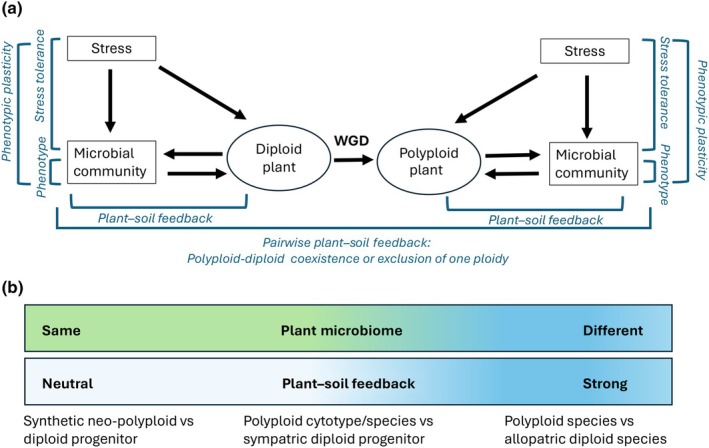
Polyploidy plays a major role in diversification and speciation of almost all plants. Separately, the microbiome is recognized for its ubiquitous role in plant functioning. Despite the importance of both processes, we lack a synthetic picture of their reciprocal relationship. I forge this missing linkage by presenting the ways in which plant polyploidy can shape the microbiome and how the microbiome in turn can affect polyploid phenotype and fitness. I illustrate these interactions by drawing on the small, but compelling, set of comparisons of the plant-microbial community interaction with taxa representing different stages of the polyploid continuum and thereby shed light on how the advantages of polyploidy may be influenced by microbes. I use findings from a range of studies to build the case for plant-microbiome reciprocal interactions in both key pathways for polyploid persistence: overcoming their minority cytotype disadvantage and increasing competitive ability and/or niche shifts relative to diploids. I put forward how the microbiome likely plays a role in polyploid stress tolerance, abiotic niche breadth, range limits and coexistence. I conclude by identifying the research needed to test these hypotheses and how doing so could transform our understanding of polyploidy as a driver of plant ecology and evolution.
Keywords: coexistence; microbiome; minority cytotype; niche breadth; plant–microbe interaction; plasticity; polyploidy.
© 2025 The Author(s). New Phytologist © 2025 New Phytologist Foundation.
Conflict of interest statement
None declared.
Figures
References
-
- Abdelfattah A, Tack AJM, Lobato C, Wassermann B, Berg G. 2023. From seed to seed: the role of microbial inheritance in the assembly of the plant microbiome. Trends in Microbiology 31: 346–355. - PubMed
-
- Afkhami ME, McIntyre PJ, Strauss SY. 2014. Mutualist‐mediated effects on species' range limits across large geographic scales. Ecology Letters 17: 1265–1273. - PubMed
-
- Aleklett K, Hart M, Shade A. 2014. The microbial ecology of flowers: an emerging frontier in phyllosphere research. Botany 92: 253–266.
-
- Anneberg TJ, Cullen NP, O'Neill EM, Wei N, Ashman T‐L. 2024. Neopolyploidy has variable effects on the diversity and composition of the wild strawberry microbiome. American Journal of Botany 111: e16287. - PubMed
-
- Anneberg TJ, O'Neill EM, Ashman T‐L, Turcotte MM. 2023a. Polyploidy impacts population growth and competition with diploids: multigenerational experiments reveal key life history tradeoffs. New Phytologist 238: 1294–1304. - PubMed
Publication types
MeSH terms
Grants and funding
LinkOut - more resources
Full Text Sources
