


Desiccated desert locust embryos reserve yolk as a "lunch box" for posthatching survival
- PMID: 40432906
- PMCID: PMC12107552
- DOI: 10.1093/pnasnexus/pgaf132
Desiccated desert locust embryos reserve yolk as a "lunch box" for posthatching survival
Abstract
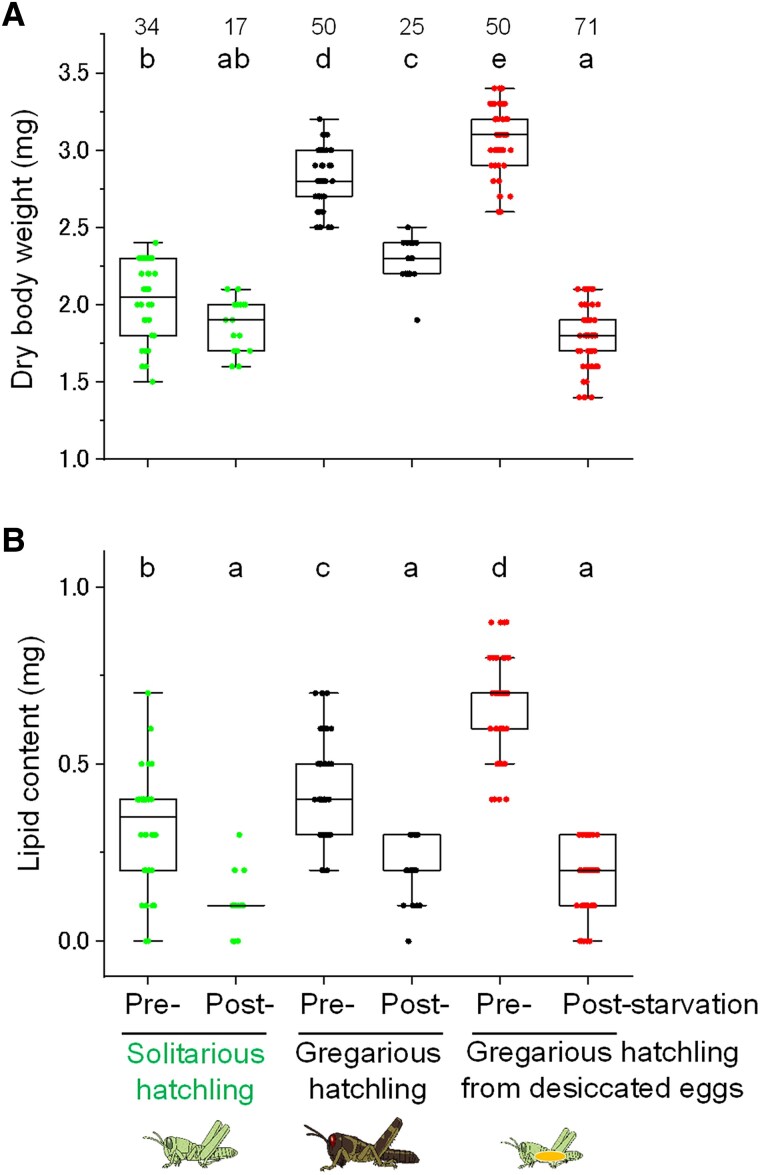
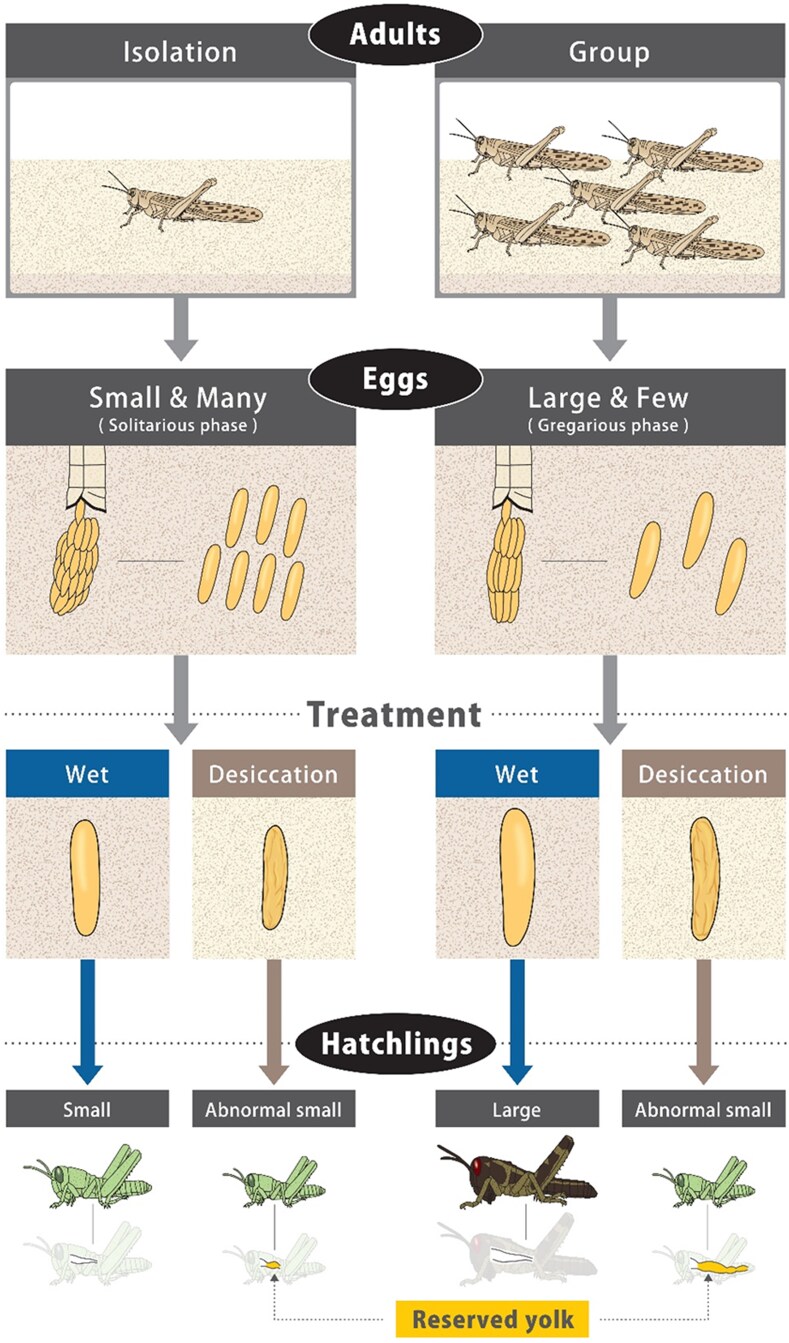
Oviparous animals often prioritize the allocation of reproductive resources to egg size over clutch size, but the impact of this maternal investment on the allocation of embryonic yolks and its ecological functions is poorly understood. We investigated how desert locust embryos allocate yolk for survival energy after hatching, rather than embryonic somatic growth depending on egg size in response to desiccation stress. Crowd-reared females (gregarious phase) produced significantly larger progeny with higher tolerance to starvation than females reared in isolation (solitarious phase). Abnormally small hatchlings with residual yolk in their gut emerged from small and large eggs when exposed to desiccation. In particular, these small hatchlings of desiccated eggs survived significantly longer under starvation than those of wet ones, with larger eggs providing even greater survival benefits. Physiological analysis showed that hatchlings from desiccated eggs showed a trade-off by reserving more lipids without somatic growth than those from normal eggs. Desiccation could be a reliable signal for embryos to predict future poor vegetation, and reserved energy could increase the chance of accessing food after hatching. Our results underscore adaptive plasticity in maternal and embryonic resource allocation in desert locusts in response to unpredictably variable semi-arid habitats.
Keywords: adaptive strategy; desiccation; embryos; maternal effects; resource allocation.
© The Author(s) 2025. Published by Oxford University Press on behalf of National Academy of Sciences.
Figures


References
-
- Danks HV. 2002. Modification of adverse conditions by insects. Oikos. 99:10–24.
-
- Deeming DC, Ferguson MWJ. Egg incubation: its effects on embryonic development in birds and reptiles. Cambridge University Press, Cambridge, 1991.
-
- Counce SJ. 1961. The analysis of insect embryogenesis. Annu Rev Entomol. 6:295–312.
-
- Kraemer JE, Bennett SH. 1981. Utilization of posthatching yolk in loggerhead sea turtles, Caretta caretta. Copeia. 1981:406–411.
-
- Postlethwait JH, Giorgi F. 1985. Vitellogenesis in insects. In: Browder LW, editor. Developmental biology. A comprehensive synthesis. Vol. 1. New York, London: Plenum Press. p. 85–126. - PubMed
LinkOut - more resources
Full Text Sources
