


Exploring district implementation of national guidelines and maintenance of essential health services during the COVID-19 pandemic in Uganda
- PMID: 40433072
- PMCID: PMC12107466
- DOI: 10.1136/bmjph-2024-001813
Exploring district implementation of national guidelines and maintenance of essential health services during the COVID-19 pandemic in Uganda
Abstract
Introduction: The effectiveness of national policies in decentralised health systems depends on local-level implementation. This study examines whether variation in implementation of national guidelines across districts and health system functions explains differences in local health system performance in maintaining continuity of essential maternal health, family planning and child vaccination services during the COVID-19 pandemic in Uganda.
Methods: We used routine health data and an interrupted time-series analysis to estimate district-specific relative declines in service outputs during COVID-19 compared with expected volumes if prepandemic trends continued for maternal health, family planning and child vaccination services. We randomly selected 57 districts across 15 regions and measured the implementation of national guidelines for maintaining essential health services through a web-based survey of district health teams. We generated 'implementation summary scores' by health system function and service category, representing the proportion of guidelines reported implemented by districts. We tested associations between implementation scores and performance.
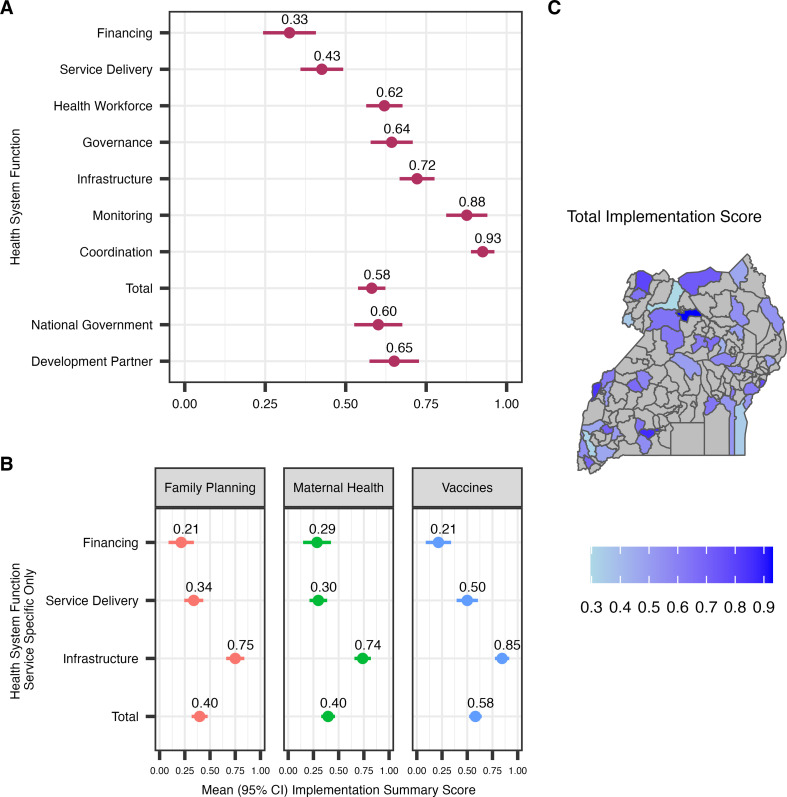
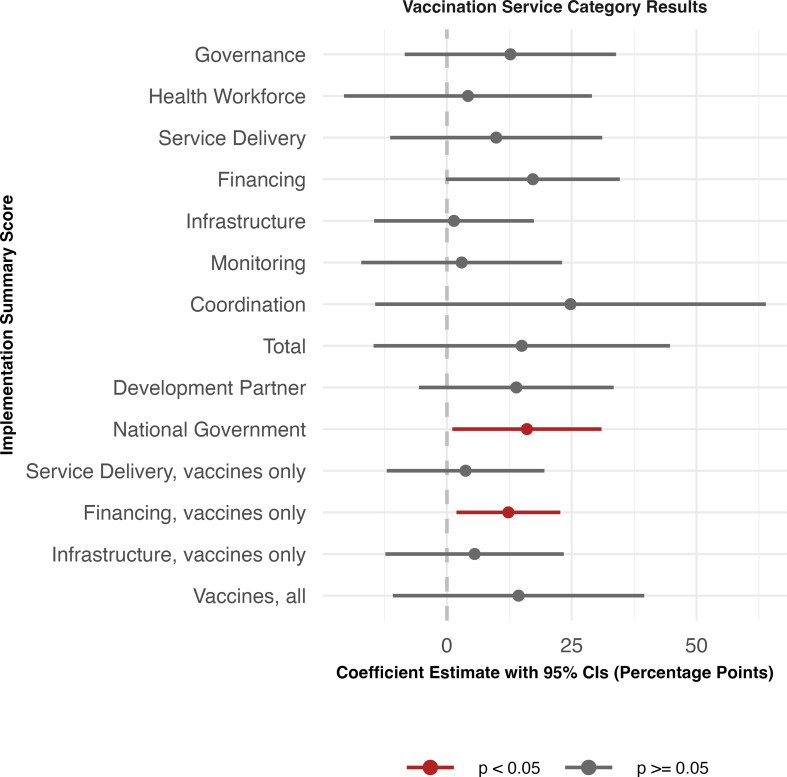
Results: On average, districts (n=42; 74% response rate) reported implementing 58% (95% CI 54-62) of guidelines across health system functions, ranging from 33% (24-41) for 'financing' and 43% (36-49) for 'service delivery' to 93% (89-96) for 'coordination and communication' and 88% (81-94) for 'monitoring'. Districts reported implementing 60% (53-68) of guidelines requiring national government action. District performance in maintaining child vaccination services was positively associated with vaccine-specific 'financing' and 'national government' implementation summary scores after controlling for geography and district characteristics.
Conclusion: Variation in implementing national-level policy across districts indicates inefficiencies or inequities across geographies in Uganda in terms of ability and capacity to respond to emergencies. Local guideline implementation also varied across health system functions, with financing and service delivery-related guidelines having the lowest implementation scores. Future emergency responses should consider how to balance local adaptations with central support by identifying which health system functions districts can more easily manage and adjust independently.
Keywords: COVID-19; Health Services Accessibility; Public Health; economics.
Copyright © Author(s) (or their employer(s)) 2025. Re-use permitted under CC BY-NC. Published by BMJ Group.
Conflict of interest statement
None declared.
Figures
References
-
- Sagan A, Erin W, Dheepa R, et al. Health system resilience during the pandemic: it’s mostly about governance. Eurohealth (Lond) 2021;27:10–5.
-
- Falleti TG. A Sequential Theory of Decentralization: Latin American Cases in Comparative Perspective. Am Polit Sci Rev. 2005;99:327–46. doi: 10.1017/S0003055405051695. - DOI
LinkOut - more resources
Full Text Sources