Wound state monitoring by multiplexed, electrochemical, real-time, localized, inflammation-tracking nitric oxide sensor (MERLIN)
- PMID: 40435247
- PMCID: PMC12118596
- DOI: 10.1126/sciadv.adv2385
Wound state monitoring by multiplexed, electrochemical, real-time, localized, inflammation-tracking nitric oxide sensor (MERLIN)
Abstract
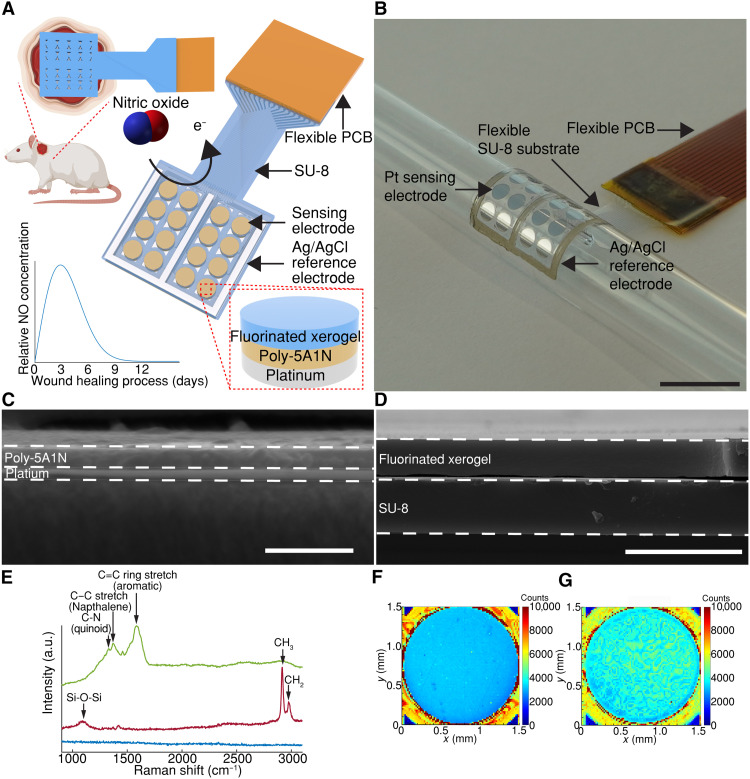
Nitric oxide (NO) released endogenously by induced NO synthase (iNOS) in macrophages is a key regulatory biomarker for wound inflammation. Detecting NO directly on the wound bed is challenging due to its short half-life time (6 to 50 seconds), low physiological concentration (nanomolar to micromolar), and interferences in the complex wound environment. Here, we present a compliant, multiplexed, electrochemical, real-time, localized, inflammation-tracking NO sensor (MERLIN) array for in vivo spatiotemporal measurement of NO, with high sensitivity (883 ± 283 nanoamperes per micromolar per square centimeter); selectivity against nitrites (~27,900-fold), ascorbic acid (~3800-fold), and uric acid (~6900-fold); and low limit of detection (~8.00 nM). MERLIN spatiotemporally tracked NO on rat skin wounds for 7 days, and results indicated that NO peaks on day 3, in line with previously reported iNOS activity. MERLIN allows spatial mapping of the NO gradient across the wound bed, which can be used to provide diagnostic information to assist wound care.
Figures


References
-
- Picón-Pagès P., Garcia-Buendia J., Munoz F. J., Functions and dysfunctions of nitric oxide in brain. Biochim. Biophys. Acta Mol. Basis Dis. 1865, 1949–1967 (2019). - PubMed
-
- Ziche M., Morbidelli L., Nitric oxide and angiogenesis. J. Neuro-Oncol. 50, 139–148 (2000). - PubMed
-
- Coleman J. W., Nitric oxide in immunity and inflammation. Int. J. Immunopharmacol. 1, 1397–1406 (2001). - PubMed
MeSH terms
Substances
LinkOut - more resources
Full Text Sources
Medical