Inhalant Allergen Sensitization: Prevalence, Risk Factors, and Geographic Variation in the USA
- PMID: 40435963
- PMCID: PMC12258866
- DOI: 10.1159/000545508
Inhalant Allergen Sensitization: Prevalence, Risk Factors, and Geographic Variation in the USA
Abstract
Introduction: We aimed to assess the prevalence of IgE-mediated sensitization to two perennial (dust mite and animal) and four seasonal allergen sources (tree, grass, weed, and mold/fungi) using data from a national clinical reference laboratory (Quest Diagnostics).
Methods: Patients tested in 2019 for ≥1 specific serum IgE toward 4 dust mites, 14 animals, 32 trees, 12 grasses, 21 weeds, or 19 mold/fungi allergens were included. Patients with ≥1 specific IgE ≥0.10 kU/L within a source were considered sensitized for the source. Chi-square tests and multivariate logistic regression were used to compare the estimated prevalence of allergic sensitization related to demographics, geography, and clinical diagnosis.
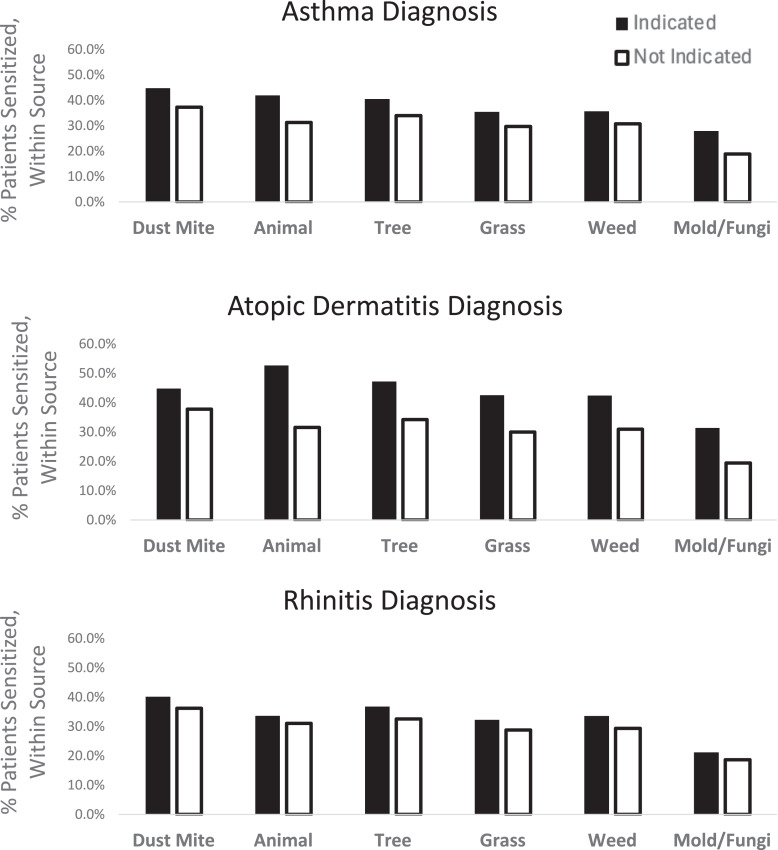
Results: Sensitization for dust mite, animal, tree, grass, weed, and mold/fungi sources was 38.0% (21,161/55,735), 32.1% (21,888/68,035), 34.5% (22,975/66,567), 30.3% (21,664/71,575), 31.2% (22,960/73,605), and 19.7% (13,514/68,574), respectively. Across allergen sources, males had higher prevalence (from lowest to highest: 25.3% mold/fungi to 43.0% dust mite) compared to females (from lowest to highest: 16.1% mold/fungi to 34.6% dust mite); prevalence peaked in 10-19 years (from lowest to highest: 29.7% mold/fungi to 54.2% dust mite) and then decreased with increasing age; large metropolitan areas (from lowest to highest: 39.6% dust mite to 20.7% mold/fungi) had higher prevalence compared to small-to-medium metro (from lowest to highest: 36.6% dust mite to 17.9% mold/fungi) or nonmetro areas (from lowest to highest: 32.4% dust mite to 19.5% mold/fungi); a higher prevalence was observed in patients with asthma, atopic dermatitis, or rhinitis than in those with none of these diagnoses reported. Sensitization to perennial and seasonal allergens showed regional variation.
Conclusions: Prevalence of allergic sensitization to perennial and seasonal allergens is associated with patient age and sex, census regions, level of urbanization, and allergic disease states. These factors should be considered when designing and selecting allergen panels for diagnosing and treating symptomatic patients.
Keywords: Geography; Inhalant allergen; Risk factors; Seasonal allergen; Sensitization; USA.
© 2025 The Author(s). Published by S. Karger AG, Basel.
Conflict of interest statement
L.H.H. and Z.C. are employees of Quest Diagnostics and may own its stock. L.S. declares no conflicts of interest. K.K. is consultant and independent contractor for ThermoFisher Scientific.
Figures



References
-
- Dierick BJH, van der Molen T, Flokstra-de Blok BMJ, Muraro A, Postma MJ, Kocks JWH, et al. Burden and socioeconomics of asthma, allergic rhinitis, atopic dermatitis and food allergy. Expert Rev Pharmacoecon Outcomes Res. 2020;20(5):437–53. - PubMed
-
- Bernstein IL, Li JT, Bernstein DI, Hamilton R, Spector SL, Tan R, et al. Allergy diagnostic testing: an updated practice parameter. Ann Allergy Asthma Immunol. 2008;100(3 Suppl 3):S1–148. - PubMed
LinkOut - more resources
Full Text Sources