


A nomogram for predicting delirium in the ICU among older patients with chronic obstructive pulmonary disease
- PMID: 40437405
- PMCID: PMC12117959
- DOI: 10.1186/s12877-025-06049-7
A nomogram for predicting delirium in the ICU among older patients with chronic obstructive pulmonary disease
Abstract
Background: Delirium is common among critically ill older patients with chronic obstructive pulmonary disease (COPD). This study aims to develop a nomogram model to predict the risk of ICU delirium in older patients with COPD.
Methods: This study included 1,912 older COPD patients admitted to the ICU from the MIMIC-IV database. The patients were randomly divided into training and validation sets in a 7:3 ratio. LASSO regression, univariable and multivariable logistic regression were used to select the best predictive factors based on demographic, clinical, laboratory, and treatment data at ICU admission. A nomogram model was then constructed. The model's accuracy was evaluated using calibration curves. Its predictive performance and clinical utility were assessed using the area under the receiver operating characteristic curve (AUC), decision curve analysis (DCA), and clinical impact curves (CIC).
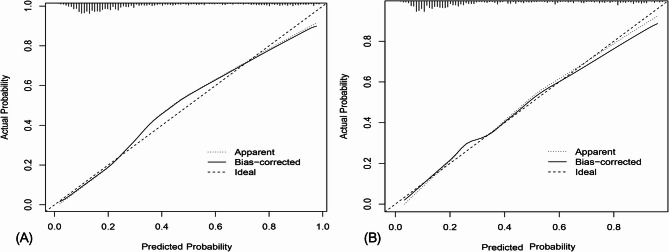
Results: A total of 638 patients (33.4%) developed ICU delirium, with a median age of 76.00 (IQR: 71.00-83.00) years. Ten independent factors were identified for the nomogram model, including cerebrovascular disease (OR: 1.91; 95% CI, 1.38-2.64), Charlson Comorbidity Index (OR: 1.08; 95% CI, 1.02-1.13), Glasgow Coma Scale (OR: 0.82; 95% CI, 0.77-0.87), SOFA score (OR: 1.15; 95% CI, 1.07-1.22), heart rate (OR: 1.01; 95% CI, 1.01-1.02), body temperature (OR: 1.60; 95% CI, 1.14-2.24), blood urea nitrogen (OR: 1.01; 95% CI, 1.00-1.02), 24-hour urine output (OR: 1.02; 95% CI, 1.01-1.02), fentanyl (OR: 1.94; 95% CI, 1.47-2.55), and oxygen flow (OR: 1.04; 95% CI, 1.02-1.07). The model achieved an AUC of 0.86 (95% CI, 0.83-0.90) in the training set and 0.86 (95% CI, 0.84-0.88) in the validation set. The calibration curve showed good agreement between predicted and observed values (P > 0.05). DCA and CIC results indicated the model's strong predictive value and clinical applicability.
Conclusions: This study developed an intuitive and simple nomogram model to predict the risk of ICU delirium in older patients with COPD. The model can help clinicians quickly identifying high-risk delirium patients upon ICU admission, thereby optimizing early intervention and treatment strategies.
Keywords: Chronic obstructive pulmonary disease; ICU delirium; Intensive care unit; MIMIC-IV database; Nomogram.
© 2025. The Author(s).
Conflict of interest statement
Declarations. Ethics approval and consent to participate: All procedures performed in the present study were in accordance with the principles outlined in the 1964 Helsinki Declaration and its later amendments. This study was exempted from obtaining informed consent. Because the MIMIC IV database has received ethical approval from the Massachusetts Institute of Technology (Cambridge, MA) and Beth Israel Deaconess Medical Center (Boston, MA) its data is publicly available and all patient data are de-identified. In addition, this study was registered and passed the Ethics Committee of the First Affiliated Hospital of Wenzhou Medical University and our clinical trial number was 2016131. Consent for publication: Not applicable. Competing interests: The authors declare no competing interests.
Figures



References
MeSH terms
Grants and funding
- 21YF11FA001/Key research and development program of Gansu Province science and technology plan project
- Y20210671/Wenzhou Science and Technology Bureau project
- 2016YFC1304000/National Key Research and Development Program of China grants
- 82170017, 82370085/National Natural Scientific Foundation of China
LinkOut - more resources
Full Text Sources
Medical
Miscellaneous
