. 2025 May 28;26(1):201.
doi: 10.1186/s12931-025-03256-z.

ITIH4 attenuates acute lung injury by Fe-containing particulate matter in mice via Hippo pathway in type II alveolar epithelial cells

Affiliations

ITIH4 attenuates acute lung injury by Fe-containing particulate matter in mice via Hippo pathway in type II alveolar epithelial cells

Vincent Laiman et al. Respir Res. .

Abstract

Background: Metals in particulate matter (PM), like iron (Fe), were associated with lung injury. Inter-alpha-trypsin inhibitor heavy chain H4 (ITIH4) was suggested to inhibit lung inflammation. However, the effect of metals in PM, particularly Fe, on lung inflammation involving ITIH4 remained unclear.

Methods: We investigated the effects of recombinant ITIH4 (rITIH4) against acute lung injury in C57BL/6JNarl and B6.Sftpc-CreERT2;Ai14(RCL-tdT)-D mice exposed to Fe-containing PM. Mice were exposed to diesel exhaust particles (DEP) or soluble iron (FeCl₃) via intratracheal instillation, while rITIH4 treatment was administered intranasally after exposure. Lung function, Fe levels (both bulk and single-cell by inductively-coupled plasma mass spectrometry (ICP-MS) and single-cell ICP-MS, respectively), inflammatory cell infiltration, and Hippo pathway regulation in type II alveolar epithelial cells (AECII) were assessed.

Results: We observed correlation between lung function changes and Fe levels, both in bulk and single-cell Fe in peripheral blood mononuclear cells. Single-cell RNA sequencing of the control group identified AECII-related cells characterized by high Sftpc, Sftpa1, Mzb1, B3 gnt5, Cacna1e, and Agbl1 expression. rITIH4 treatment in DEP-exposed mice restored Hippo pathway Cdh1, Itih4, Pdpn, Wwtr1, and Yap1 in AECII. rITIH4 reversed DEP- and Fe-induced increases in neutrophil infiltration, neutrophil-to-lymphocyte ratio, and monocyte depletion in bronchoalveolar lavage fluid (BALF). rITIH4 reduced BALF CXCL1/KC levels by DEP and serum 8-isoprostane levels by Fe. rITIH4 also reduced DEP-induced lung damage, increased ⍺-catenin and p-YAP in Fe-exposed mice, and pTAZ/TAZ ratio in both DEP- and Fe-exposed mice. rITIH4 increased pYAP/YAP ratio in DEP-exposed mice while decreasing LC3BII/I ratio in Fe-exposed mice.

Conclusion: ITIH4 attenuated acute lung injury in mice exposed to PM, specifically Fe, by modulating the Hippo pathway in AECII.

Keywords: Air pollution; Autophagy; Diesel exhaust particles; Inflammation; Single-cell analysis.


Conflict of interest statement

Declarations. Ethics approval and consent to participate: All animal protocols were prepared in accordance with the Guide for the Care and Use of Laboratory Animals and were approved by the Laboratory Animal Center at Taipei Medical University (IACUC: LAC-2021–0430) (Taipei, Taiwan). Consent for publication: Not applicable. Competing interests: The authors declare no competing interests.

Figures

Fig. 1
Fig. 1
A Schematic diagram of experiment in which male C57Bl/6 JNarl mice of 8 weeks old were intratracheally administered with either phosphate buffered saline (PBS), diesel exhaust particle (DEP), and soluble iron salt (FeCl3). The experiment was concluded on day 2. B Lung function tests in C57Bl/6 JNarl mice in control, DEP, and FeCl3 groups (n = 14–18). C Correlation heatmap between lung function and metals in peripheral blood mononuclear cells. The color depth represents the strength of the correlation coefficient (red: positive correlation; blue: negative correlation). The size of the data point reflects the significance of the correlation. CRS, compliance respiratory system; mWOB, minute work of breathing; scFe, single-cell Fe
Fig. 2
Fig. 2
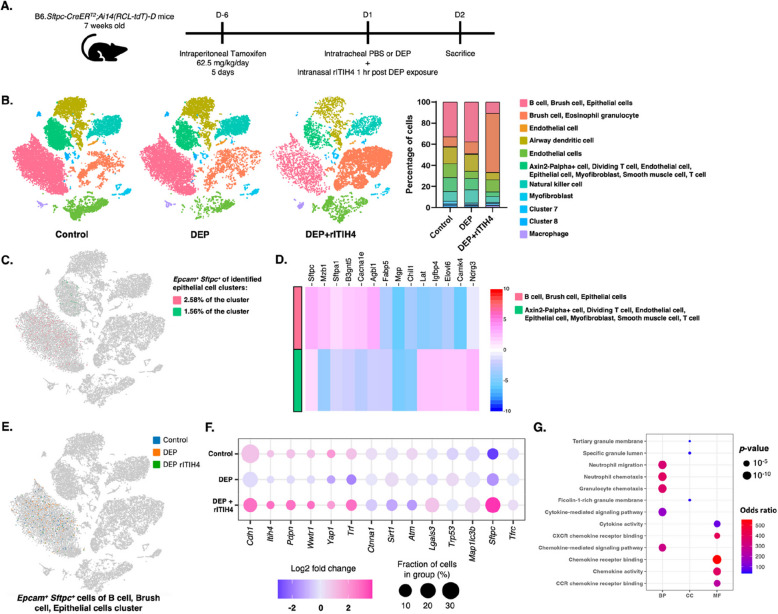
A Schematic diagram of 7 weeks old B6.Sftpc-CreERT2;Ai14(RCL-tdT)-D mice pre-treated with Tamoxifen injection were intratracheally administered with either phosphate buffered saline (PBS) or diesel exhaust particle (DEP). After 1 h, the DEP-exposed mice were intranasally administered with recombinant ITIH4 (rITIH4) protein. B t-stochastic neighbor embedding (t-SNE) plot of all cells colored by their cellular identity and percentages of each cells cluster in lung of B6.Sftpc-CreERT2;Ai14(RCL-tdT)-D mice in control, DEP, and DEP with rITIH4 treatment groups. C t-SNE plot, percentages of cells, and (D) heatmap displaying the gene expressions of type II alveolar epithelial cell (AECII) by Epcam-positive (Epcam+) and Sftpc-positive (Sftpc+) cells within the B cell, brush cell, and epithelial cell cluster (pink), as well as the Axin2-Palpha + cell, dividing T cell, endothelial cell, epithelial cell, myofibroblast, smooth muscle cell, and T cell cluster (green). E t-SNE plot of AECII cells (Epcam+ Sftpc+) within the B cell, brush cell, and epithelial cell cluster and (F) dot plot of gene expressions related to Hippo pathway in control, DEP, and DEP with rITIH4 treatment groups. The depth of the color indicates log2 fold changes (red: positive fold change; blue: negative fold change). The size of the point indicates the percentage of cells in the group. G Gene ontology enrichment analysis related to biological processes (BP), cellular component (CC), and molecular function (MF). The depth of the color indicates the activation odds ratio. The size of the point indicates the p-values of the enrichment analysis
Fig. 3
Fig. 3
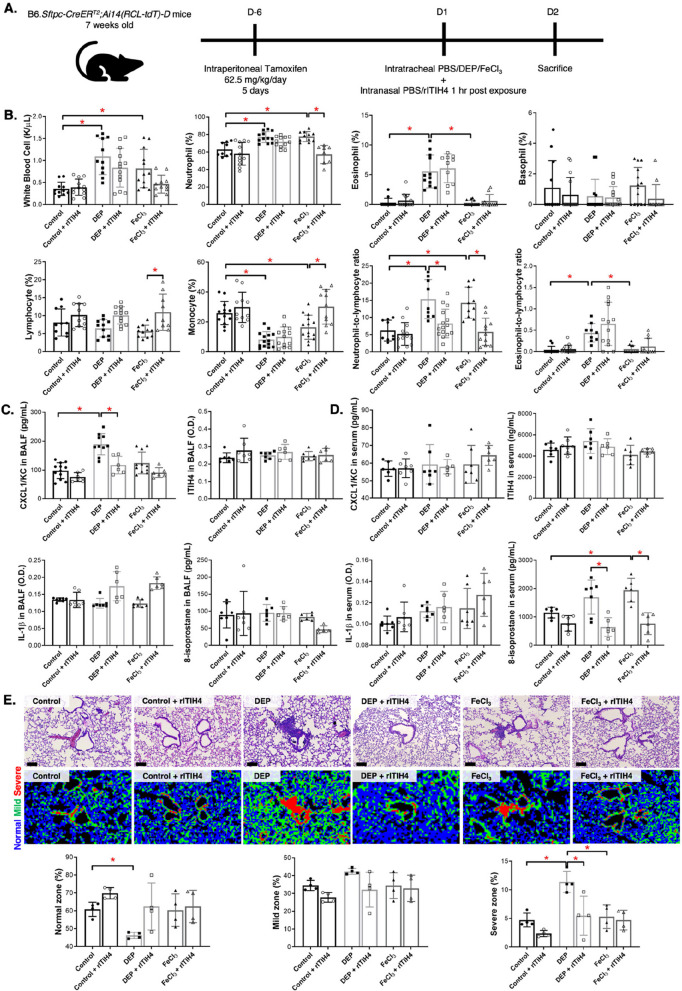
A Schematic diagram of 7 weeks old B6.Sftpc-CreERT2;Ai14(RCL-tdT)-D mice pre-treated with Tamoxifen injection were intratracheally administered with either phosphate buffered saline (PBS), diesel exhaust particle (DEP), or soluble iron salt (FeCl3). After 1 h, the mice were intranasally administered with either PBS or recombinant ITIH4 (rITIH4) protein. B Inflammatory cells differential count in bronchoalveolar lavage fluid (BALF) of B6.Sftpc-CreER.T2;Ai14(RCL-tdT)-D mice in control, control with rITIH4, DEP, DEP with rITIH4, FeCl3, and FeCl3 with rITIH4 groups (n = 8–12) (C) Measurement of chemokine (C-X-C motif) ligand 1(CXCL1)/keratinocyte-derived chemokine (KC), ITIH4, interleukin (IL)−1β, and 8-isoprostane in BALF and (D) CXCL1/KC, rITIH4, IL-1β, and 8-isoprostane in serum of mice in control, control with rITIH4, DEP, DEP with rITIH4, FeCl3, and FeCl3 with rITIH4 groups (n = 6–11). *p < 0.05. (E) Lung damage assessment of mice in control, control with rITIH4, DEP, DEP with rITIH4, FeCl3, and FeCl3 with rITIH4 groups (scale bar = 100 μm). The percentages of normal zone indicating homeostatic appearing areas (blue), mild zone indicating active morphological remodeling areas (green) as, and severe zone indicating areas of maximal damage (red) were shown (n = 4). *p < 0.05
Fig. 4
Fig. 4
Violin plot of gene expressions (presented in log2 fold changes) in type II alveolar epithelial cells (AECII) Epcam+ Sftpc+ cells by single-cell RNA in lungs of B6.Sftpc-CreERT2;Ai14(RCL-tdT)-D mice in control, diesel exhaust particle (DEP), and DEP with rITIH4, representative western blot images, quantitative analysis of the western blot images with normalization to β-actin compared to control group, and representative immunofluorescent staining of lungs of mice in control, control with rITIH4, DEP, DEP with rITIH4, soluble iron (FeCl3), and FeCl3 with rITIH4 groups. A Violin plot of Cdh1 and Ctnna1, western blot images of E-cadherin and ⍺-catenin, and immunofluorescent staining with SPC (red), E-cadherin (purple), and ⍺-catenin (green) (nuclear staining with DAPI in blue). B Violin plot of Yap1, western blot images of YAP and p-YAP, and immunofluorescent staining with SPC (red), YAP (green), and p-YAP (purple) (nuclear staining with DAPI in blue). C Violin plot of Wwtr1, western blot images of TAZ and p-TAZ, and immunofluorescent staining with SPC (red), TAZ (purple), and p-TAZ (green) (nuclear staining with DAPI in blue) (scale bar = 50 μm). *p < 0.05
Fig. 5
Fig. 5
A Violin plots (presented in log2 fold changes) of Trf, Trfc, and Map1 lc3b in type II alveolar epithelial cells (AECII) Epcam+ Sftpc+ cells by single-cell RNA of B6.Sftpc-CreERT2;Ai14(RCL-tdT)-D mice lungs in control, diesel exhaust particle (DEP), and DEP with recombinant ITIH4 (rITIH4). B representative western blot images and quantitative analysis of the western blot images with normalization to β-actin compared to control group, and representative immunofluorescent staining of lungs of mice in control, control with rITIH4, DEP, DEP with rITIH4, soluble iron (FeCl3), and FeCl3 with rITIH4 groups. *p < 0.05

References

    1. Manullang A, Chung C-L, Lee Y-L, Yuan T-H, Tran HM, Makrufardi F, Chung KF, Lee K-Y, Chang J-H, Chuang H-C. COPD with Eosinophilic Inflammation is Susceptible to Particulate Air Pollution Exposure. Aerosol Air Qual Res. 2023;23:1–14.
    1. Li T, Hu R, Chen Z, Li Q, Huang S, Zhu Z, Zhou LF. Fine particulate matter (PM2.5): The culprit for chronic lung diseases in China. Chronic Diseases and Translational Medicine. 2018;4:176–86. - PMC - PubMed
    1. Xing YF, Xu YH, Shi MH, Lian YX. The impact of PM2.5 on the human respiratory system. J Thorac Dis. 2016;8:E69-74. - PMC - PubMed
    1. Mermiri M, Mavrovounis G, Kanellopoulos N, Papageorgiou K, Spanos M, Kalantzis G, Saharidis G, Gourgoulianis K, Pantazopoulos I. Effect of PM2.5 Levels on ED Visits for Respiratory Causes in a Greek Semi-Urban Area. J Pers Med. 2022;12:1–10. - PMC - PubMed
    1. Sun Y, Milando CW, Spangler KR, Wei Y, Schwartz J, Dominici F, Nori-Sarma A, Sun S, Wellenius GA. Short term exposure to low level ambient fine particulate matter and natural cause, cardiovascular, and respiratory morbidity among US adults with health insurance: case time series study. Bmj. 2024;384:e076322 . - PMC - PubMed

MeSH terms

LinkOut - more resources