


Cost-effectiveness of risk model-based lung cancer screening in smokers and nonsmokers in China
- PMID: 40437557
- PMCID: PMC12121091
- DOI: 10.1186/s12916-025-04065-3
Cost-effectiveness of risk model-based lung cancer screening in smokers and nonsmokers in China
Abstract
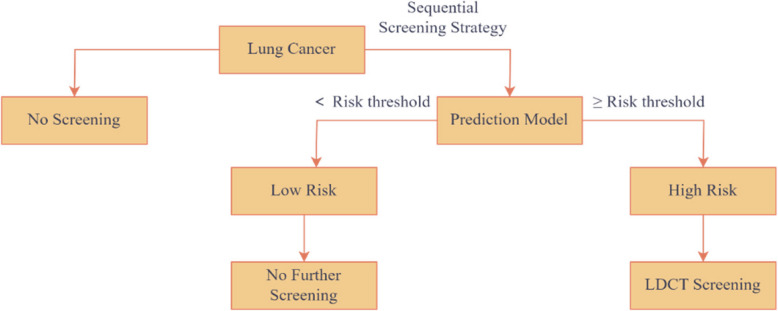
Background: China bears the largest global burden of lung cancer, with a striking 40% of cases occurring in individuals who have never smoked. While the mortality-reducing benefits of low-dose computed tomography (LDCT) for lung cancer screening are established, the quest for an optimal screening strategy continues, considering the potential adverse effects of LDCT. The Chinese NCC-LCm2021 model was developed based on a nationwide population to identify at-risk individuals among smokers and nonsmokers. However, the cost-effectiveness of this model has yet to be determined.
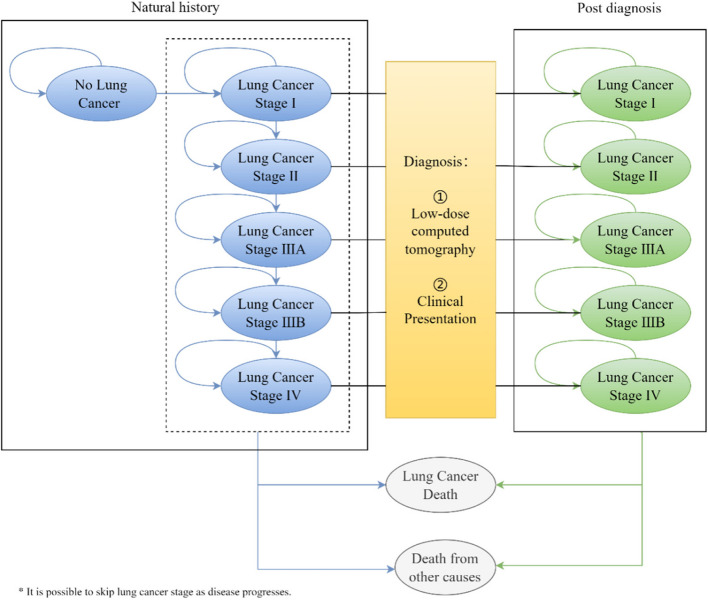
Methods: The cost-effectiveness analysis simulates a Chinese birth cohort using a calibrated Markov model based on individual data from a prospective cohort of the Guangzhou Lung Cancer Screening Program. Health utility was extracted from the literature. Cost parameters were obtained from the price of basic medical services in public medical institutions. Our analysis evaluated 236 distinct screening strategies, varying by screening initiation age, risk thresholds, and smoking status. The primary outcomes were quality-adjusted life-years (QALYs) and incremental cost-effectiveness ratios (ICERs).
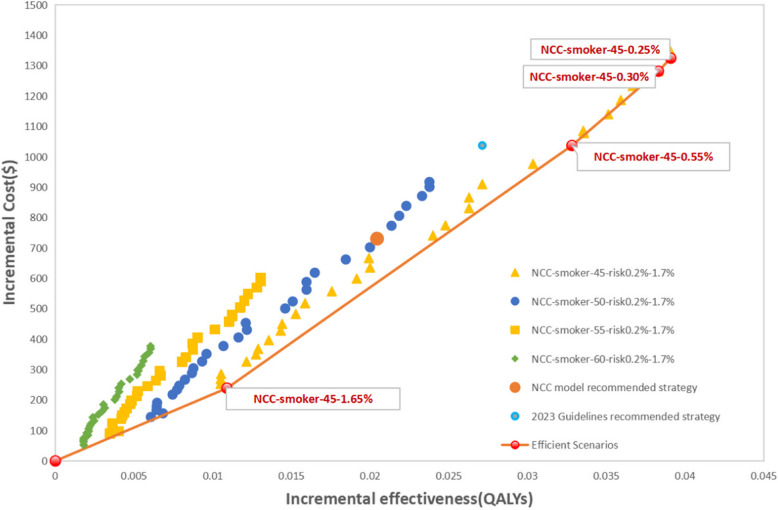
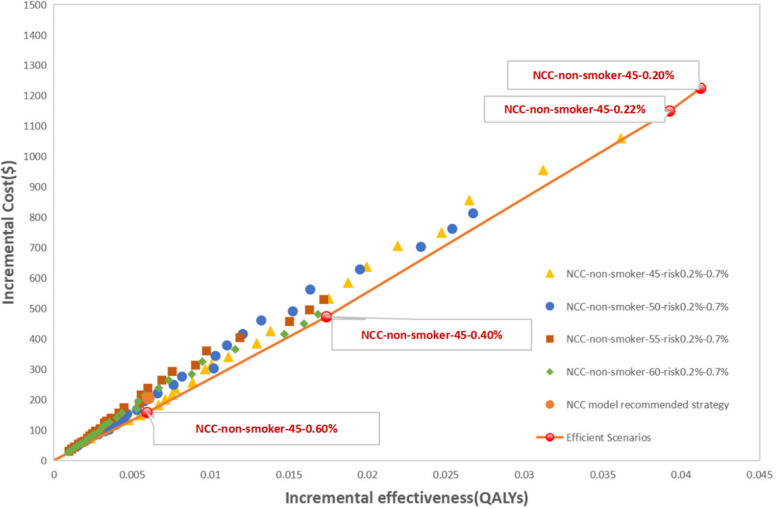
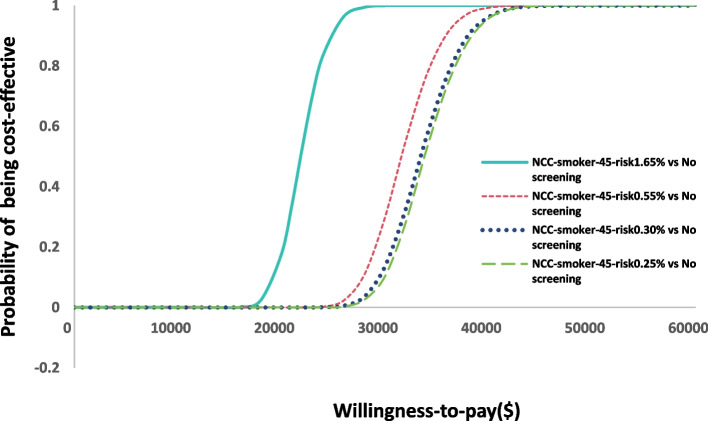
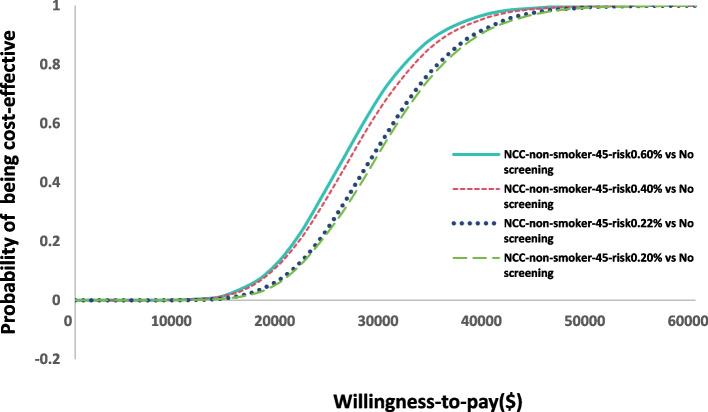
Results: For smokers, four strategies on the efficiency frontier yielded incremental QALYs ranging from 0.011 to 0.039 compared to no screening, with ICERs ranging from $21,874 to $55,038 when compared to the previous efficient strategies. The optimal strategy was annual screening of smokers aged 45 years and older with a 3-year risk of lung cancer incidence of 0.55%, offering the largest gain in QALYs at a willingness-to-pay (WTP) threshold of $38,224 (three times GDP per capita). This optimal strategy dominated the 2023 Chinese guideline-recommended strategy. For nonsmokers, the strategies on the efficiency frontier yielded incremental QALYs ranging from 0.006 to 0.041 compared to no screening, with ICERs ranging from $26,517 to $37,994 when compared to the previous efficient strategies. Correspondingly, the optimal strategy is annual screening of nonsmokers aged 45 years and older with a 3-year risk of lung cancer incidence of 0.20%.
Conclusions: This economic evaluation found that lung cancer screening strategies based on the Chinese NCC-LCm2021 model were cost-effective for both smokers and non-smokers in China. Furthermore, tailoring risk thresholds to smokers and nonsmokers can enhance the cost-effectiveness of lung cancer screening.
Keywords: Cost-effectiveness; Lung cancer; Risk prediction model; Screening.
© 2025. The Author(s).
Conflict of interest statement
Declarations. Ethics approval and consent to participate: Ethical approval was obtained from the First Affiliated Hospital of Guangzhou Medical University and approved by Guangzhou Municipal Health Commission and the Institutional Review Board (No. YKLS2015-25) and all participants provided written informed consent for participation. Consent for publication: Not applicable. Competing interests: The authors declare no competing interests.
Figures
References
-
- Horeweg N, Scholten ET, de Jong PA, van der Aalst CM, Weenink C, Lammers JW, Nackaerts K, Vliegenthart R, ten Haaf K, Yousaf-Khan UA, et al. Detection of lung cancer through low-dose CT screening (NELSON): a prespecified analysis of screening test performance and interval cancers. Lancet Oncol. 2014;15(12):1342–50. - DOI - PubMed
MeSH terms
Grants and funding
- 72274079/National Natural Science Foundation of China
- 72274079/National Natural Science Foundation of China
- 72274079/National Natural Science Foundation of China
- 72274079/National Natural Science Foundation of China
- 72274079/National Natural Science Foundation of China
- 72274079/National Natural Science Foundation of China
- 72274079/National Natural Science Foundation of China
- 72274079/National Natural Science Foundation of China
- SRPG22-017/Program of Guangzhou National Laboratory
- SRPG22-017/Program of Guangzhou National Laboratory
- SRPG22-017/Program of Guangzhou National Laboratory
- SRPG22-017/Program of Guangzhou National Laboratory
- SRPG22-017/Program of Guangzhou National Laboratory
LinkOut - more resources
Full Text Sources
Medical
