


Prevalence and determinants of undernutrition in the urban slums of Belagavi: a cross-sectional study among young children
- PMID: 40438785
- PMCID: PMC12116494
- DOI: 10.3389/fped.2025.1559692
Prevalence and determinants of undernutrition in the urban slums of Belagavi: a cross-sectional study among young children
Abstract
Introduction: Rapid urbanization in low- and middle-income countries has led to the expansion of slums, where children face a heightened risk of undernutrition. This study aimed to determine the prevalence of undernutrition and its determinants among children residing in the urban slums of Belagavi, Karnataka.
Methods: The anthropometric measurements, clinical signs, demographic information, and dietary history of children aged 9-36 months from urban slums were assessed. The chi-square test, bivariate analysis, and multivariable logistic regression were used to identify the risk factors at the child, maternal, and household levels for undernutrition.
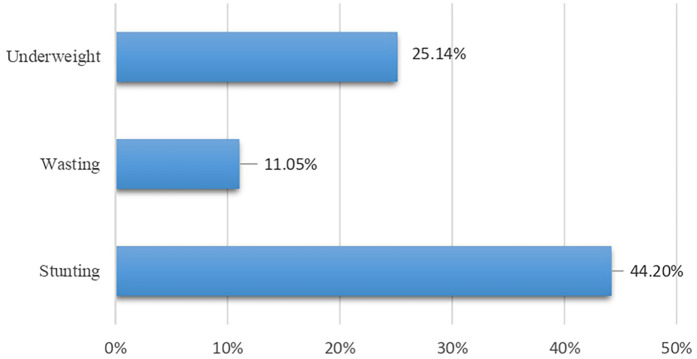
Results: The prevalence of stunting, wasting, and underweight among children aged 9-36 months was 44%, 11%, and 25%, respectively. Common predictors of stunting and underweight included low birth weight, short maternal stature, lack of maternal exposure to print media, and maternal consumption of iron-folic acid during pregnancy. A lack of maternal exposure to print media was also associated with wasting. In addition, stunting was linked to male sex and low maternal education, while underweight was associated with children from non-Hindu and non-Muslim religious backgrounds, and maternal lack of autonomy or control over household finances. Wasting, however, was associated with the 24-36 months age group and maternal gestational diabetes.
Conclusion: A high level of undernutrition was observed in the urban slums of Belagavi, with the prevalence of stunting exceeding the national and state averages. Undernutrition was linked to maternal, child, and household factors, including low birth weight, maternal stature, education, and autonomy.
Keywords: determinants; maternal factors; stunting; undernutrition; undernutrition in India; urban slums; wasting; young children.
© 2025 Oswal, Angolkar, Mahantashetti, Singh, Haritay and Godbole.
Conflict of interest statement
The authors declare that the research was conducted in the absence of any commercial or financial relationships that could be construed as a potential conflict of interest.
Figures
References
-
- World Health Organization. Levels and trends in child malnutrition: UNICEF/WHO/World Bank Group joint child malnutrition estimates: key findings of the 2023 edition. Available at: https://www.who.int/publications-detail-redirect/9789240073791 (Accessed February 21, 2024).
-
- Arora A. UNICEF DATA. 2020. Global Nutrition Report 2020. Available at: https://data.unicef.org/resources/global-nutrition-report-2020/ (Accessed July 27, 2024).
-
- World Health Organization. SDG Target 2.2 Malnutrition. Available at: https://www.who.int/data/gho/data/themes/topics/sdg-target-2_2-malnutrition (Accessed February 22, 2024).
-
- data.gov. Open Government Data (OGD) Platform India (2022). Available at: https://data.gov.in (Accessed February 22, 2024).
LinkOut - more resources
Full Text Sources
