


Effectiveness of Fatigue-Reducing Interventions in Pediatric Rheumatic Diseases: A Systematic Review
- PMID: 40438837
- PMCID: PMC12116829
- DOI: 10.7759/cureus.83056
Effectiveness of Fatigue-Reducing Interventions in Pediatric Rheumatic Diseases: A Systematic Review
Abstract
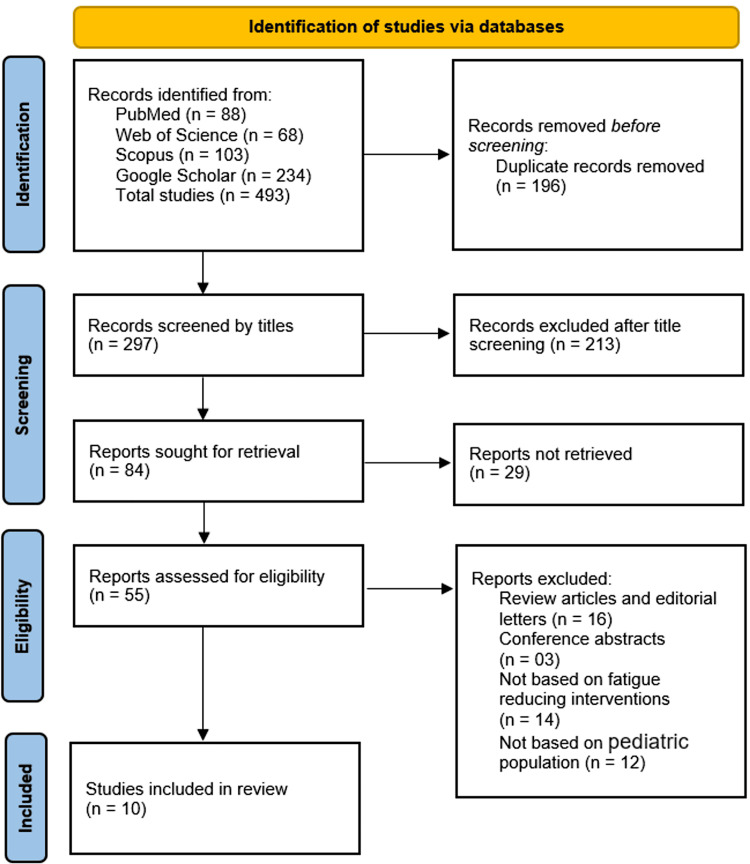
There are few intervention trials aimed at lowering fatigue in pediatric rheumatic conditions (PRCs), despite the fact that it is a common and upsetting symptom in these patients. The study's primary goal is to thoroughly examine the data pertaining to the effectiveness of treatments meant to lessen fatigue in PRC patients. We followed the Preferred Reporting Items for Systematic Reviews and Meta-Analyses (PRISMA) guidelines to search for relevant studies across four different databases (PubMed, Web of Science, Scopus, and Google Scholar). A total of 493 records were identified through database searches, and after removing 196 duplicates, 297 unique studies remained for screening. Following title screening and eligibility assessment, 45 studies were excluded for various reasons, and 10 studies met the inclusion criteria for this systematic review. The interventions included exercise treatment on land and in water, prednisolone, vitamin D and creatine supplements, psychological counseling, and a program for transitioning into a mature rheumatology program. Every included study measured fatigue using self-reported questionnaires. Two randomized controlled studies found land-based exercise treatment to be ineffective, while one pre-post intervention research found it to be useful. Compared to land-based exercise therapy, aquatic-based physical therapy was found to be more beneficial. Prednisolone combined with vitamin D significantly reduced subjective fatigue in two placebo-controlled trials. Creatine did not seem to be beneficial. The effectiveness of the present therapies to lessen fatigue in PRCs is not sufficiently supported by the available data. Future research should focus on intervention studies targeted at treating fatigue in adolescents and children with PRCs, as indicated by the small number of investigations, non-comparable therapies, risk of bias, and unclear outcomes of the included studies. It is necessary to identify potential underlying biological and psychological pathways as potential therapy targets in order to lessen fatigue symptoms in kids and teenagers with PRCs.
Keywords: adolescents; children; fatigue; interventions; pediatrics.
Copyright © 2025, Awad Abdu Alla et al.
Conflict of interest statement
Conflicts of interest: In compliance with the ICMJE uniform disclosure form, all authors declare the following: Payment/services info: All authors have declared that no financial support was received from any organization for the submitted work. Financial relationships: All authors have declared that they have no financial relationships at present or within the previous three years with any organizations that might have an interest in the submitted work. Other relationships: All authors have declared that there are no other relationships or activities that could appear to have influenced the submitted work.
Figures
References
-
- Clinical features and disease course of patients with juvenile dermatomyositis. Gowdie PJ, Allen RC, Kornberg AJ, Akikusa JD. Int J Rheum Dis. 2013;16:561–567. - PubMed
-
- Fatigue in patients with juvenile idiopathic arthritis: a systematic review of the literature. Armbrust W, Siers NE, Lelieveld OT, Mouton LJ, Tuinstra J, Sauer P. Semin Arthritis Rheum. 2016;45:587–595. - PubMed
-
- Making the diagnosis of systemic lupus erythematosus in children and adolescents. Tucker LB. Lupus. 2007;16:546–549. - PubMed
-
- Prevalence of severe fatigue among adolescents with pediatric rheumatic diseases. Nijhof LN, van de Putte EM, Wulffraat NM, Nijhof SL. Arthritis Care Res (Hoboken) 2016;68:108–114. - PubMed
-
- Physical activity for paediatric rheumatic diseases: standing up against old paradigms. Gualano B, Bonfa E, Pereira RM, Silva CA. Nat Rev Rheumatol. 2017;13:368–379. - PubMed
Publication types
LinkOut - more resources
Full Text Sources
Miscellaneous