Randomized Controlled Trial
. 2025 May 29;16(1):4989.
doi: 10.1038/s41467-025-60285-4.

Early mucosal responses following a randomised controlled human inhaled infection with attenuated Mycobacterium bovis BCG

Affiliations
Randomized Controlled Trial

Early mucosal responses following a randomised controlled human inhaled infection with attenuated Mycobacterium bovis BCG

Julia L Marshall et al. Nat Commun. .

Abstract

The development of an effective vaccine against Mycobacterium tuberculosis is hampered by an incomplete understanding of immunoprotective mechanisms. We utilise an aerosol human challenge model using attenuated Mycobacterium bovis BCG, in BCG-naïve UK adults. The primary endpoint of this study (NCT03912207) was to characterise the early immune responses induced by aerosol BCG infection, the secondary endpoint was to identify immune markers associated with in-vitro protection. Blinded volunteers were randomised to inhale 1 × 10⁷ CFU aerosolised BCG or 0.9% saline (20:6); and sequentially allocated to bronchoscopy at day 2 or 7 post-inhalation (10 BCG, 3 saline each timepoint). In the bronchoalveolar lavage post-aerosol BCG infection, there was an increase in frequency of eosinophils, neutrophils, NK cells and Donor-Unrestricted T cells at day 7, and the frequency of antigen presenting cells decreased at day 7 compared with day 2. The frequency of interferon-gamma+ BCG-specific CD4+ T cells increased in the BAL and peaked in the blood at day 7 post-BCG infection compared to day 2. BAL cells at day 2 and day 7 upregulated gene pathways related to phagocytosis, MHC-II antigen loading, T cell activation and proliferation. BCG's lack of key virulence factors and its failure to induce granulomas, may mean the observed immune responses do not fully recapitulate Mycobacterium tuberculosis infection. However, human infection models can provide unique insights into early immune mechanisms, informing vaccine design for complex pathogens.


Conflict of interest statement

Competing interests: The authors declare no competing interests.

Figures

Fig. 1
Fig. 1. CONSORT diagram of volunteer recruitment.
The first volunteers were screened on 19th March 2019 and enrolment commenced on 29th April 2019. The final volunteer was enrolled on 12th February 2020, and the last volunteer visit was 30th July 2020. Volunteers were randomised to receive either 1 × 10⁷ CFU aerosol BCG Danish (Group A) or aerosol saline (Group B) with a bronchoscopy at either Day 2 (D2; Group 1) or Day 7 (D7; Group 2) following inhalation. Volunteers were blinded to intervention. Reasons for exclusion during screening included blood dyscrasias, respiratory disease or poor baseline lung function, IGRA positivity.
Fig. 2
Fig. 2. Frequency of innate cells in BAL (upper panels) and whole blood (lower panels) post-BCG infection.
BAL post-BCG or saline inhalation, or blood post-BCG inhalation. Stained with Panel 1. A Eosinophils were defined as live singlets, Lin- (CD19, CD56, CD3), CD16- Siglec8+ and shown as % CD3- cells. BAL D7 control v BCG p = 0.03, BCG D2 v D7 p = 0.0007; after correction BCG D2 v D7 p = 0.01. Blood baseline to D2 p = 0.03, D56 p = 0.045. B Neutrophils were defined as live singlets, Lin- (CD19, CD56, CD3), CD16+ , CD66b+ . Shown as % CD3- cells. BAL D2 control v BCG p = 0.007, BCG D2 v D7 p = 0.009. Blood baseline to D7 p = 0.03, D14 p = 0.07, D28 p = 0.003, D56 p = 0.003. After Dunns correction D7 p = 0.02, D28 p = 0.03, D56 p = 0.02. C Antigen presenting cells (APCs) refer to macrophages, monocytes and dendritic cells and were defined as live singlets, CD19-CD3-CD56-CD66b- CD45+ and shown as % leucocytes, defined as live singlets, CD19-. BAL D7 control v BCG p = 0.003, BCG D2 v D7 p = 0.0007; after correction BCG D2 v D7 p = 0.002. Blood baseline to D14 p = 0.03, D28 p = 0.006. After Dunns correction D28 p = 0.01. D Natural Killer (NK) cells defined as CD19-, CD3-, CD56+ to identify the total NK cell population as % CD3- cells; or E CD16+ NK cells as % total NK cell population. BAL NK cells BCG D2 v D7 p < 0.0001, after correction p = 0.0009. BAL CD16+ NK cells D7 control v BCG p = 0.007, BCG D2 v D7 p = 0.02. After correction D7 control v BCG p = 0.01. Blood baseline to D2 p = 0.04. Differences in cell frequency between BAL groups were calculated using a two-sided Mann-Whitney and corrected with Dunns; and in the blood, differences between baseline samples and corresponding timepoints following BCG inhalation were calculated using a paired two-sided Wilcoxon signed rank test against baseline only and corrected with Dunns. Statistically significant differences are presented in the figure, red asterix indicates significant differences after Dunn’s correction. *p < 0.05, **p < 0.01, ***p < 0.001, ****p < 0.0001. See Supplementary Note 2 and source data for sample sizes per group. Source data are provided as a Source Data file. BAL: Black dots indicate BCG, grey squares saline control. Blood: Solid dots indicate Group 1 (D2 bronchoscopy) volunteers and circles represent Group 2 (D7 bronchoscopy) volunteers. Box and whisker plots show median, IQR and min/max.
Fig. 3
Fig. 3. Frequency of Donor Unrestricted T cells (DURTs) in BAL (upper panels) and blood (lower panels) post-BCG infection.
BAL post-BCG or saline inhalation or blood post-BCG inhalation stained with Panel 2 (γδ T cells and CD3+ CD56+ cells, whole blood) and Panel 3 (MAITs, iNKTs, CD161 + T cells, PBMCs). As Panel 3 was third priority, there were only sufficient BAL cells for three D2 BCG-infection and four D7 BCG-infection BAL samples to be stained for detection of MAIT, iNKT and CD161+ T cells. A MAITs defined as live singlets, CD19-, CD14-, CD3+ 5-OP-RU MR1 tetramer + , 6-FP control MR1 tetramer- (NIH Tetramer Core facility); and shown as % CD14-CD19- cells. B CD161+ T cells defined as live singlets, CD14- CD19- CD3 + CD161+ and shown as % CD14-CD19- cells. C γδ T cells were live singlets, CD19- CD14- CD3+ γδpan+ cells combined with live singlets, CD19- CD14- CD3 + γδ2+ cells. Expressed as % CD14- CD19- cells. BAL: BCG D2 v D7 p = 0.02; after correction p = 0.04. Blood: baseline to D7 p = 0.002. D iNKTs defined as live singlets, CD19- CD14- CD3+ , Vα24+ Vβ11+ CD56+ CD3+ cells and shown as % CD14-CD19- cells. Blood: baseline to D2 p = 0.03. E NKT-like CD3+ CD56+ cells defined as live singlets, CD19- CD14- CD3+ CD56+ cells and shown as % CD14- CD19- cells. BAL: BCG D2 v D7 p = 0.0001; after correction BCG D2 v D7 p = 0.0006. MAITs (F), CD161 + T cells (G) and iNKT cells (H) were further defined by CD4 CD8 subsets; median % parent. DN: double negative (CD4-CD8-) (FH BAL on upper panels and blood on lower panels). Differences in cell frequency between BAL groups were calculated using a two-sided Mann-Whitney and corrected with Dunn’s; and in the blood, differences between baseline samples and corresponding timepoints following BCG inhalation were calculated using a two-sided paired Wilcoxon signed rank test against baseline only and corrected with Dunn’s. Statistically significant differences are presented in the figure, red asterix indicates significant differences after Dunn’s correction. *p < 0.05, **p < 0.01, ***p < 0.001, ****p < 0.0001. See Supplementary Note 2 and source data for sample sizes per group. Source data are provided as a Source Data file. BAL: Black dots indicate BCG, grey squares saline control. Blood: Solid dots indicate Group 1 (D2 bronchoscopy) volunteers and circles represent Group 2 (D7 bronchoscopy) volunteers. Box and whisker plots show median, IQR and min/max.
Fig. 4
Fig. 4. T cells and antigen-specific responses in the BAL and blood post-BCG infection.
A BAL (upper panels) and whole blood (lower panels) cells (baseline, D2, D7, D14, D28, D56), Panel 2 staining. T cells (live singlets, CD19-, CD14-, CD3+ ); % Leucocytes (singlets, CD19-). (i) Total T cells; (ii) CD4 + T cells; (iii) CD8+ T cells; (iv) CD4-CD8- T cells (double negative, DN); (v) CD4+ CD8+ T cells (double positive, DP). (i) Total T cells: BAL BCG D2 v D7 p < 0.0001, after correction p = 0.0003; Blood baseline to D2 p = 0.003, after correction p = 0.03. (ii) CD4 + T cells: BAL BCG D2 v D7 p = 0.0016, after correction p = 0.003. (iii) CD8+ T cells: BAL D7 control v BCG p = 0.02, after correction p = 0.03; BCG D2 v D7 p = 0.02. (iv) DN T cells: BAL D7 control v BCG p = 0.04. (iv) CD4+ CD8+ cells: BAL D2 control v BCG p = 0.01; D7 control v BCG p = 0.009 after correction p = 0.02. BCG D2 v D7 p = 0.002, after correction p = 0.01. B BAL, Panel 2 or 4 staining. Antigen (BCG)-specific IFN-γ+ T-cells in (i) Total T cells; (ii) CD4+; (iii) CD8+; (iv) DN; or (v) CD4+ CD8+ T cells. Shown as % parent. (i+ii) Total and CD4 + T cells: BCG D2 v D7 p = 0.02 with correction p = 0.03. (v) CD4+ CD8+ T cells: D7 control v BCG p = 0.02, BCG D2 v D7 p = 0.03. C, D BCG-stimulated whole blood cells. Panel 2 or 4 staining. C Antigen (BCG)-specific IFN-γ+ (i), TNF-α+ (ii) or IL-2+ (iii) CD4+ T cells or CD8+ T cells. Shown as % parent. C (i) IFN-γ+ CD4+ T cells: D7 p = 0.03, D28 p = 0.03. IFN-γ+ CD8+ T cells: D28 p = 0.03. (iii) IL2+ CD4+ T cells: D28 p = 0.03, D56 p = 0.0002. IL2+ CD8+ T cells: D2 p = 0.03. D TNF-α+ BCG-reactive monocytes. D7 p = 0.004, D14 p = 0.02, D56 p = 0.003.  E Antigen (PPD)-specific IFN-γ ELISpot responses in fresh PBMCs. SFC = spot-forming cells. Different timepoints after BCG: Wilcoxon paired test, D7 p < 0.0001, D14 p = 0.0003, D28 p = 0.01, D56 p = 0.04; after correction, D7 p = 0.0008, D14 p = 0.003. BCG v control: Mann-Whitney, D2 p = 0.049, D7 p = 0.0006, D14 p = 0.04, D56 p = 0.01; after correction, D7 p = 0.001, D56 p = 0.04. Statistically significant differences are presented in the figure. BAL: Two-sided Mann-Whitney; blood: two-sided paired Wilcoxon against baseline. Red asterix indicates significant differences after correction (Dunns). *p < 0.05, **p < 0.01, ***p < 0.001, ****p < 0.0001. See Supplementary Note 2 and source data (provided as a Source Data file) for sample sizes. BAL: Black dots BCG, grey squares saline control. Blood: Solid dots Group 1 (D2 bronchoscopy), circles Group 2 (D7 bronchoscopy). Box and whisker plots show median, IQR and min/max, crosses show mean.
Fig. 5
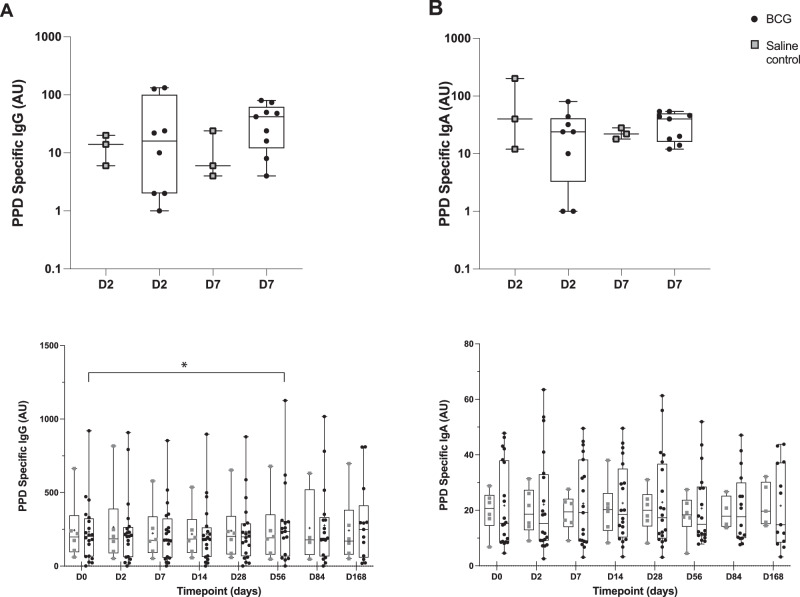
Fig. 5. Anti-PPD IgG and IgA antibodies in BAL (upper panel) and serum (lower panel) post-BCG infection.
Total IgG (A) and IgA (B) against Purified Protein Derivative (PPD) were measured using a standardised in-house indirect ELISA. Arbitrary units (AU). Statistically significant differences are presented in the figure. IgG serum: D56 p = 0.0155 two-sided Wilcoxon, no significance after Dunnett’s correction. See Supplementary Note 2 and source data (provided as a Source Data file) for sample sizes per group. Black dots indicate BCG, grey squares saline control. Box and whisker plots show median, IQR and min/max, crosses show mean.
Fig. 6
Fig. 6. Characterisation of BAL cell at D2 or D7 post-aerosol inhalation using single cell RNA sequencing.
A UMAP (Uniform manifold approximation and projection) plot showing the identity of each cell cluster. Distribution of cells by group. NK cell, γδ T cell, plasmacytoid DC (pDC), conventional DC (cDC), Migratory DC (McDc), Cilliated bronchial epithelial cell (CIBE), Secretory bronchial epithelial cell (ScBE), T regulatory cell (Treg), Proliferating cells (Prl), unidentified cell type (Unk), terminally differentiated effector memory cells re-expressing CD45RA-like CD8 + T cell (EMRA CD8), Naïve (Nv), Cytotoxic-like (Ctx), non-resident Macrophage (nrMo), Macrophage (Mo), Activated macrophage (AcMo). Source data are provided as a Source Data file. B Enriched blood transcriptomic modules (BTMs; red, enrichment of upregulated genes; blue, enrichment of downregulated genes) of differentially expressed genes (DEGs) were shown for each cell type on D2 and D7. The differential gene expression analysis was between BCG (D2 or D7) and Saline. One-sided (upper tail) hypergeometric test adjusted by Benjamini-Hochberg multiple testing correction was used to test the enrichment of each gene set. Source data are provided as a Source Data file. C The T1-T17 subpopulation 1 score, subpopulation 2 score, PPD-response score in T and NK cell populations following aerosol saline or BCG challenge. Two-sided Dunn’s test adjusted by Benjamini-Hochberg multiple testing correction was used to compare the score of each cell type at time points post-aerosolised BCG challenge to that in saline controls. Bars show medians with interquartile ranges (IQR). The upper whisker extends to the largest value no further than 1.5 × IQR from the hinge. The lower whisker extends from the hinge to the smallest value at most 1.5 × IQR from the hinge. N = 6, 3, 3 biologically independent samples for Saline, D2 BCG, D7 BCG, respectively. Source data are provided as a Source Data file.

References

    1. Lobo, N. et al. 100 years of bacillus calmette–guérin immunotherapy: from cattle to COVID-19. Nat. Rev. Urol.18, 611–622 (2021). - PMC - PubMed
    1. Schrager, L. K. et al. WHO preferred product characteristics for new vaccines against tuberculosis. Lancet Infect. Dis.18, 828–829 (2018). - PubMed
    1. McShane, H. & Williams, A. A review of preclinical animal models utilised for TB vaccine evaluation in the context of recent human efficacy data. Tuberculosis (Edinb.)94, 105–110 (2014). - PMC - PubMed
    1. Darrah, P. A. et al. Prevention of tuberculosis in macaques after intravenous BCG immunization. Nature577, 95–102 (2020). - PMC - PubMed
    1. Fletcher, H. A. & Dockrell, H. M. Human biomarkers: can they help us to develop a new tuberculosis vaccine?. Future Microbiol11, 781–787 (2016). - PubMed

Publication types

MeSH terms