Review
. 2025 Oct;27(6):975-989.
doi: 10.1111/plb.70057. Epub 2025 May 29.

Factors determining chromosomal localization of transposable elements in plants

Affiliations
Review

Factors determining chromosomal localization of transposable elements in plants

E Kejnovsky et al. Plant Biol (Stuttg). 2025 Oct.

Abstract

Transposable elements (TEs) constitute a significant part of plant genomes and shape their genomic landscape. While some TEs are ubiquitously dispersed, other elements specifically occupy discrete genomic loci. The evolutionary forces behind the chromosomal localization of TEs are poorly understood. Therefore, we first review specific chromosomal niches where TEs are often localized including (i) centromeres, (ii) (sub)telomeres, (iii) genes, and (iv) sex chromosomes. In the second part of this review, we focus on the processes standing behind non-equal distribution of various TEs in genomes including (i) purifying selection, (ii) insertion site preference or targeting of TEs, (iii) post-insertion ectopic recombination between TEs, and (iv) spatiotemporal regulation of TE jumping. Using the combination of the above processes, we explain the distribution of TEs on sex chromosomes. We also describe the phenomena of mutual nesting of TEs, epigenetic mark silencing in TEs, and TE interactions in the 3D interphase nucleus concerning TE localization. We summarize the functional consequences of TE distribution and relate them to cell functioning and genome evolution.

Keywords: Centromere; chromosomes; plant genome; recombination; transcription factor; transposable elements.


Conflict of interest statement

On behalf of all authors, the corresponding author states that there is no conflict of interest.

Figures

Fig. 1
Fig. 1
Contrasting patterns of transposable elements chromosomal localization by FISH in dioecious model plant Silene latifolia, possessing XY chromosomes. (a) centromeric localization of CRM centromeric LTR retrotransposon (green), (b) subtelomeric localization of Retand LTR retrotransposon (red), (c) accumulation of Athila retrotransposon (red) on the Y chromosome, (d) absence of Ogre LTR retrotransposon (red) on the non‐recombining Y chromosome, Subtelomeric satellite X43.1 is in green (b,d) or red (a).
Fig. 2
Fig. 2
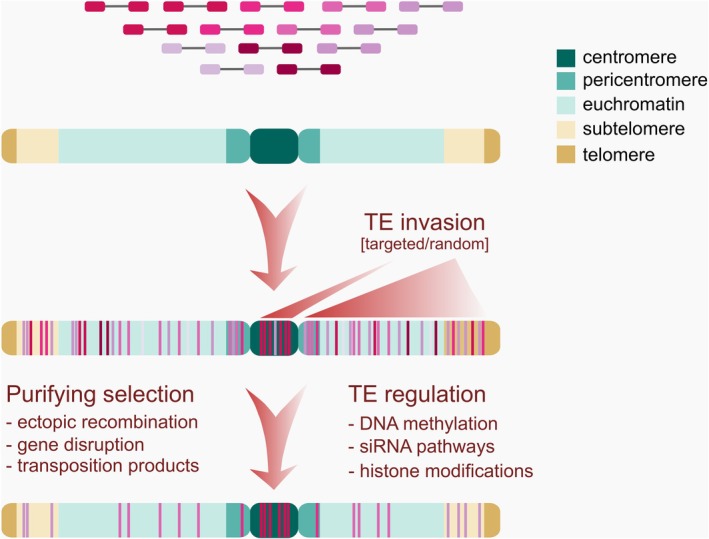
Reasons of transposable elements gathering in specific chromosomal niches. TEs are either randomly inserted along the whole chromosome but are later retained only in specific niches, or TEs are targeted into centromeres and therefore are localized only in these chromosomal niches.
Fig. 3
Fig. 3
Removal of LTR retrotransposons by ectopic recombination. (a) Intrachromosomal ectopic recombination leaving behind a soloLTR and circular molecules in TE copies located on the same chromatid. (b) Intermolecular ectopic recombination of copies in different chromosomes resulting in soloLTRs and tandemly arranged TEs.
Fig. 4
Fig. 4
Possible mechanisms of sex‐specific retrotransposon jumping. (a) Simplified representation of TE distribution on heteromorphic non‐recombining sex chromosomes when a single TE lineage is shown in isolation. Left—insertion density of a TE lineage that is active maternally (red strips). Right—insertion density of a paternally active TE lineage (blue strips; adapted from Hobza et al. 2017). (b) TE lineages may not be silenced equally by epigenetic mechanisms. The figure shows a general scheme of epigenetic defence against TEs reactivated by epigenetic genome reprogramming in plant germlines and gametophytes. Vegetative cell of pollen grain with relaxed epigenetic silencing is a source of TE transcripts that are processed into siRNA molecules. The siRNAs move to sperm cells and ensure TE silencing. Similarly in female gametophyte, siRNAs are produced in the central cell of embryo sac, endosperm and seed coats. After relocalization into the egg cell and embryo, siRNAs ensure TE silencing (adapted from Law & Jacobsen 2010). (c) Colocalization of a TE master copy with sex‐biased gene can trigger sex‐specific bursts of activity. (d) Spatiotemporal regulation of TE transcription by transcription factors (TFs) may lead to either paternal or maternal proliferation. The diverse TE lineages contain binding sites for tissue‐specific TFs in their LTRs (Horvath et al. 2024). Depending on the identity of the TFs, TEs may be transcriptionally activated only transiently in certain cell types, eg. male or female sexual organs. The new genomic copies of TEs are then passed to the progeny via gametes. Different lineages of TEs are likely to preferentially use either male or female organs for their proliferation.

References

    1. Aguilar M., Prieto P. (2020) Sequence analysis of wheat subtelomeres reveals a high polymorphism among homoeologous chromosomes. Plant Genome, 13, e20065. 10.1002/tpg2.20065 - DOI - PubMed
    1. Ahmed H.I., Heuberger M., Schoen A., Koo D.H., Quiroz‐Chavez J., Adhikari L., Raupp J., Cauet S., Rodde N., Cravero C., Callot C., Lazo G.R., Kathiresan N., Sharma P.K., Moot I., Yadav I.S., Singh L., Saripalli G., Rawat N., Datla R., Athiyannan N., Ramirez‐Gonzalez R.H., Uauy C., Wicker T., Tiwari V.K., Abrouk M., Poland J., Krattinger S.G. (2023) Einkorn genomics sheds light on history of the oldest domesticated wheat. Nature, 620, 830–838. 10.1038/s41586-023-06389-7 - DOI - PMC - PubMed
    1. Aiewsakun P., Katzourakis A. (2017) Marine origin of retroviruses in the early Palaeozoic era. Nature Communications, 8, 13954. 10.1038/ncomms13954 - DOI - PMC - PubMed
    1. Almeida M.V., Vernaz G., Putman A.L.K., Miska E.A. (2022) Taming transposable elements in vertebrates: from epigenetic silencing to domestication. Trends in Genetics, 38, 529–553. 10.1016/j.tig.2022.02.009 - DOI - PubMed
    1. Arkhipova I.R. (2006) Distribution and phylogeny of penelope‐like elements in eukaryotes. Systematic Biology, 55, 875–885. 10.1080/10635150601077683 - DOI - PubMed

MeSH terms

Substances

LinkOut - more resources