. 2025 May 8;13(2):156-169.
doi: 10.1515/jtim-2025-0020. eCollection 2025 Apr.

Nano particle loaded EZH2 inhibitors: Increased efficiency and reduced toxicity for malignant solid tumors

Affiliations

Nano particle loaded EZH2 inhibitors: Increased efficiency and reduced toxicity for malignant solid tumors

Yunyun Guo et al. J Transl Int Med. .

Abstract

Background and objectives: Aberrant upregulation or mutations of EZH2 frequently occur in human cancers. However, the clinical benefits of EZH2 inhibitors (EZH2i) remain unsatisfactory for majority of solid tumors. Therefore, there is an urgent need to develop new strategies to expand the therapeutic benefits of EZH2i. Nanocarriers have gained increased attention due to their advantages of prolonged blood circulation, enhanced cellular uptake, and active targeting capabilities. This study aims to address the challenges of EZH2i GSK126's limited efficacy and severe adverse effects against solid tumors.

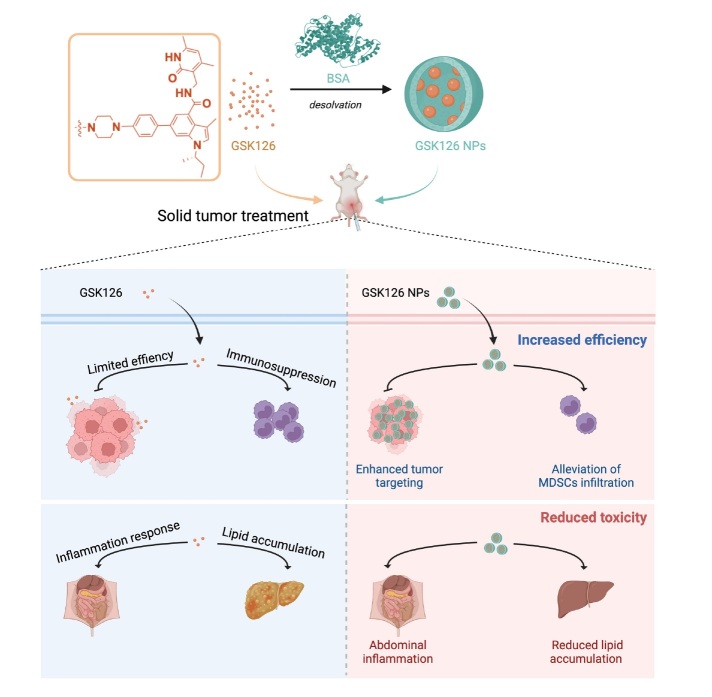
Methods: A nano delivery system was developed by encapsulating GSK126 within albumin nanoparticles (GSK126 NPs).

Results: The prepared GSK126 NPs exhibited a small spherical core with an average diameter of 30.09 nm ± 1.55 nm, high drug loading capacity (16.59% ± 2.86%) and good entrapment efficiency (99.53% ± 0.208%). GSK126 NPs decreased tumor weight and volume in the B16F10 xenograft mice, while such effects were not observed in the free GSK126 group. Subsequently, histological analysis demonstrated that GSK126 NPs significantly alleviated lipid-associated liver toxicity. Additionally, GSK126 NPs can partially counteract the effects of GSK126 on MDSCs, particularly by decreasing the infiltration of M-MDSCs into tumors.

Conclusions: Albumin-based EZH2i NPs have potent anti-cancer efficacy with tolerable adverse effects, providing promising opportunity for future clinical translation in treating solid tumors.

Keywords: EZH2 inhibitors; epigenetics; nanocarriers; solid tumors.


Figures

None
Graphical abstract
Figure 1
Figure 1
Efficacy of EZH2 inhibitor GSK126 in solid tumors. (A) Cell proliferation of B16F10, 4T1 and MC38 cells in GSK126 (10-16 μmol/L) treatment monitored by IncuCyte S3. Mean ± SEM is shown (n = 6). (B) Images, (C) tumor growth curve, and (D) tumor weight of mice bearing B16F10 in the vehicle group (n = 6) and GSK126 (50 mg/kg) treatment group (n = 6). (E) Images, (F) tumor growth curve, and (G) tumor weight of mice carrying 4T1 in the vehicle group (n = 6) and GSK126 (50 mg/kg) treatment group (n = 7). (H) Images, (I) tumor growth curve, and (J) tumor weight of mice carrying MC38 in the vehicle group (n = 5) and GSK126 (50 mg/kg) treatment group (n = 5). Tumor volume was measured with a vernier caliper every 2–3 days. Tumor volume = Length × Width × Width / 2. Tumor weights were measured at day 15. (K) Body weight of B16F10, 4T1, and MC38 xenograft mice. (L) Oil Red O staining of liver sections in B16F10 tumor-bearing mice of Vehicle and GSK126 treatment group. Data in (D), (G) and (J) were analyzed by one-way ANOVA with Tukey multiple comparison posttest. ns, nonsignificant, *P < 0.05.
Figure 2
Figure 2
(A) Enrichment plots generated by Gene Set Enrichment Analysis (GSEA) for gene ontology chemokine production genes (left) and hit genes expression in heat map (right), n = 3. (B) Enrichment plots generated by GSEA for gene ontology cytokine production. (C) Enrichment plots generated by GSEA for signaling pathways probably related to cytokine production. (D) Volcano plot of differential expressed genes between GSK126-treated cells and vehicle (UP, red color indicating log2 Fold Change > 1.0 and adjust P value < 0.05; DOWN, blue color indicating Log2 Fold Change < -1.0 and adjust P value < 0.05; other genes are colored in grey. (E) Enrichment plots generated by GSEA for signaling pathways probably related to chemokine production. (F) Enrichment plots generated by GSEA for glycerolipid metabolism.
Figure 3
Figure 3
Morphological and physical characterizations of GSK126 NPs. (A) UV spectrum of BSA, GSK126, and GSK126 NPs. (B-C) The size and surface charge of GSK126 NPs were determined by dynamic light scattering using Zetasizer Nano ZS. (D) Surface morphology of GSK126 NPs was determined by TEM. (E) The intracellular localization of Cou NPs was examined by confocal microscope, and Cou was used as a model fluorescent dye. (F) Flow cytometry analysis of the cellular uptake of Cou NPs.
Figure 4
Figure 4
Effects of GSK126 NPs on reducing side effects and increasing efficacy. (A) Images, (B) tumor growth curve, (C) tumor weight, (D) body weight and (E) Oil Red O staining of liver sections of mice carrying B16F10 in the control group (n = 7), GSK126 (50 mg/kg) treatment group (n = 7) and GSK126 NPs (50 mg/kg) treatment group (n = 7). Tumor volume was measured with a vernier caliper every 2 days. Tumor volume = Length × Width× Width / 2. Tumor weights were measured at day 12 after engraftment. Data were analyzed by one-way ANOVA with Tukey multiple comparison posttest. ns, nonsignificant, *P < 0.05, **P < 0.01.
Figure 5
Figure 5
GSK126 NPs affect the generation and infiltration of MDSCs. (A) Gating strategy for CD3+ and MDSCs in flow cytometry. (B-D) Proportions of CD3+ T lymphocytes and CD11b+ myeloid cells among CD45+ leukocytes in (B) peripheral blood, (C) spleen, and (D) tumor. (E-F) Effects of vehicle control, free GSK126, and GSK126 NPs on M-MDSCs, PMN-MDSCs, and total MDSCs in peripheral blood. (G-H) Effects of vehicle control, free GSK126, and GSK126 NPs on M-MDSCs, PMN-MDSCs, and total MDSCs in spleen. (I-J) Effects of vehicle control, free GSK126, and GSK126 NPs on M-MDSCs, PMN-MDSCs, and total MDSCs in tumor-infiltrating cells. ns: nonsignificant, *P < 0.05, **P < 0.01, ***P < 0.001.

References

    1. Margueron R, Reinberg D. The Polycomb complex PRC2 and its mark in life. Nature. 2011;469:343. - - PMC - PubMed
    1. Laugesen A, Højfeldt JW, Helin K. Molecular mechanisms directing PRC2 recruitment and H3K27 methylation. Mol Cell. 2019;74:8. - - PMC - PubMed
    1. Blackledge NP, Klose RJ. The molecular principles of gene regulation by polycomb repressive complexes. Nat Rev Mol Cell Biol. 2021;22:815. - - PMC - PubMed
    1. Zhang T, Gong Y, Meng H, Li C, Xue L. Symphony of epigenetic and metabolic regulation-interaction between the histone methyltransferase EZH2 and metabolism of tumor. Clin Epigenetics. 2020;12:72. - PMC - PubMed
    1. Lee TI, Jenner RG, Boyer LA, Guenther MG, Levine SS, Kumar RM. Control of developmental regulators by Polycomb in human embryonic stem cells. Cell. 2006;125:301. et al . - - PMC - PubMed

LinkOut - more resources