


The improvement path of depression and anxiety among adult women in Shanxi Province, China: a fuzzy-set qualitative comparative analysis
- PMID: 40443923
- PMCID: PMC12119263
- DOI: 10.3389/fpubh.2025.1531431
The improvement path of depression and anxiety among adult women in Shanxi Province, China: a fuzzy-set qualitative comparative analysis
Abstract
Background: Depression and anxiety (D&A) are currently recognized as complex and prevalent mental disorders that pose major threats to mental health. Women are more susceptible to D&A than men.
Methods: We collected data from female participants in Shanxi Province between November 2021 and March 2022 through on-site investigations and an online survey. The survey collected information on sociodemographic traits, lifestyle factors, and physical and mental health. The degree of D&A was evaluated using the Center for Epidemiological Studies Depression Scale (CESD-10) and the Generalized Anxiety Disorder Assessment Scale (GAD-7). We assessed the impact of these factors on D&A symptoms among women using regression and fuzzy-set qualitative comparative analysis (fsQCA).
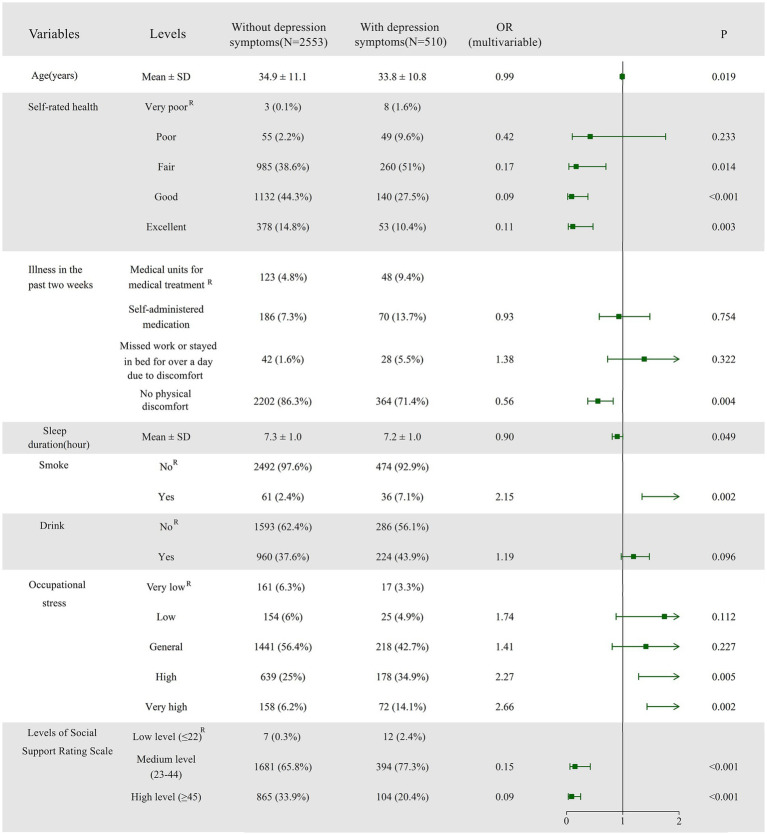
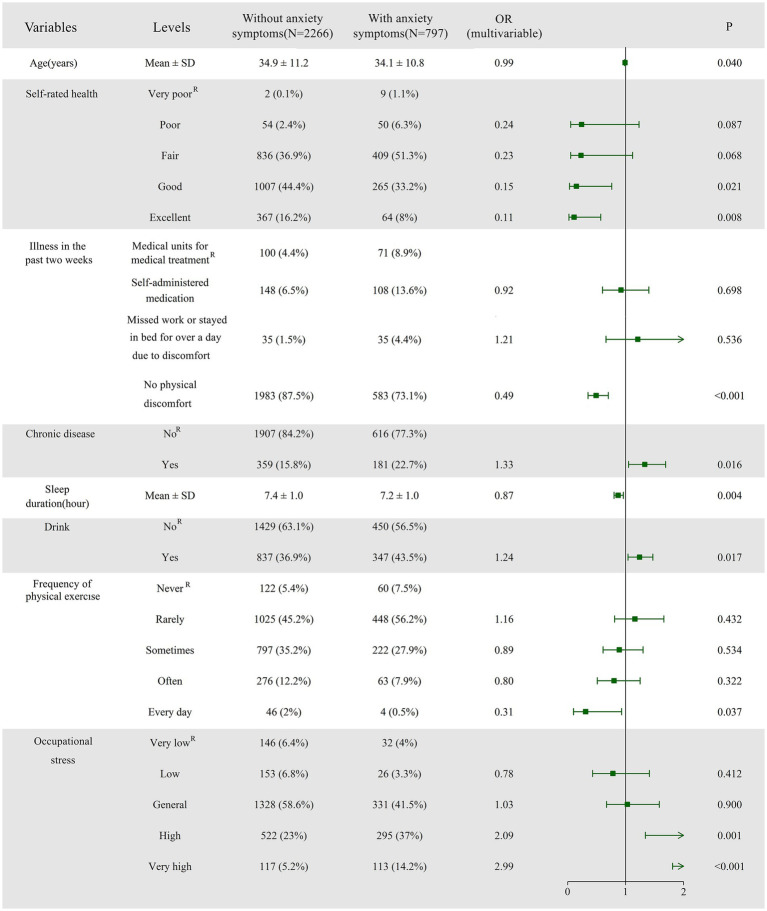
Results: D&A symptoms had many common influencing factors. Regression analysis identified key protective factors against D&A, including better self-rated health (Depression: OR = 0.11, 95% CI = 0.03-0.47; Anxiety: OR = 0.11, 95% CI = 0.02-0.57) and the absence of recent illness (Depression: OR = 0.56, 95% CI = 0.38-0.83; Anxiety: OR = 0.49, 95% CI = 0.35-0.70). Age exhibited marginal protective effects for both conditions (OR = 0.99, 95% CI = 0.98-1.00). In contrast, occupational stress constituted a significant risk factor, substantially increasing the likelihood of depression (OR = 2.66, 95% CI = 1.43-4.96) and anxiety (OR = 2.99, 95% CI = 1.43-4.96). FsQCA analysis did not identify the conditions for ideal mental health (all consistency < 0.9). However, it did identify eight condition configurations predicting mental health (absence of depression symptoms), each achieving consistency ≥0.87. Additionally, two distinct configurations explained resilience to anxiety (consistency ≥0.80). All configurations met fsQCA's consistency requirements, with self-rated health (present in 10/10 pathways), social support (9/10), and marital status (9/10) playing important roles in most configurations.
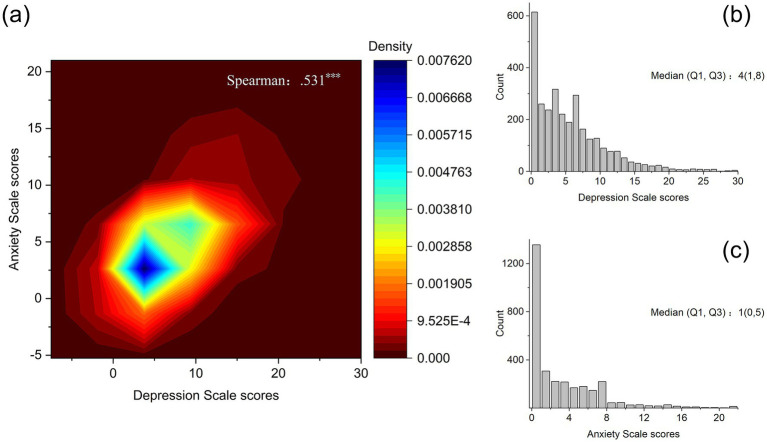
Conclusion: Women's mental health faces significant challenges, with D&A being closely intertwined. FsQCA did not identify any specific condition for the absence of D&A symptoms. However, it revealed multiple pathways to mental well-being, highlighting the need for personalized, multifactorial interventions rather than a one-size-fits-all approach. Regression and fsQCA complement each other, offering unique strengths, and their combined insights should be widely applied to broader research and practice.
Keywords: adult women; anxiety; depression; fuzzy-set qualitative comparative analysis; regression.
Copyright © 2025 Wu, Zeng, Cheng, Liu, Li, Qin, He and Feng.
Conflict of interest statement
The authors declare that the research was conducted in the absence of any commercial or financial relationships that could be construed as a potential conflict of interest.
Figures
Similar articles
-
Revealing the complexity of depression configurations in HIV-positive men who have sex with men: a fuzzy-set qualitative comparative analysis.BMC Public Health. 2025 May 14;25(1):1769. doi: 10.1186/s12889-025-22951-6. BMC Public Health. 2025. PMID: 40369556 Free PMC article.
-
Prevalence of and Risk Factors Associated With Mental Health Symptoms Among the General Population in China During the Coronavirus Disease 2019 Pandemic.JAMA Netw Open. 2020 Jul 1;3(7):e2014053. doi: 10.1001/jamanetworkopen.2020.14053. JAMA Netw Open. 2020. PMID: 32609353 Free PMC article.
-
The path of depression in rural children: A fuzzy-set qualitative comparative analysis across multiple provinces in China.J Affect Disord. 2024 Nov 15;365:237-245. doi: 10.1016/j.jad.2024.08.095. Epub 2024 Aug 22. J Affect Disord. 2024. PMID: 39173922
-
A community-based cross-sectional study of sleep quality among internal migrant workers in the service industry.Compr Psychiatry. 2020 Feb;97:152154. doi: 10.1016/j.comppsych.2019.152154. Epub 2019 Dec 16. Compr Psychiatry. 2020. PMID: 31884329
-
Smoking cessation for improving mental health.Cochrane Database Syst Rev. 2021 Mar 9;3(3):CD013522. doi: 10.1002/14651858.CD013522.pub2. Cochrane Database Syst Rev. 2021. PMID: 33687070 Free PMC article.
References
-
- Javaid SF, Hashim IJ, Hashim MJ, Stip E, Samad MA, Ahbabi AA. Epidemiology of anxiety disorders: global burden and sociodemographic associations. Middle East Current Psychiatry. (2023) 30:44. doi: 10.1186/s43045-023-00315-3 - DOI
Publication types
MeSH terms
LinkOut - more resources
Full Text Sources
Medical
Miscellaneous
