. 2025 May 30;11(22):eadt8916.
doi: 10.1126/sciadv.adt8916. Epub 2025 May 30.

Development of enhanced HIV-1 non-nucleoside reverse transcriptase inhibitors with improved resistance and pharmacokinetic profiles

Affiliations

Development of enhanced HIV-1 non-nucleoside reverse transcriptase inhibitors with improved resistance and pharmacokinetic profiles

Zhao Wang et al. Sci Adv. .

Abstract

HIV-1 infection is a manageable chronic condition, with non-nucleoside HIV-1 reverse transcriptase inhibitors (NNRTIs) remaining a cornerstone of antiretroviral therapy. Nevertheless, drug resistance to existing therapeutics is a serious and immediate concern. Using structure-based and scaffold-hopping approaches, we designed evolved diarylpyrimidine analogs targeting reverse transcriptase (RT), exploiting chemical space surrounding the NNRTI-binding pocket. We identified compounds 5i3 and 5e2, with robust antiviral efficacy against wild-type HIV-1 and rilpivirine-resistant strains. Encouragingly, in vitro selection of mutant strains with 5i3 took 39 passages to select resistance, with no phenotypic cross-resistance observed with known RT drugs. Co-crystal structures of wild-type and mutant RT with 5i3 and 5e2 revealed their resilience toward resistance mutations due to enhanced conformational flexibility and positional adaptability. 5i3 exhibited good pharmacokinetic properties and favorable safety profiles, without substantial cytochrome P450 inhibition, and excellent oral bioavailability. These derivatives represent a promising scaffold for the development of anti-HIV drugs.


Figures

Fig. 1.
Fig. 1.. Rational design of DAPY-evolved derivatives as potent HIV-1 inhibitors.
(A) Chemical structures of the FDA-approved NNRTIs etravirine (ETR) and rilpivirine (RPV) and the lead compounds K-5a2 and 25a. (B) Illustration of the structure-based design strategy and molecular optimization campaign of DAPY-evolved derivatives in this work.
Fig. 2.
Fig. 2.. Biological activity evaluation results of the designed compounds.
(A) Anti–HIV-1 (WT) activity of series 5a. (B) Anti–HIV-1 (WT) activity of series 5b–e, 5g, and 5h. (C) Anti–HIV-1 (WT) activity of series 5f and 5i. (D) Kinetics of resistance development for the HIV-1 (IIIB) following selective pressure with compounds 5e2 and 5i3. HIV-1 (IIIB) was cultured in MT-4 cells for 39 passages in the presence of increasing compound concentrations.
Fig. 3.
Fig. 3.. Polder OMIT maps for each ligand in either the WT RT or GH9 RT complexes.
(A) Polder OMIT maps for WT RT/5i3 (1.99-Å resolution) and WT RT/5e2 (2.18-Å resolution). (B) Polder OMIT maps for GH9 RT/5i3 (2.36-Å resolution) and GH9 RT/5e2 (2.15-Å resolution). All maps are shown at a contour of 3.0σ.
Fig. 4.
Fig. 4.. Interactions of WT RT and GH9 RT with bound inhibitors.
(A) Co-crystal structures of 5i3 (yellow ball and stick) and WT RT (green sticks). (B) Co-crystal structures of 5e2 (violet ball and stick) and WT RT (green sticks). (C) Co-crystal structures of 5i3 (yellow ball and stick) and GH9 RT (red sticks). (D) Co-crystal structures of 5e2 (violet ball and stick) and GH9 RT (red sticks). Hydrogen bonds are indicated by blue lines and waters are shown as red spheres.
Fig. 5.
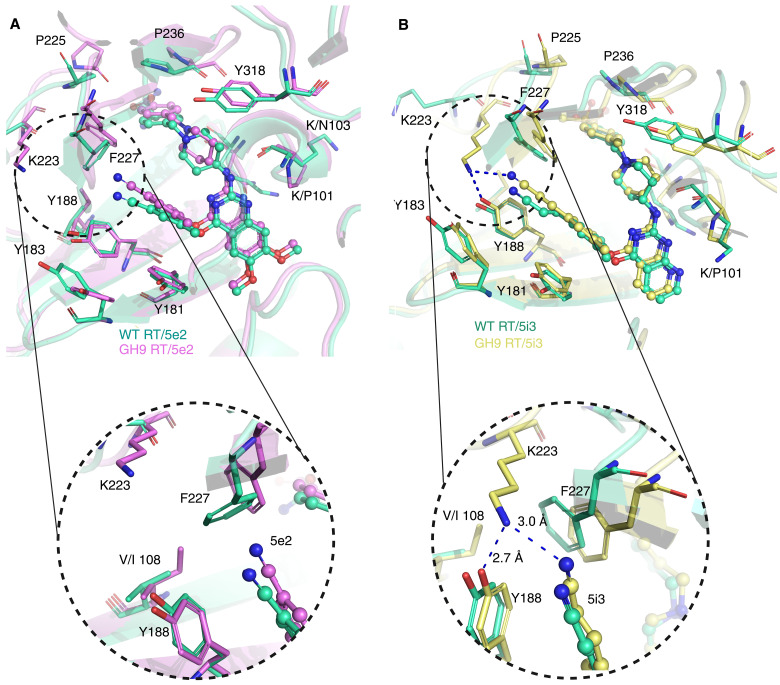
Fig. 5.. Superposition of WT and K101P/K103N/V108I (GH9) RT complexes illustrate rearrangements of the NNIBP to overcome resistance mutations.
(A) WT RT bound to 5e2 (pale green) superposed onto GH9 RT bound to 5e2 (violet). (B) WT RT bound to 5i3 (pale green) superposed onto GH9 RT bound to 5i3 (pale yellow). Zoomed-in regions are shown at the bottom of the image. Hydrogen bonds are shown as blue sticks, and hydrophobic interactions are shown as yellow dashes.
Fig. 6.
Fig. 6.. Preliminary drug-like profiles evaluation of compound 5i3.
(A) Inhibitory activity of compound 5i3 against the hERG potassium channel in the CHO-hERG cell. (B) Body weights of all Kunming mice in the 5i3 administration group and the vehicle control group during the acute toxicity assay. (C) Plasma concentration–time curve of 5i3 following oral administration (20 mg/kg po) and intravenous administration (2 mg/kg iv) in Sprague-Dawley rats.

References

    1. The Lancet HIV , UNAIDS strategy aligns HIV priorities with development goals. Lancet HIV 8, e245 (2021). - PubMed
    1. Fauci A. S., Lane H. C., Four decades of HIV/AIDS—Much accomplished, much to do. N. Engl. J. Med. 383, 1–4 (2020). - PubMed
    1. Beyrer C., Pozniak A., HIV drug resistance—An emerging threat to epidemic control. N. Engl. J. Med. 377, 1605–1607 (2017). - PubMed
    1. Li M., Oliveira Passos D., Shan Z., Smith S. J., Sun Q., Biswas A., Choudhuri I., Strutzenberg T. S., Haldane A., Deng N., Li Z., Zhao X. Z., Briganti L., Kvaratskhelia M., Burke T. R. Jr., Levy R. M., Hughes S. H., Craigie R., Lyumkis D., Mechanisms of HIV-1 integrase resistance to dolutegravir and potent inhibition of drug-resistant variants. Sci. Adv. 9, eadg5953 (2023). - PMC - PubMed
    1. Engelman A., Cherepanov P., The structural biology of HIV-1: Mechanistic and therapeutic insights. Nat. Rev. Microbiol. 10, 279–290 (2012). - PMC - PubMed

MeSH terms

Substances