


How policy entrepreneurs solve local health problems in the global South: an exploratory study
- PMID: 40446089
- PMCID: PMC12360174
- DOI: 10.1093/heapol/czaf033
How policy entrepreneurs solve local health problems in the global South: an exploratory study
Abstract
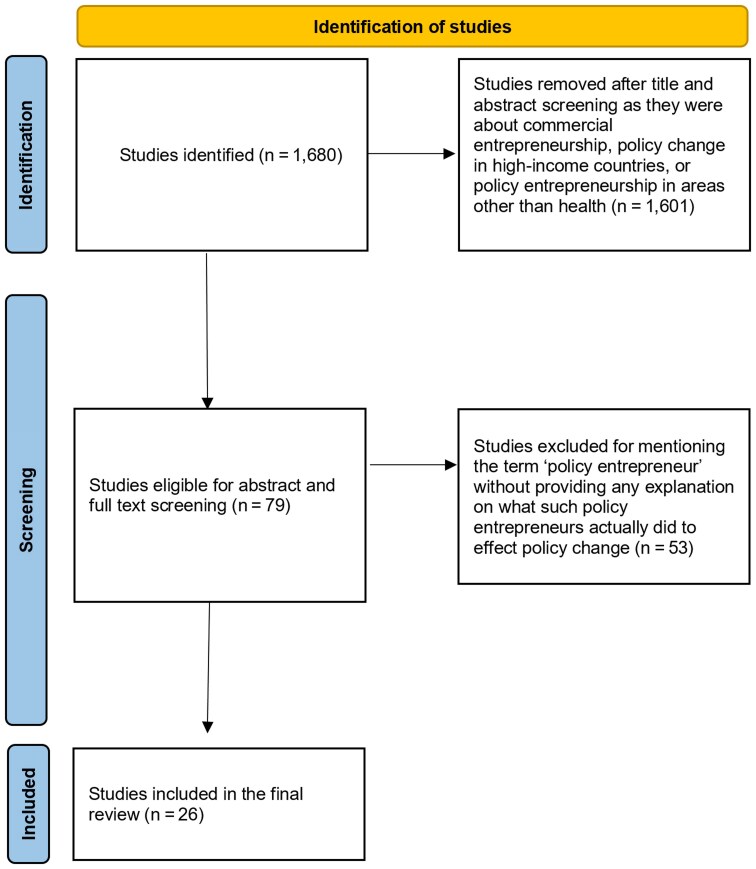
The presence, absence, or effectiveness of policy entrepreneurs is often invoked as an explanation for the state of health policy making, especially in the global South. However, much remains under-analyzed about their structure and function. This qualitative study aims to understand how policy entrepreneurs influence policy change in the global South. We complemented a review of the literature (26 papers) with key informant interviews of seven policy entrepreneurs from Zimbabwe. We used an adapted framework with four elements of policy entrepreneurship to frame the analysis: displaying social acuity, defining problems, building teams, and leading by example. Our analysis showed that policy entrepreneurship exists amongst high-level elites and low-level actors. Local policy entrepreneurs tend to exhibit high levels of social acuity to define context-relevant problems and devise holistic solutions. They define situations as problems through comparison with desirable states of affairs, emphasizing the failure of current policies and interpreting data as crises. They achieve team building by constantly re-framing problems to expand policy portrayals and increase the number of people mobilized around the problem. Displaying social acuity stands out as highly consequential for policy entrepreneurship, as it helps in defining problems in a way that resonates with other actors and in mobilizing teams to take collective action. Local policy entrepreneurs lead by example as they implement and demonstrate the workability of their solutions, ultimately proving to be key actors in tackling pervasive and oft-marginalized health problems. That underscores the need to value local ideas as opposed to preference for those that are influenced by global movements. Systematic programmes-such as establishing policy institutes in the global South-should be set up to drive such processes and to, more broadly, support local policy entrepreneurship, including through the formal training of actors in policy sciences.
Keywords: building teams; global South; leading by example; policy entrepreneurship; problem definition; social acuity.
© The Author(s) 2025. Published by Oxford University Press in association with The London School of Hygiene and Tropical Medicine.
Conflict of interest statement
Conflict of interest: None declared.
Figures
References
-
- Arksey H, O'Malley L. Scoping studies: towards a methodological framework. Int J Soc Res Methodol 2005;8:19–32. 10.1080/1364557032000119616 - DOI
MeSH terms
LinkOut - more resources
Full Text Sources
Medical
