


Symptoms and pathophysiology of post-acute sequelae following COVID-19 (PASC): a cohort study
- PMID: 40449327
- PMCID: PMC12166779
- DOI: 10.1016/j.ebiom.2025.105792
Symptoms and pathophysiology of post-acute sequelae following COVID-19 (PASC): a cohort study
Abstract
Background: Several studies reported long-term consequences of severe COVID-19. However, pathophysiological mechanisms of Post-Acute Sequelae following COVID-19 (PASC) in patients with mild acute COVID-19 have been less investigated. Specifically, the link between PASC and immuno-inflammatory abnormalities is inconsistent in the literature. The hypothesis that different pathophysiological mechanisms could explain the persistent symptoms needs to be explored.
Methods: The COPER cohort is a prospective study that included participants with PASC and with a history of COVID-19 without persistent symptoms. None were hospitalised for COVID-19. Participants underwent two home visits six months apart for biological sample collection and completed questionnaires on medical history, infection, vaccination, symptoms, and mental health. The study analysed association between persistent symptoms and 14 blood biomarkers, comparing participants with PASC with recovered participants.
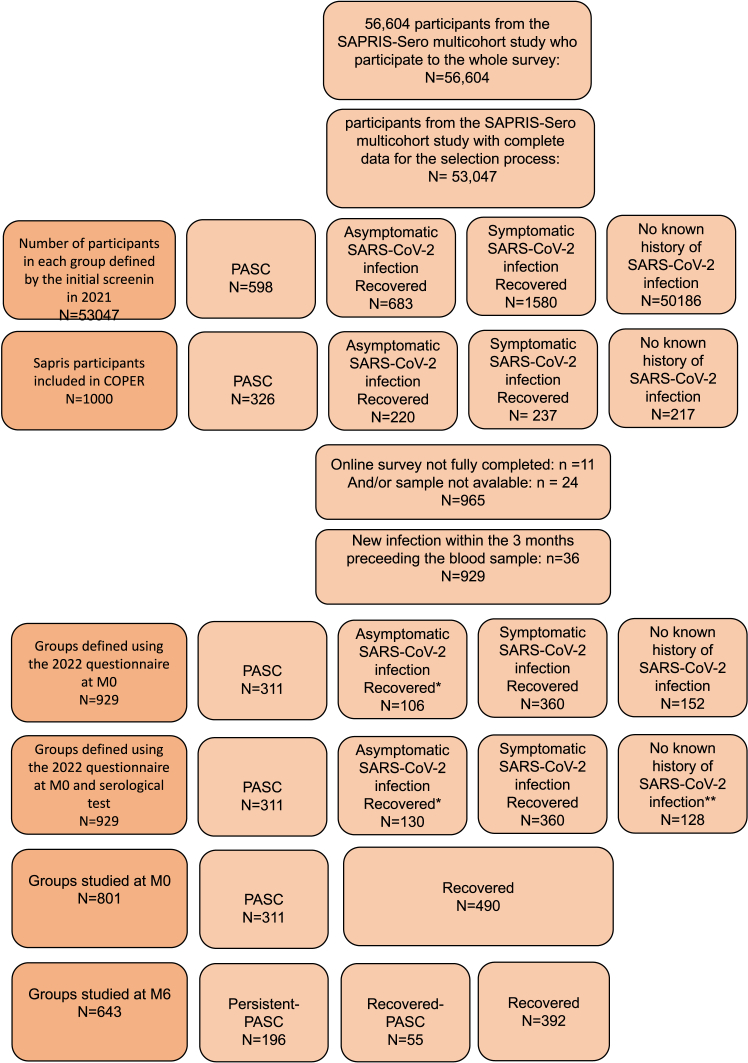
Findings: Between June and November 2022, 1000 participants were included in the study, 199 were excluded due to missing data or sample (35), SARS-CoV-2 infection less than 3 months (36) or lack of known SARS-CoV-2 infection and negative serology (128), with two groups analysed: recovered (n = 490), PASC (n = 311). Participants with PASC were more frequently women, had a higher BMI and a median number of 3 persistent symptoms, with common symptoms being asthenia, dyspnoea, cough, and sleep disorders. Biological analysis revealed significant associations between certain PACS symptoms and biomarkers of viral activation (IFNγ, IP-10), COVID-19 severity (CD163) and vascular activation (VCAM-1, ICAM-1), mainly in subjects whose symptoms had lasted less than a year. However, these associations did not persist over time.
Interpretation: The results suggest a polymorphic and dynamic pathophysiology according to symptoms and time since infection. Other hypotheses, beyond those related to persistent inflammation, should be explored.
Funding: French Ministry of Health and Prevention and the French Ministry of Higher Education, Research and Innovation.
Keywords: Biomarkers; Long COVID; PASC; Post-infectious symptoms; Postacute symptoms following COVID-19; SARS-CoV-2.
Copyright © 2025 The Authors. Published by Elsevier B.V. All rights reserved.
Conflict of interest statement
Declaration of interests OR declare financial support from Gilead, ViiV, MSD, Moderna, Pfizer outside the submitted work. CL reports non-financial support from Nordic Pharma France, outside the submitted work. Other authors have nothing to declare.
Figures
References
-
- Ghosn J., Bachelet D., Livrozet M., et al. Prevalence of post-acute coronavirus disease 2019 symptoms twelve months after hospitalization in participants retained in follow-up: analyses stratified by gender from a large prospective cohort. Clin Microbiol Infect. 2023;29(2):254.e7–254.e13. doi: 10.1016/j.cmi.2022.08.028. - DOI - PMC - PubMed
-
- Coste J., Delpierre C., Richard J.B., et al. Prevalence of long COVID in the general adult population according to different definitions and sociodemographic and infection characteristics: a nationwide random sampling survey in France in autumn 2022. Clin Microbiol Infect. 2024;30(7):924–929. doi: 10.1016/j.cmi.2024.03.020. - DOI - PubMed
MeSH terms
Substances
LinkOut - more resources
Full Text Sources
Medical
Research Materials
Miscellaneous
