


Workers' well-being during viral pandemics and epidemics: A scoping review
- PMID: 40453652
- PMCID: PMC12126619
- DOI: 10.1016/j.cpnec.2025.100286
Workers' well-being during viral pandemics and epidemics: A scoping review
Abstract
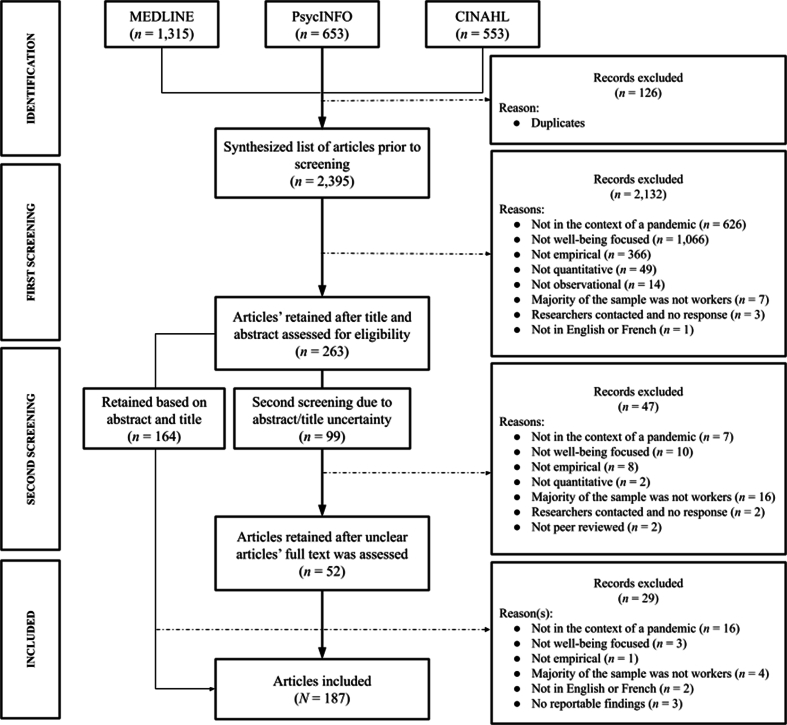
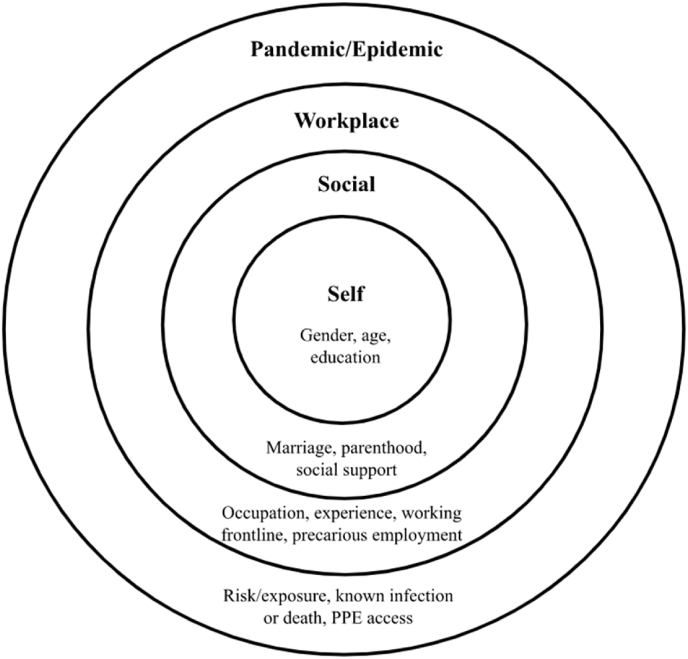
Studies have documented workers' well-being during individual pandemics and epidemics. However, there lies a need to summarize worker well-being across crises. Moreover, there is a scarcity of reviews exploring precarious workers' well-being during these crises. Adopting a multidisciplinary perspective via positive psychology's third wave, this scoping review examines positive and negative well-being across diverse occupational groups and situations (e.g., precarious employment) and across crises. Inspired by Ecological Systems Theory, factors at different ecological levels (self, social, workplace, pandemic) relevant to workers' well-being are reviewed. The following questions are addressed: 1) How are virus-related public health crises (i.e., epidemics, pandemics) related to workers' well-being? 2) What resilience and risk factors are associated with workers' well-being in these crises? And 2a) How is the well-being of precarious workers impacted during virus-related public health crises? Of the 2,395 potentially relevant articles published before October 23rd, 2020, 187 were retained. Overall, more research has been conducted on negative than positive well-being. Workers experienced: 1) positive well-being frequently or at moderately high levels overall during pandemics and epidemics, 2) mild to moderate negative well-being during SARS and COVID-19's beginning and high negative well-being during other crises, and 3) high work-related well-being during such crises. Factors at self- (age, gender), social- (social support), workplace- (occupation, frontline status), and pandemic-related (risk/exposure, knowing someone infected/killed by the virus, PPE access) levels were associated with workers' well-being. Although explored infrequently, precarious employment was typically associated with greater negative well-being. Practice- and policy-related recommendations are discussed.
Keywords: Epidemic; Pandemic; Precarious work; Well-being; Worker.
© 2025 The Authors.
Conflict of interest statement
On behalf of all authors, the corresponding author states that there is no conflict of interests.
Figures
References
-
- Madhav N., Oppenheim B., Gallivan M., Mulembakani P., Rubin E., Wolfe N. In: Disease Control Priorities: Improving Health and Reducing Poverty. third ed. Jamison D.T., Gelband H., Horton S., Jha P., Laxminarayan R., Mock C.N., Nugent R., editors. The World Bank Group; 2017. Pandemics: Risks, impacts, and mitigation; pp. 315–345. - DOI
-
- Lee J.-W., McKibbin W.J. In: Learning from SARS: Preparing for the Next Disease Outbreak: Workshop Summary. Knobler S., Mahmoud A., Lemon S., Mack A., Sivitz L., Oberholtzer K., editors. National Academies Press; 2004. Estimating the global economic costs of SARS; pp. 92–109.https://www.ncbi.nlm.nih.gov/books/NBK92473/ - PubMed
-
- Centre for Addiction and Mental Health. (n.d.). COVID-19 national survey dashboard. https://www.camh.ca/en/health-info/mental-health-and-covid-19/covid-19-n....
Publication types
LinkOut - more resources
Full Text Sources
Miscellaneous
