


Juglans regia and Pfaffia paniculata extracts: implications for periodontal disease treatment and correlation with Alzheimer's risk
- PMID: 40453709
- PMCID: PMC12122433
- DOI: 10.3389/fcimb.2025.1585438
Juglans regia and Pfaffia paniculata extracts: implications for periodontal disease treatment and correlation with Alzheimer's risk
Abstract
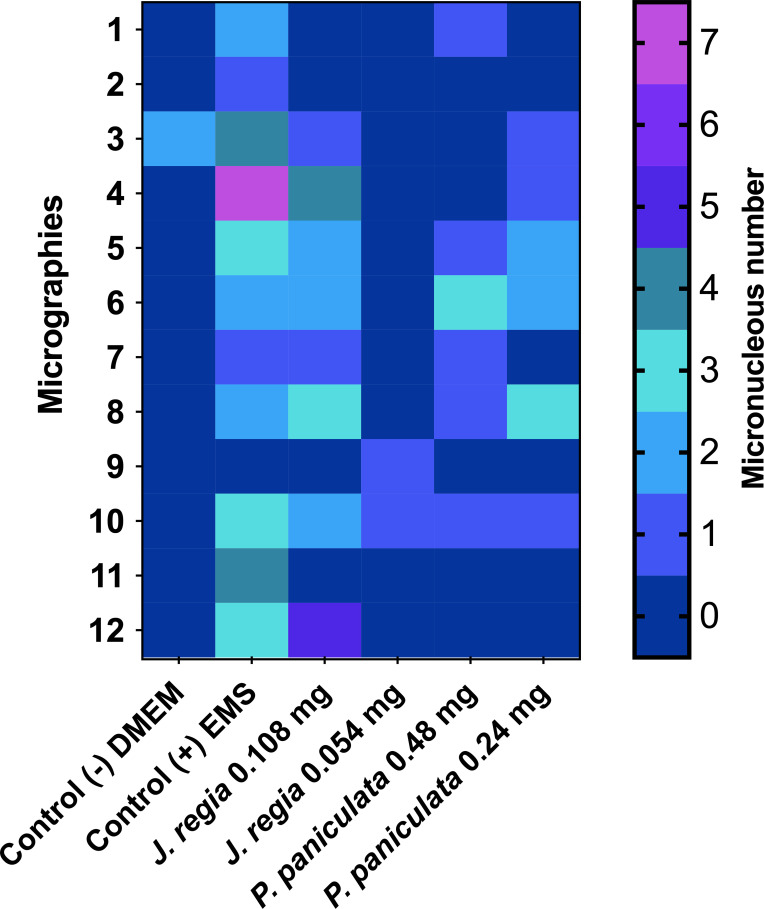
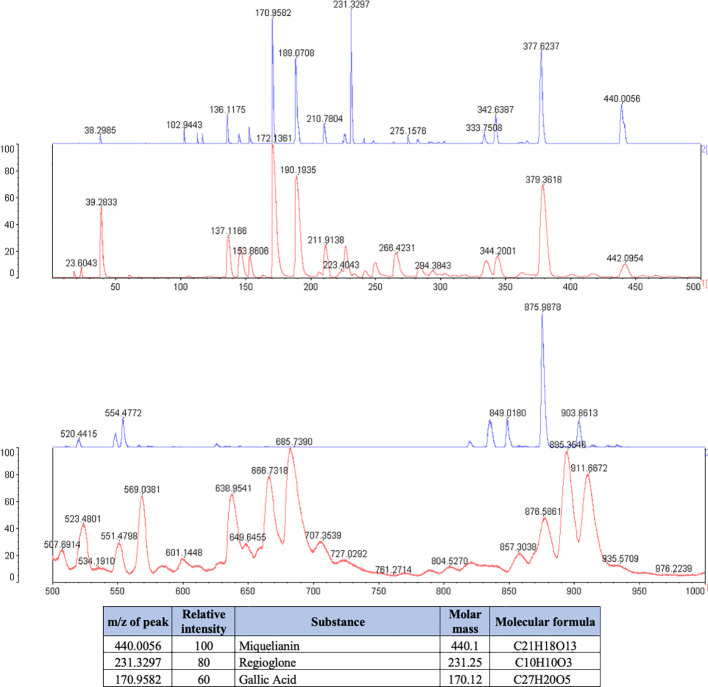
Periodontal disease (PD) is a significant global health concern, affecting approximately 19% of the world's population. It is one of the most prevalent diseases today, causing substantial socio-economic impacts and diminished quality of life. Recent research has also revealed a potential link between PD and Alzheimer's disease. This study investigated the antimicrobial effects of Juglans regia and Pfaffia paniculata extracts against P. endodontalis and P. gingivalis, bacteria that cause PD and are related to Alzheimer's risk. The study also assessed the impact of these extracts on macrophage metabolic activity, pro- and anti-inflammatory cytokine expression, and genotoxicity. The phytochemical analysis of the extract was carried out first. Antimicrobial activity was performed using the M11-A7 protocol (CLSI) for planktonic cultures on monotypic biofilms matured for 168 hours in anaerobiosis. Cell viability analysis was carried out using MTT on mouse macrophages (RAW 264-7), as well as genotoxicity assessment using micronuclei. The anti-inflammatory activity was evaluated using ELISA method, checking the cytokines IL-6, IL-1B, TNF-alpha, IL-17 and IL-10. Phytochemical analysis revealed the presence of Miquelianin, Regiolone and Gallic Acid in J. regia extract. For the P. paniculata extract, we identified the glycosides Pfaffoside C, Pfaffoside A, 3-O-β-D-glycopyranosyl-oleanolic acid and Beta-ecdysone. Antimicrobial activity revealed a MBC of 1.73 for the extract of J. regia and 0.48 for P. paniculata against P. endodontalis and P. gingivalis. All biofilms were reduced by more than 89% after treatment with the extracts for 5 min. Cytotoxicity evaluations revealed that cell viability remained above 50% at concentrations up to 0.216 mg/ml for J. regia and 0.015 mg/ml for P. paniculata. Neither extract exhibited genotoxicity. Furthermore, both demonstrated anti-inflammatory activity by promoting the production of the cytokine IL-10. In conclusion, the antimicrobial and anti-inflammatory activities of J. regia and P. paniculata extracts suggest their potential as treatments for oral dysbiosis, which may contribute to a reduced risk of neurodegenerative diseases.
Keywords: Porphyromonas endodontalis; Porphyromonas gingivalis; antimicrobial agents; dementia; gram-negative anaerobes; herbal medicine; inflammation; neurodegenerative disease.
Copyright © 2025 Miranda, Carrouel, Attik, Araujo, Dos Santos Lopes, Marcucci, Rodrigues, Caires, Vigerelli, Godoi, Pacheco-Soares and Ramos.
Conflict of interest statement
The authors declare that the research was conducted in the absence of any commercial or financial relationships that could be construed as a potential conflict of interest. The author(s) declared that they were an editorial board member of Frontiers, at the time of submission. This had no impact on the peer review process and the final decision.
Figures


References
-
- Acquaviva R., D’Angeli F., Malfa G. A., Ronsisvalle S., Garozzo A., Stivala A., et al. (2021). Antibacterial and anti-biofilm activities of walnut pellicle extract (Juglans regia L.) against coagulase-negative staphylococci. Nat. Prod Res. 35, 2076–2081. doi: 10.1080/14786419.2019.1650352 - DOI - PubMed
MeSH terms
Substances
LinkOut - more resources
Full Text Sources
Medical
