


Internal and External Loads during Formal Training and Competition, Physical Capacities, and Technical Skills in Youth Basketball: A Comparison between Starters and Rotation Players
- PMID: 40453903
- PMCID: PMC12121891
- DOI: 10.5114/jhk/201159
Internal and External Loads during Formal Training and Competition, Physical Capacities, and Technical Skills in Youth Basketball: A Comparison between Starters and Rotation Players
Abstract
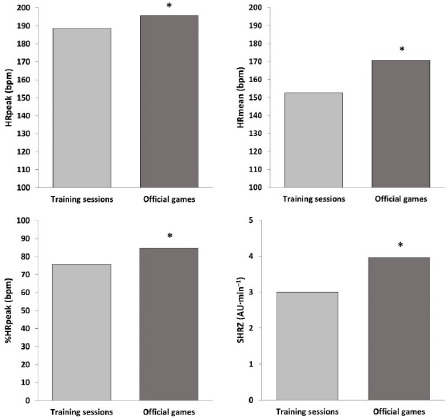
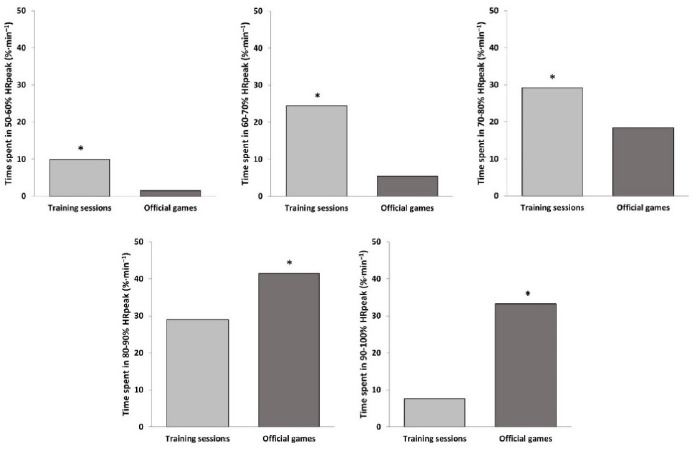
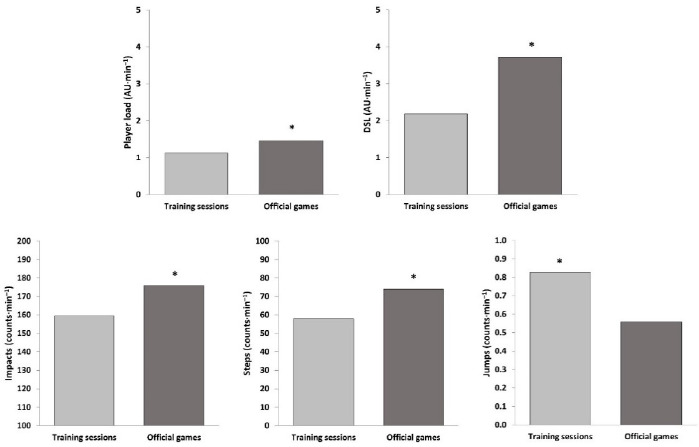
This preliminary study had two aims: (i) to compare the internal and external loads between training sessions and official games in youth basketball players; (ii) to investigate the effects of the playing role on physical capacities, basketball skills, and internal and external loads accumulated during training and competition. Thirteen under-16 male basketball players, aged 15.30 ± 0.88 years, were followed over 10 consecutive weeks and assigned into two groups according to their playing role: starters and rotation players. Prior to the 10-week monitoring period, players' training experience, basic anthropometrics, physical capacities, and basketball skills were assessed. Then, internal and external loads were monitored in formal training and official competition. Data were analyzed using non-parametric techniques. Players attained significantly higher values in most measures of internal and external loads during official games (r = 0.82 to 0.88, p < 0.01). Starters outperformed rotation players in the 20-m sprint (r = 0.61, p < 0.05), the lane agility drill (r = 0.77, p < 0.01), and the control dribble (r = 0.73, p < 0.01). They also reached a lower HRpeak in practice (r = 0.65, p < 0.05), but a higher %HRpeak (r = -0.61, p < 0.05) and greater scores in the summated-heart-rate-zones model (r = -0.61, p < 0.05) as well as the dynamic stress load during official games (r = -0.57, p < 0.05). The findings highlight that young basketball players apparently do not train as intensely as they play. Moreover, it was during competition that starting players experienced higher internal and external loads. It is recommended that basketball coaches regularly monitor loads in both formal training and competition to closely match game demands when planning their practices. Finally, it is suggested that future research includes larger sample sizes to provide a more comprehensive understanding of both internal and external loads in youth basketball.
Keywords: basketball skills; physical performance; playing role; training and game demands; youth players.
Copyright: © Academy of Physical Education in Katowice.
Conflict of interest statement
The authors declare no conflict of interest.
Figures
References
-
- Arede, J., Ferreira, A. P., Esteves, P., Gonzalo-Skok, O., & Leite, N. (2020). Train Smarter, Play More: Insights About Preparation and Game Participation in Youth National Team. Research Quarterly for Exercise and Sport, 91(4), 583–593. - PubMed
-
- Bangsbo, J., Iaia, F. M., & Krustrup, P. (2008). The Yo-Yo Intermittent Recovery Test: A Useful Tool for Evaluation of Physical Performance in Intermittent Sports. Sports Medicine (Auckland, N.Z.), 38(1), 37–51. - PubMed
LinkOut - more resources
Full Text Sources