. 2025 May 25:18:6735-6748.
doi: 10.2147/JIR.S502616. eCollection 2025.

HMGB1 Inhibition Alleviates Chronic Nonbacterial Prostatitis by Suppressing M1 Polarization of Macrophages

Affiliations

HMGB1 Inhibition Alleviates Chronic Nonbacterial Prostatitis by Suppressing M1 Polarization of Macrophages

Jilong Zhou et al. J Inflamm Res. .

Abstract

Background and objective: Chronic Prostatitis/Chronic Pelvic Pain Syndrome (CP/CPPS) poses a significant threat to male urinary health and has an unclear pathogenesis. High-mobility group box 1 (HMGB1), a danger-associated molecular pattern that has been identified as a key mediator in various inflammatory diseases. However, its role in CP/CPPS remains unclear. This study aimed to investigate HMGB1's potential contributions to the pathogenesis of CP/CPPS, offering new perspectives for innovative treatments.

Materials and methods: We have successfully extracted prostate antigens from Sprague-Dawley rat prostate tissue and established an experimental autoimmune prostatitis (EAP) mouse model in non-obese diabetic (NOD) mice. Subsequently, EAP mice were treated with recombinant HMGB1 protein (rmHMGB1) or the HMGB1-specific inhibitor glycyrrhizin for 14 days. Behavioral test was performed to assess the chronic pelvic pain. Hematoxylin and eosin (H&E) staining was employed to assess the extent of inflammatory cell infiltration in the prostate, and enzyme-linked immunosorbent assay (ELISA) was performed to assess levels of inflammatory cytokines. Co-immunofluorescence was used to analyze the functional phenotype of macrophages and spatial localization of HMGB1 in prostate of EAP mice. To further validate these findings, we conducted in vitro experiments. In these experiments, lipopolysaccharide (LPS) was used to induce an inflammatory environment in RAW264.7 cells. Interventions included administering rmHMGB1, silencing HMGB1 gene expression with siRNA, and treating cells with the TRAF6 inhibitor C25-140. After interventions, Western blot and immunofluorescence were employed to evaluate the impact on M1 macrophage polarization and inflammation.

Results: In this study, we demonstrate that HMGB1 is highly expressed in the prostate tissues of EAP mice. Treating EAP mice with rmHMGB1 significantly increased prostate histological scores (2.83 vs 1.83, p < 0.05) and the sensitivity to pain stimuli, as evidenced by a higher response frequency to von Frey filament stimulation at 4 g (68.33% vs 53.33%, p < 0.05). This treatment also increased the levels of inflammatory proteins IL-6 and TNF-α. In contrast, suppressing HMGB1 with glycyrrhizin significantly reduced inflammation, as indicated by decreased histological scores (0.50 vs 2.17, p < 0.05), and attenuated pain sensitivity, as evidenced by a lower response frequency to von Frey filament stimulation at 4 g (30.83% vs 52.50%, p < 0.05). Glycyrrhizin treatment also reduced IL-6 and TNF-α levels. Furthermore, the proportion of CD11b+iNOS+ cells, indicative of M1 macrophage polarization, was significantly reduced after glycyrrhizin treatment. In vitro, HMGB1 can regulate the activity of TRAF6 by partially modulating its ubiquitination and degradation, thereby amplifying TRAF6-mediated NF-κB activation, promoting M1 macrophage polarization, and exacerbating inflammation.

Discussion and conclusions: HMGB1 can enhance TRAF6-mediated NF-κB activation, thereby driving M1 macrophage polarization and exacerbating prostate inflammation in EAP mice. Inhibiting HMGB1 expression with glycyrrhizin can suppress M1 polarization of macrophages to alleviate prostate inflammation. This study suggests that targeting the HMGB1/TRAF6/NF-κB signaling pathway may be an effective therapeutic approach for CP/CPPS.

Keywords: HMGB1; TRAF6; chronic nonbacterial prostatitis; inflammation; macrophages.


Conflict of interest statement

The authors declare no conflicts of interest in this work.

Figures
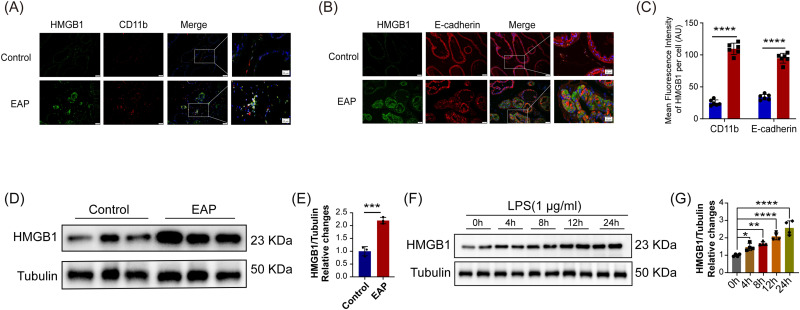
Figure 1
Figure 1
HMGB1 is increased in the prostate of EAP mice. Representative images of immunofluorescence staining for HMGB1 and markers of macrophage (A) and prostate epithelial cell (B). (C) Quantification of HMGB1 immunofluorescence intensity for macrophages and prostate epithelial cells in the prostate from the normal and EAP groups (n=6). (D and E) Western blot analysis of HMGB1 protein in the prostate tissues from the normal and EAP groups (n=3). (F and G) The HMGB1 protein levels at 0 h, 4 h, 8 h, 12 h and 24 h after LPS-stimulated RAW264.7 were detected by Western blot and quantified (n=4). Data are shown as mean ± SD, and analyzed by unpaired, two-tailed Student’s t-test analysis (C and E) or one-way ANOVA analysis (G). *P < 0.01; **P < 0.01; ***P < 0.001; ****P < 0.0001.
Figure 2
Figure 2
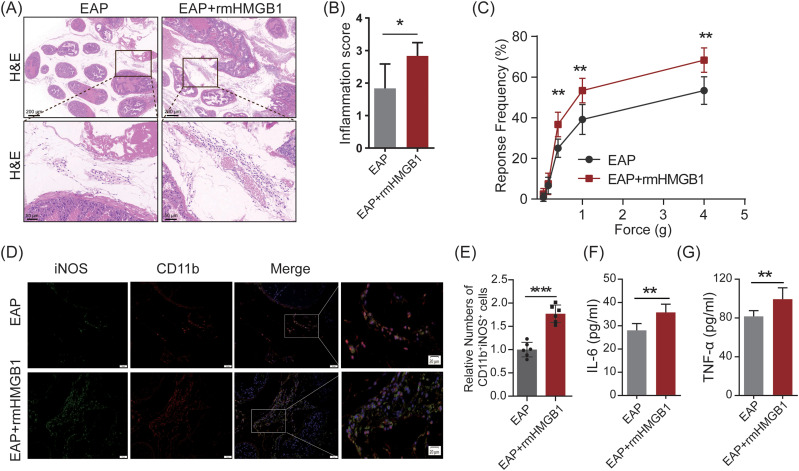
HMGB1 Promotes EAP severity. (A) Histological evaluation for the degree of inflammation for mice in the EAP and rmHMGB1 treatment groups. (B) The inflammation score for mice in the EAP and rmHMGB1 treatment groups (n=6). (C) Pain response test for mice in the EAP and rmHMGB1 treatment groups. (D) Representative images of immunofluorescence staining for iNOS and CD11b in the prostate of EAP and rmHMGB1 treatment mice. Cells were stained for iNOS (green) and CD11b (red). (E) Relative quantification of the numbers of CD11b+iNOS+ cells in prostate from EAP and rmHMGB1 treatment groups (n=6). (F and G) The expression levels of IL-6 and TNF-α in serum from EAP and rmHMGB1 treatment groups. Data are shown as mean ± SD, and analyzed by unpaired, two-tailed Student’s t-test analysis (B, E, F and G) or two‐way ANOVA analysis (C). *P < 0.01; **P < 0.01; ****P < 0.0001.
Figure 3
Figure 3
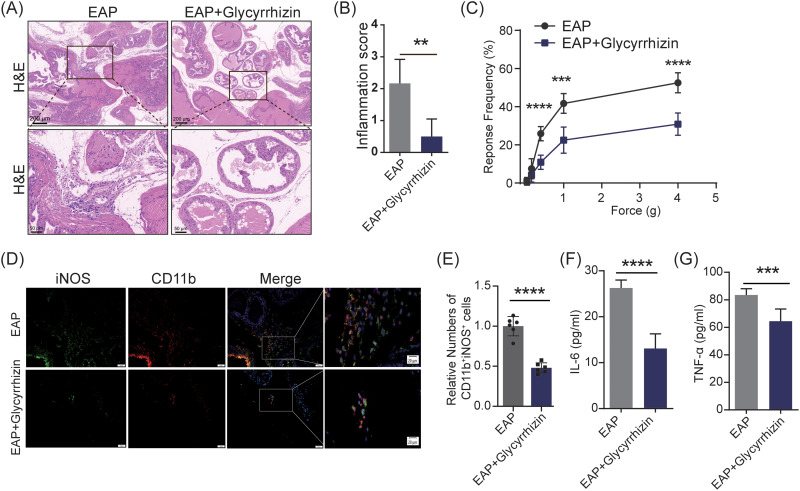
Suppression of HMGB1 with glycyrrhizin ameliorates EAP severity. (A) Histological evaluation for the degree of inflammation for mice in the EAP group and glycyrrhizin treatment group. (B) The inflammation score for mice in the EAP group and glycyrrhizin treatment group (n=6). (C) Pain response test for mice in the EAP group and glycyrrhizin treatment group (n=6). (D) Representative images of immunofluorescence staining for iNOS and CD11b in the prostate of EAP and glycyrrhizin treatment mice. Cells were stained for iNOS (green) and CD11b (red). (E) Relative quantification of the numbers of CD11b+iNOS+ cells in prostate from EAP and glycyrrhizin treatment group (n=6). (F and G) The expression levels of IL-6 and TNF-α in serum from EAP and glycyrrhizin treatment groups (n=6). Data are shown as mean ± SD, and analyzed by unpaired, two-tailed Student’s t-test analysis (B, E, F and G) or two‐way ANOVA analysis (C). **P < 0.01; ***P < 0.001; ****P < 0.0001.
Figure 4
Figure 4
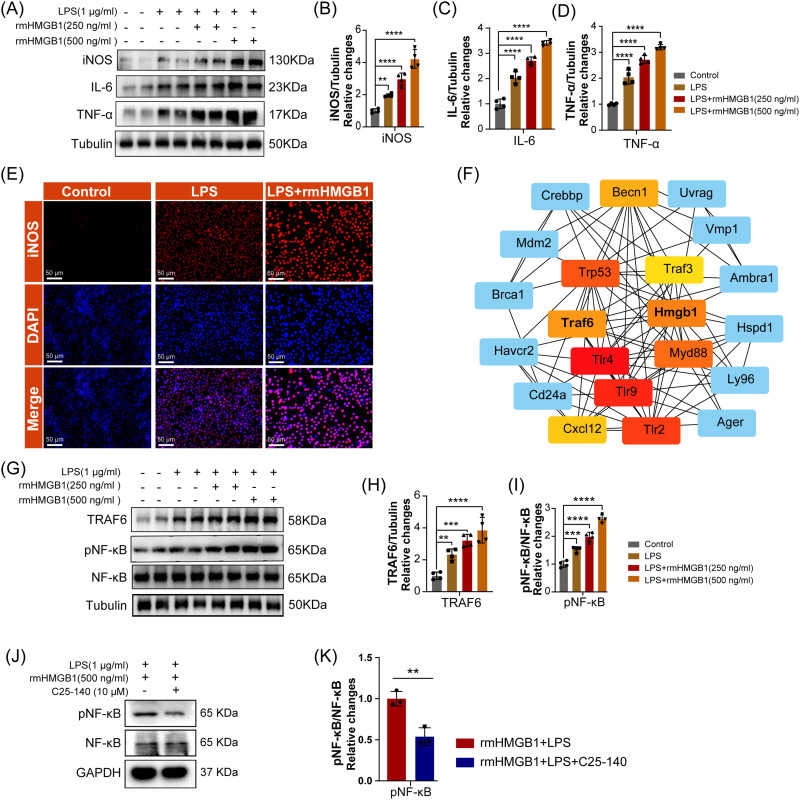
HMGB1 promotes M1 polarization of macrophages through TRAF6/NF-κB pathway. (A) Western blot was used to detect the protein levels of iNOS, IL-6 and TNF-α in RAW264.7 treated with rmHMGB1. Relative quantification of the protein levels of iNOS (B), IL-6 (C) and TNF-α (D) (n=4). (E) The iNOS was detected by immunofluorescence combined with DAPI staining for nuclei. (F) Protein-protein interaction diagram was performed by STRING website (http://string-db.org/). (G) Western blot was used to detect the protein levels of TRAF6, NF-κB, and pNF-κB in RAW264.7 treated with rmHMGB1. Relative quantification of the protein levels of TRAF6 (H), and pNF-κB (I) (n=4). (J) Western blot was used to detect the protein levels of pNF-κB and NF-κB in RAW264.7 pretreatment with the TRAF6-specific inhibitor C25-140 (10 μM) prior to rmHMGB1 and LPS treatment. (K) Relative quantification of the protein levels of pNF-κB (n=3). Data are shown as mean ± SD, and analyzed by unpaired, two-tailed Student’s t-test analysis (K) or one‐way ANOVA analysis (B, C, D, H and I). **P < 0.01; ***P < 0.001; ****P < 0.0001.
Figure 5
Figure 5
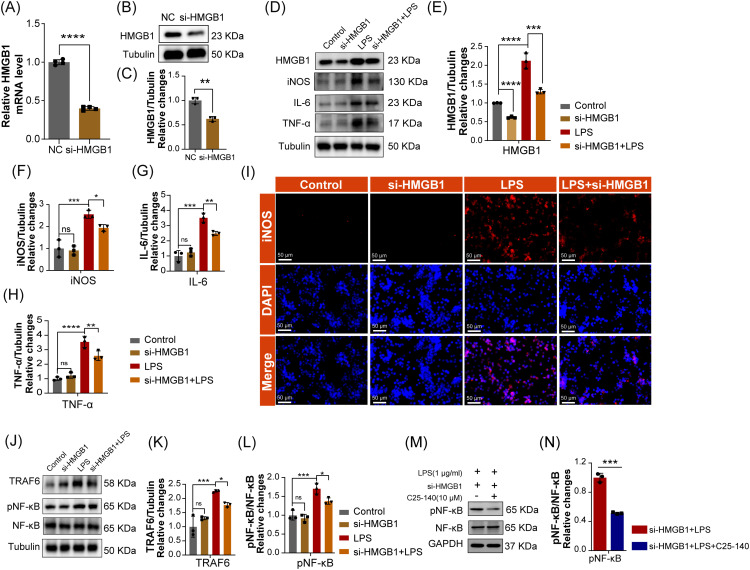
Silencing HMGB1 prevents the secretion of inflammatory mediators of macrophages via TRAF6/NF-κB pathway. (A–C) The silencing efficiency of HMGB1 in RAW264.7 was tested by RT-qPCR and Western blot. (D) Western blot was used to detect the protein levels of HMGB1, iNOS, IL-6 and TNF-α in si-HMGB1 group. Relative quantification of the protein levels of HMGB1 (E), iNOS (F), IL-6 (G) and TNF-α (H) (n=3). (I) The iNOS was detected by immunofluorescence combined with DAPI staining for nuclei. (J) Western blot was used to detect the protein levels of TRAF6, NF-κB, and pNF-κB in si-HMGB1 group. Relative quantification of the protein levels of TRAF6 (K), and pNF-κB (L) (n=3). (M) Western blot was used to detect the protein levels of pNF-κB and NF-κB in si-HMGB1 cells pretreatment with the TRAF6-specific inhibitor C25-140 (10 μM) prior to LPS stimulation. (N) Relative quantification of the protein levels of pNF-κB (n=3). Data are shown as mean ± SD, and analyzed by unpaired, two-tailed Student’s t-test analysis (C and N) or one‐way ANOVA analysis (E, F, G, H, K and L). *P < 0.05; **P < 0.01; ***P < 0.001; ****P < 0.0001.
Figure 6
Figure 6
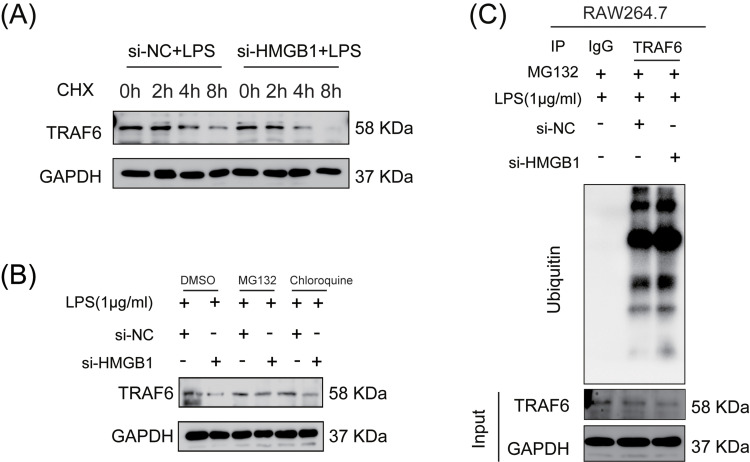
HMGB1 inhibited ubiquitination and degradation of TRAF6 protein. (A) TRAF6 protein was discerned by Western blot after treatment with CHX (20 μg/mL) at 0 h, 2 h, 4 h, 8 h in si-NC and si-HMGB1 cells in the presence of LPS. (B) TRAF6 protein was discerned by Western blot after treatment with MG132 (0.35 μM) and lysosomal inhibitor chloroquine (50 μM) in si-NC and si-HMGB1 cells in the presence of LPS. (C) Ubiquitination level of TRAF6 was detected by Western blot si-HMGB1 cells.
Figure 7
Figure 7
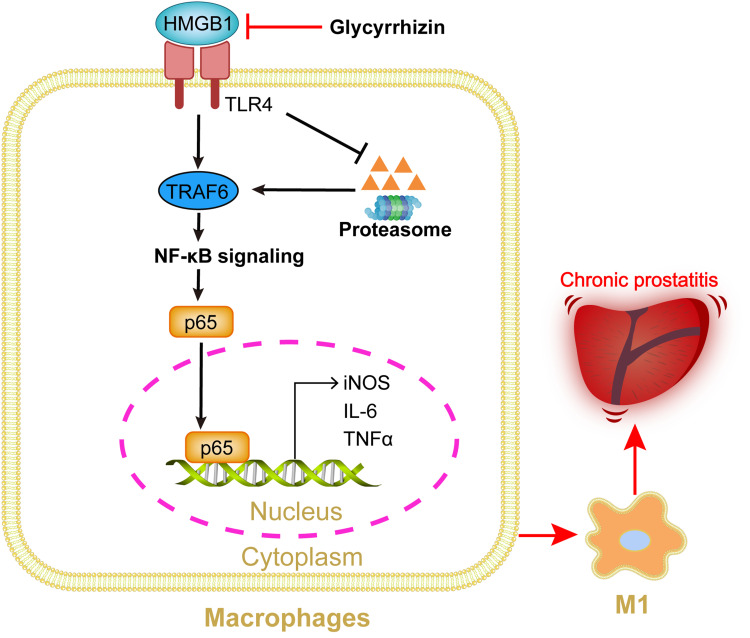
Schematic diagram of the pathogenicity of HMGB1 in mice with EAP. HMGB1 aggravates prostatic inflammation and pelvic pain in the EAP model by activating the TRAF6/NF-κB signaling to promote M1 polarization and the secretion of inflammatory mediators.

References

    1. Krieger JN, Lee SW, Jeon J, et al. Epidemiology of prostatitis. Int J Antimicrob Agents. 2008;31(Suppl 1):S85–90. doi: 10.1016/j.ijantimicag.2007.08.028 - DOI - PMC - PubMed
    1. Krieger JN, Nyberg L, Nickel JC. NIH consensus definition and classification of prostatitis. JAMA. 1999;282(3):236–237. doi: 10.1001/jama.282.3.236 - DOI - PubMed
    1. Baiyi L, Hongbin C, Wen H, et al. Protective effect of bamboo shoot oil on experimental nonbacterial prostatitis in rats. Food Chem. 2011;124(3):1017–1023. doi: 10.1016/j.foodchem.2010.07.066 - DOI
    1. Clemens JQ, Mullins C, Ackerman AL, et al. Urologic chronic pelvic pain syndrome: insights from the MAPP research network. Nat Rev Urol. 2019;16(3):187–200. doi: 10.1038/s41585-018-0135-5 - DOI - PMC - PubMed
    1. Krsmanovic A, Tripp DA, Nickel JC, et al. Psychosocial mechanisms of the pain and quality of life relationship for chronic prostatitis/chronic pelvic pain syndrome (CP/CPPS). Can Urol Assoc J. 2014;8(11–12):403–408. doi: 10.5489/cuaj.2179 - DOI - PMC - PubMed

LinkOut - more resources