. 2025 Mar 1;7(6):101367.
doi: 10.1016/j.jhepr.2025.101367. eCollection 2025 Jun.

Lipidomics-based plasma signature of alcohol-related hepatitis linked to short-term mortality

Affiliations

Lipidomics-based plasma signature of alcohol-related hepatitis linked to short-term mortality

Florent Artru et al. JHEP Rep. .

Abstract

Background & aims: Severe alcohol-related hepatitis (sAH) is an inflammatory condition with high short-term mortality. Hypothesis-driven approaches have failed to identify effective treatments. Given the role of lipids as inflammatory mediators, this study aimed to identify lipidomic changes and lipid species associated with sAH and mortality risk.

Methods: Untargeted lipidomics was performed on serum samples from two cohorts of patients with sAH and decompensated cirrhosis (DC). Principal component analysis and orthogonal partial least squares discriminant analysis were used to assess lipidome changes. Correlations were made with lipoproteins, lipid mediators, cytokines, cytokeratin fragments, and histological indices.

Results: In the first part, 78 patients with sAH were matched on bilirubin levels with 23 patients with DC. Lipidomics identified a distinct sAH signature involving glycerophospholipids, including PC(34:2) (odds ratio [OR] 2.18, 95% confidence interval [CI] 1.45-7.05, p = 0.01), PC(O-38:5) (OR 3.31, 95% CI 2.23-7.14, p = 0.002), PI(38:4) (OR 0.71, 95% CI 0.46-0.88, p = 0.02), and LPC(18:1) (OR 0.47, 95% CI 0.32-0.82, p = 0.01). These lipids demonstrated excellent discriminatory power between sAH and DC with areas under the receiver operating characteristic curve (AUROCs) between 0.87 and 0.88. In the second part, in 159 sAH patients, specific lipids, including carnitines CAR(2:0) (OR 2.51, 95% CI 1.25-4.96, p = 0.008) and CAR(16:1) (OR 2.21, 95% CI 1.09-7.48, p = 0.009), were linked to 90-day mortality. Acylcarnitines correlated with disease severity parameters such as model for end-stage liver disease, pro-inflammatory cytokines levels, and hepatocyte ballooning on pathology.

Conclusions: Untargeted lipidomics identified a glycerophospholipid and sphingolipid signature distinguishing sAH from DC, implicating lipid species involved in liver regeneration and immune function. Acylcarnitine accumulation in patients with sAH and poor prognosis suggests mitochondrial dysfunction and warrants further investigation into therapeutic potential.

Impact and implications: Lipids can act as mediators at the interface between the immune system and metabolism, potentially contributing to the pathogenesis and outcomes of patients with severe alcohol-related hepatitis, prompting us to investigate lipidomic changes in this population using untargeted approaches, compared with patients with decompensated cirrhosis. This study highlights a distinct lipidomic signature in patients with severe alcohol-related hepatitis compared with decompensated cirrhosis, primarily involving glycerophospholipids and sphingolipids. Specific lipid classes, such as acylcarnitines, suggest significant mitochondrial dysfunction and are associated with disease severity and short-term mortality in patients with severe alcohol-related hepatitis. These findings underscore the importance of targeted investigations into these lipid species, their pathways, and their links to disease severity and outcomes, particularly in this condition that currently lacks specific treatments.

Keywords: Acute-on-chronic liver failure; Acylcarnitines; Alcohol-related hepatitis; Cirrhosis; Glycerophospholipids; Lipidomics; Lysophospholipids; Mitochondrial dysfunction.


Conflict of interest statement

The authors declare no conflicts of interest that pertain to this work. Please refer to the accompanying ICMJE disclosure forms for further details.

Figures

Image 1
Graphical abstract
Fig. 1
Fig. 1
Untargeted lipidomics in positive ionisation mode in patients with sAH (n = 78) matched to patients with DC (n = 23) on bilirubin level. (A) Score plot of the model. Each dot represents the model in one patient: sAH in orange and DC in green. It shows how the samples are grouped based on their lipidome. Two distinct clusters suggest that the two groups are separable from a lipidome perspective. (B) Permutation test demonstrating the validity of the model. A permutation plot tests whether the OPLS-DA model’s ability to separate groups is real or as a result of random chance. A good model shows much higher performance metrics (R2 and Q2) for the actual data compared with randomised models, with a clear downward trend in performance as the data are permuted. (C) AUROC using the discriminant variables of the OPLS-DA model. (D) S-plot of the model. Each variable is plotted. Variables in red are those with a VIP value ≥2. This plot shows the relationship between the variables’ importance (x-axis) and their correlation with group separation (y-axis). Points far from the centre are the most relevant variables driving the separation. They may correspond to key biomarkers. (E) Univariable analyses of the two lipids identified from multivariable logistic regression as independently differentiating between patients with sAH and DC (PC(34:2), p = 0.0001, and PC-O(38:5), p = 0.0034, Mann-Whitney U test). (F) Performance based on the AUROC of the two-lipid model, two-lipid models adjusted for the MELD score, and the MELD score alone in differentiating patients with sAH from patients with DC. Two-lipid model vs. MELD score: p = 0.02; two-lipid model vs. two-lipid model adjusted for the MELD score: p = 0.05; two-lipid model adjusted for the MELD score vs. MELD score: p <0.0001 (Z test). AUROC, area under the receiver operating characteristic curve; DC, decompensated cirrhosis; MELD, model for end-stage liver disease; OPLS-DA, orthogonal partial least squares discriminant analysis; sAH, severe alcohol-related hepatitis; VIP, variable projection of importance.
Fig. 2
Fig. 2
Untargeted lipidomics in negative ionisation mode in patients with sAH (n = 78) matched to patients with DC (n = 23) on bilirubin level. (A) Score plots of the model. Each dot represents the model in one patient: sAH in orange and DC in green. It shows how the samples are grouped based on their lipidome. Two distinct clusters suggest that the two groups are separable from a lipidome perspective. (B) Permutation test demonstrating the validity of the positive ionisation mode. A permutation plot tests whether the OPLS-DA model’s ability to separate groups is real or as a result of random chance. A good model shows much higher performance metrics (R2 and Q2) for the actual data compared with randomised models, with a clear downward trend in performance as the data are permuted. (C) AUROC using the discriminant variables of the OPLS-DA model. (D) S-plot of the model. Each variable is plotted. Variables in red are those with a VIP value ≥2. This plot shows the relationship between the variables’ importance (x-axis) and their correlation with the group separation (y-axis). Points far from the centre are the most relevant variables driving the separation. They may correspond to key biomarkers. (E) Univariable analyses of the two lipids identified from multivariable logistic regression as independently differentiating between patients with sAH and DC (PI(38:4), p = 0.0014, and LPC(18:1), p <0.0001, Mann-Whitney U test). (F) Performance based on the AUROC of the two-lipid model, two-lipid models adjusted for the MELD score, and MELD score alone in differentiating between patients with sAH and patients with DC. Two-lipid model vs. MELD score: p = 0.04; two-lipid model vs. two-lipid model adjusted for the MELD score: p = 0.07; two-lipid model adjusted for the MELD score vs. MELD score: p = 0.01 (Z test). AUROC, area under the receiver operating characteristic curve; DC, decompensated cirrhosis; MELD, model for end-stage liver disease; OPLS-DA, orthogonal partial least squares discriminant analysis; sAH, severe alcohol-related hepatitis; VIP, variable projection of importance.
Fig. 3
Fig. 3
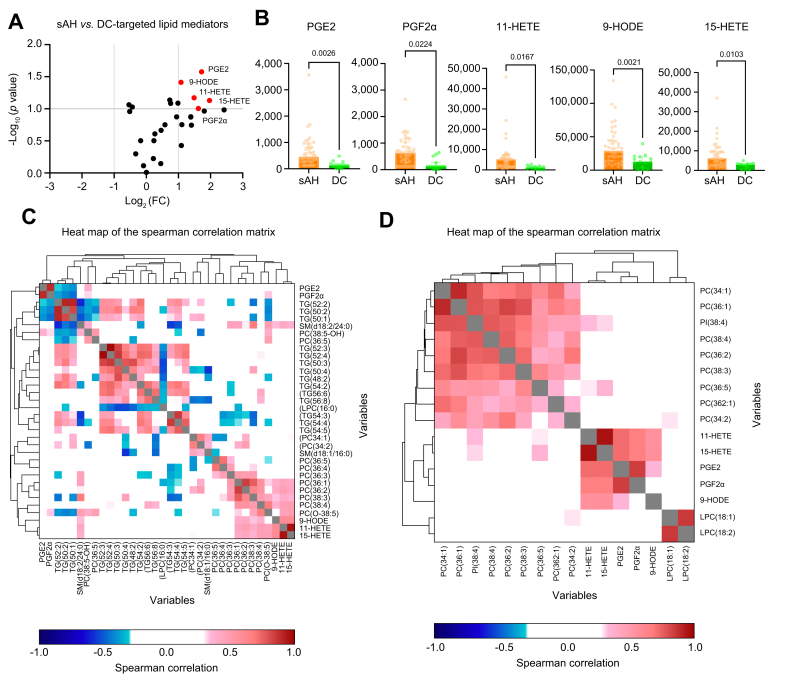
Analyses of lipid mediators in the matched cohort (sAH n = 47; DC n = 15). (A) Volcano plots of each lipid mediators with respect to condition (sAH vs. DC). Red plot identifying variables above -1;1 log2(FC) threshold and 1 -log10(p value) threshold. (B) Univariable analysis of the lipid mediators identified in (A) with respect to the condition (sAH vs. DC): PGE2, p = 0.0026; PG2Fα, p = 0.0224; 11-HETE, p = 0.0167; 9-HODE, p = 0.0021; and 15-HETE, p = 0.0103 (Mann-Whitney U test). (C) Correlation matrix (Spearman test) including lipid mediators identified in (A) and (B) with lipids with a VIP value ≥2 in positive ionisation mode. (D) Correlation matrix (Spearman test) including lipid mediators identified in (A) and (B) with lipids with a VIP value ≥2 in negative ionisation mode. DC, decompensated cirrhosis; sAH, severe alcohol-related hepatitis; VIP, variable projection of importance.
Fig. 4
Fig. 4
Untargeted lipidomics in restricted to patients with sAH based on status on day 90 (survivors n = 106; non-survivors n = 51). (A) Volcano plots of all features in positive ionisation mode with respect to the D90 status (survivors vs. non-survivors). Red plot identifying features above the -0.5;0.5 log2(FC) and 2 -log10(p value according to the Mann-Whitney U test) thresholds that were further annotated based on raw chromatograms. (B) Volcano plots of all features of negative ionisation mode with respect to the D90 status (survivors vs. non-survivors). Red plot identifying features above the -0.5;0.5 log2(FC) and 2 -log10(p value according to the Mann-Whitney U test) thresholds that were further annotated based on raw chromatograms. (C) Univariable analyses of the lipids independently associated with the D90 status in Table 4 in positive ionisation mode: CAR(2:0), p <0.0001, and CAR(16:1), p <0.0001 (Mann-Whitney U test). (D) Univariable analyses of the lipids independently associated with the D90 status in Table S7 in negative ionisation mode: PC(36:4), p <0.0001, and FA(16:0), p = 0.0244. (E) Performance based on AUROC of the two-lipid model adjusted for the Lille model and MELD score alone, in differentiating D90 survivors from non-survivors in the sAH cohort in positive ionisation mode. Two-lipid model vs. MELD score: p = 0.02; two-lipid model vs. Lille model: p = 0.50; two-lipid model vs. two-lipid model adjusted for the Lille model: p = 0.11; two-lipid model adjusted for the Lille model vs. MELD score: p = 0.001; two-lipid model adjusted for the Lille model vs. Lille model: p = 0.02. (F) Performance based on AUROC of the two-lipid model adjusted for the Lille model and MELD score alone in differentiating D90 survivors from non-survivors in the sAH cohort in negative ionisation mode. Two-lipid model vs. MELD score: p = 0.08; two-lipid model vs. Lille model: p = 0.73; two-lipid model vs. two-lipid model adjusted for the Lille model: p = 0.09; two-lipid model adjusted for the Lille model vs. MELD score: p = 0.004; two-lipid model adjusted for the Lille model vs. Lille model: p = 0.21 (Z test).

References

    1. Mathurin P., Thursz M. Endpoints and patient stratification in clinical trials for alcoholic hepatitis. J Hepatol. 2019;70:314–318. - PubMed
    1. Szabo G., Thursz M., Shah V.H. Therapeutic advances in alcohol-associated hepatitis. J Hepatol. 2022;76:1279–1290. - PubMed
    1. Rattan P., Shah V.H. Review article: current and emerging therapies for acute alcohol-associated hepatitis. Aliment Pharmacol Ther. 2022;56:28–40. - PubMed
    1. Bou Saleh M., Louvet A., Ntandja-Wandji L.C., et al. Loss of hepatocyte identity following aberrant YAP activation: a key mechanism in alcoholic hepatitis. J Hepatol. 2021;75:912–923. - PMC - PubMed
    1. Louvet A., Thursz M.R., Kim D.J., et al. Corticosteroids reduce risk of death within 28 days for patients with severe alcoholic hepatitis, compared with pentoxifylline or placebo—a meta-analysis of individual data from controlled trials. Gastroenterology. 2018;155:458–468.e8. - PubMed

LinkOut - more resources