


A comparative analysis of the prevalence and intensity of schistosomiasis and soil-transmitted helminth infections between preschool-aged children and school-going children in KwaZulu-Natal Province
- PMID: 40455295
- PMCID: PMC12130080
- DOI: 10.1007/s00436-025-08504-1
A comparative analysis of the prevalence and intensity of schistosomiasis and soil-transmitted helminth infections between preschool-aged children and school-going children in KwaZulu-Natal Province
Abstract
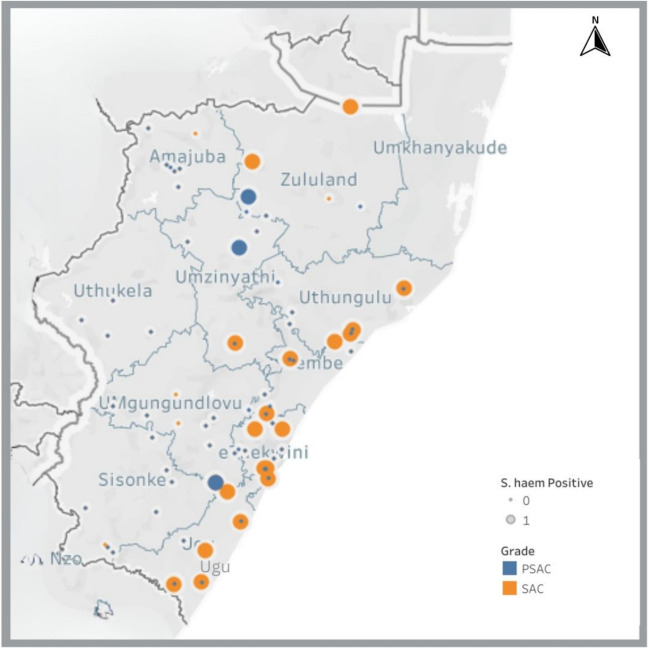
The World Health Organization (WHO) recommends conducting a baseline survey to quantify the infection burden of schistosomiasis and soil transmitted helminths (STH) in pre-school aged children (PSAC) and school-aged children (SAC) before implementing a schistosomiasis mass drug administration intervention. The objective of the study was to compare the prevalence and intensity of schistosomiasis and soil-transmitted helminth (STH) infections between preschool-aged children (PSAC) and school-age children (SAC) in the province of KwaZulu-Natal, South Africa. The study was conducted in the province of KZN. The target population was PSAC and SAC, with a sample size of 2000 children (1176 primary school-aged children and 824 pre-school-aged children). Ethical clearance was obtained from the Biomedical Research Ethics Committee of the University of KwaZulu-Natal; informed consent from parents/legal guardians and verbal assent from SAC were solicited. Data collection involved collecting stool and urine samples from children. The prevalence and intensity of infections were compared between PSAC and SAC, using statistical methods to assess differences. The results showed that 49 (4.2%) SAC were positive for Schistosoma haematobium, while only 3 (0.41%) PSAC were infected. The total number of STH infections among participants was 281 (22%), with 91 in PSAC and 190 in SAC. The chi-square test showed that SAC were infected with schistosomiasis more than PSAC counterparts in the same location. However, the difference in STH prevalence between PSAC and SAC was not statistically significant, suggesting that there was not much of a difference in the prevalence of STH among SAC and PSAC. Among the STH infections, Taenia was the most prevalent, affecting approximately 20.5% of SAC and 23.4% of PSAC. This species accounted for a substantial proportion of the overall STH burden in both age groups. The study concluded that while SAC has a higher overall prevalence, a real burden exists among PSAC indicating the need to include them in MDA programs targeting S. haematobium in the province.
Keywords: Preschool-aged children; Public health policy; Schistosomiasis; School-going children; Soil-transmitted helminths.
© 2025. The Author(s).
Conflict of interest statement
Declarations. Institutional Review Board statement: The University of KwaZulu Natal biomedical research ethics committee (BREC) issued the ethical approval for the protocol: Comparative analysis of the burden of schistosomiasis and soil transmitted helminth infection between pre-school age children in the province of KwaZulu-Natal. Degree: MMedSc. BREC Ref No: BE429/19. Informed consent statement: Informed consent was obtained from all subjects involved in the study. Conflicts of interest: The authors declare no conflicts of interest. The funders had no role in the design of the study; in the collection, analyses, or interpretation of data; in the writing of the manuscript; or in the decision to publish the results.
Figures
References
Publication types
MeSH terms
Substances
LinkOut - more resources
Full Text Sources
