


Effect of variable phosphorus availability on root mechanisms involved in mobilization of the soil P in three lupine species
- PMID: 40456812
- PMCID: PMC12130325
- DOI: 10.1038/s41598-025-03694-1
Effect of variable phosphorus availability on root mechanisms involved in mobilization of the soil P in three lupine species
Abstract
Improving the soil phosphorus (P) acquisition efficiency by plants is one of the most important challenges for modern agriculture. Only 15-20% of this nutrient applied to the soil with fertilisers is used by plants, with the majority being converted to less available forms. Lupine species are a great genetic model system with significant potential to provide novel information. Here we present an investigation into the effects of variable availability in the rhizosphere on P-mobilising mechanisms and photosynthetic activity, studied in 12 varieties of three lupine species. P uptake was significantly stimulated by low molecular weight organic acid (OA) exudation and H+-ATPase-mediated proton transport in roots. The predominant mechanism in white lupine was the H+ release into the rhizosphere, OA exudation predominated in yellow lupine, while narrow-leaved lupine varieties used both strategies effectively. Three lupine species showed significant differences in the quantitative and qualitative composition of carboxylic acids in root exudates. The variable P availability in soil solution significantly affected the photosynthetic performance of the plants studied. At the same time, the activity of the photosynthetic electron transport chain and photosynthetic CO2 assimilation was a key factor determining activity of the mechanisms involved in P mobilisation. We discuss the implications of these contrasting strategies for our understanding of tolerance to low P and in relation to breeding plants with higher P acquisition efficiency.
Keywords: H+-ATPase; Low-molecular-weight organic acids; Lupines; Phosphorus availability; Photosynthetic activity.
© 2025. The Author(s).
Conflict of interest statement
Declarations. Competing interests: The authors declare no competing interests.
Figures


 citric acid,
  malic acid,
  acetic acid and
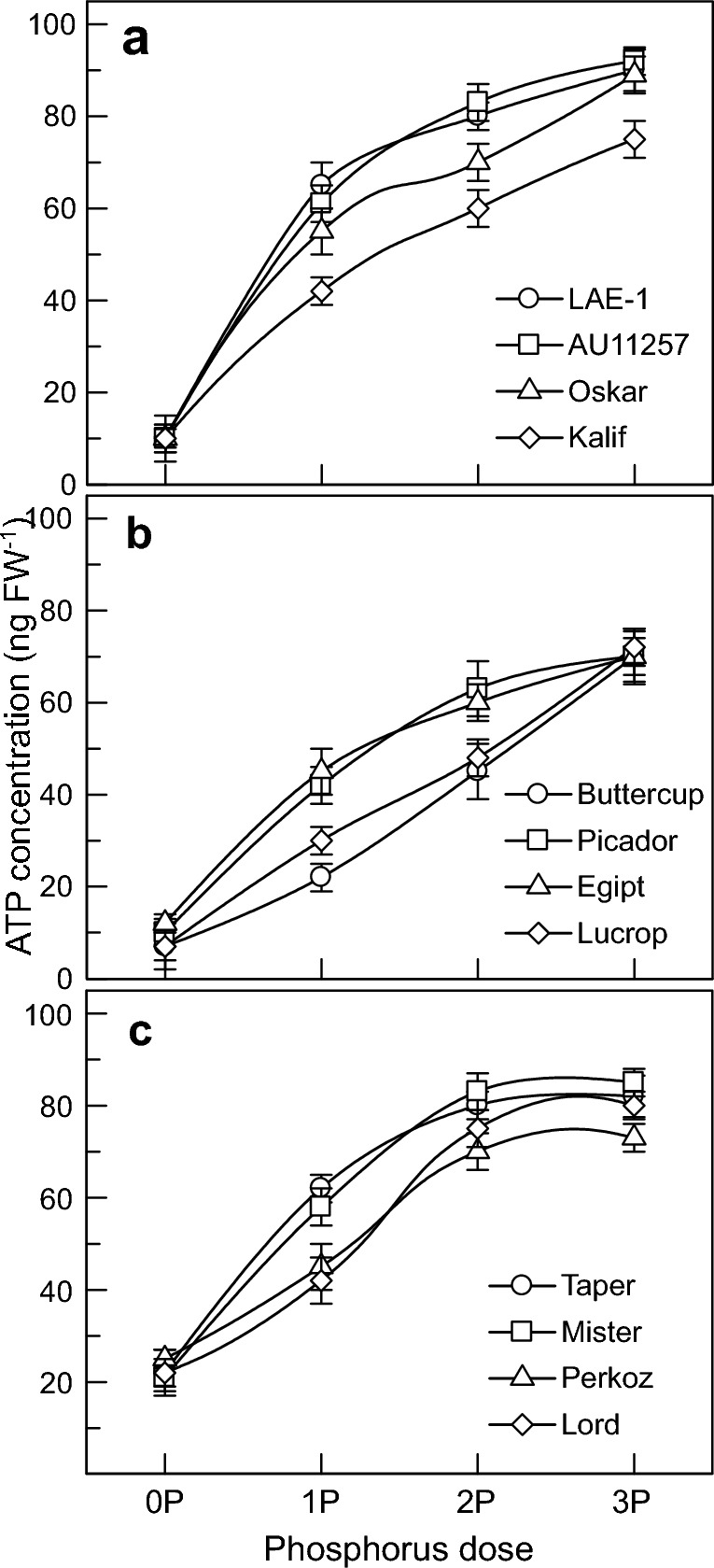
  succinic acid. The plants were supplemented with 0 (0P; control), 22 (1P), 44 (2P) and 88 (3P) mg kg−1 of P. Data points represent the means ± SE (n = 4). The same letter denote homogenous groups (interaction P dose × variety) within species after two-way ANOVA and Bonferroni post hoc test at p = 0.05.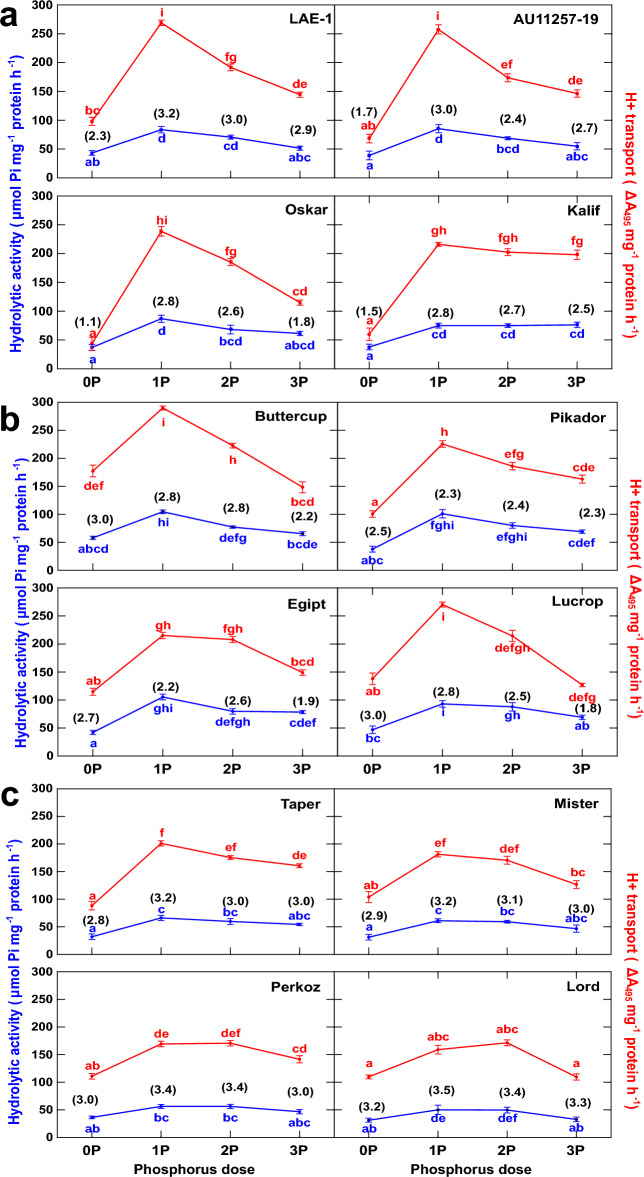
 ) and the H+-ATPase-mediated proton efflux (
 ) in roots of narrow-leafed (a), white (b) and yellow (c) lupines, grown under variable P supplementation. The plants were supplemented with 0 (0P; control), 22 (1P), 44 (2P) and 88 (3P) mg kg−1 of P. The values of the H+/ATP coupling ratio are presented in brackets. Data points represent the means ± SE (n = 4). The same letter denote homogenous groups (interaction P dose × variety) within species after two-way ANOVA and Bonferroni post hoc test at p = 0.05.


References
-
- Marschner, H. Mineral Nutrition of Higher Plants 2nd edn, 889 (Academic Press, 1995).
-
- Hopkins, B. G. Phosphorus. In Handbook of Plant Nutrition 2nd edn (eds Allen, V. & Barker Pilbeam, D. J.) 65–126 (CRC Press Taylor & Francis Group, 2015).
-
- Amadou, I., Houben, D., Lambers, H. & Faucon, M.-P. Key role of root trait combinations and plasticity in response to phosphorus forms on phosphorus-acquisition in agroecosystems. Plant Soil509, 123 (2024). - DOI
-
- Amadou, I., Houben, D. & Faucon, M.-P. Unravelling the role of rhizosphere microbiome and root traits in organic phosphorus mobilization for sustainable phosphorus fertilization. A review. Agronomy11(11), 2267 (2021). - DOI
MeSH terms
Substances
LinkOut - more resources
Full Text Sources
