


How well are implementation strategies and target healthcare professional behaviors reported? A secondary analysis of 204 implementation trials using the TIDieR checklist and AACTT framework
- PMID: 40457368
- PMCID: PMC12131398
- DOI: 10.1186/s13012-025-01442-7
How well are implementation strategies and target healthcare professional behaviors reported? A secondary analysis of 204 implementation trials using the TIDieR checklist and AACTT framework
Abstract
Background: Clear specification and reporting of implementation strategies and their targeted healthcare professional behaviors are essential for replication, adaptation, and cumulative learning in implementation science. However, critical gaps remain in the consistent use of reporting frameworks. This study aimed to: (1) assess the completeness of implementation strategy reporting using the Template for Intervention Description and Replication (TIDieR) checklist; (2) examine trends in implementation strategy reporting over time; and (3) assess the completeness of the reporting of healthcare professional behaviors targeted for change using the Action, Actor, Context, Target, Time (AACTT) framework.
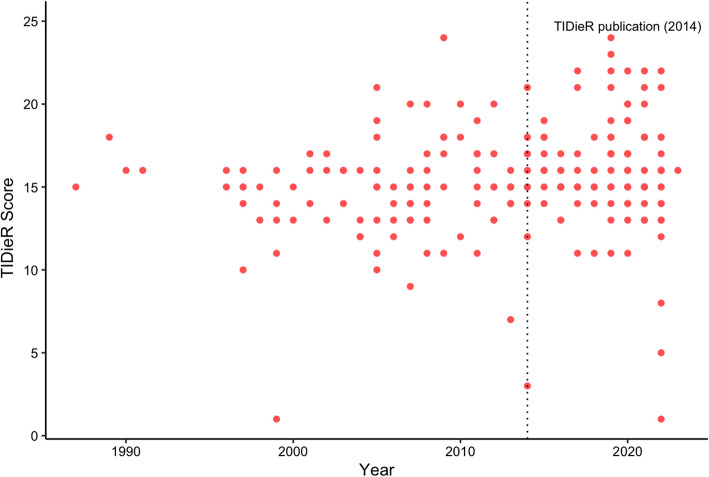
Methods: We conducted a secondary analysis of 204 trials included in a systematic review of implementation strategies aimed at changing healthcare professional behavior. Implementation strategies were assessed using the 12-item TIDieR checklist; target behaviors were characterized using the five AACTT domains. Two independent reviewers extracted and coded the data. Descriptive statistics were used to summarize reporting patterns. Data were synthesized narratively and presented in tables, with trends illustrated via a scatterplot.
Results: Assessment of implementation strategy reporting using TIDieR showed that procedural details (98%), materials used (95%), and modes of delivery (88%) were frequently reported. Critical elements such as strategy tailoring (28%), fidelity assessment (19% planned; 17% actual), and modifications (10%) were often missing. A modest improvement in reporting was observed after the publication of TIDieR, with median scores increasing from 15.0 (IQR: 13.0-16.0) pre-2014 to 16.0 (IQR: 15.0-18.0) post-2014. Assessment of target healthcare professional behavior reporting using AACTT indicated that actions (e.g., "assess illness") and actors (e.g., nurses) were generally well reported at a high level. However, key contextual and temporal details were largely absent. While physical context was documented in all studies, the emotional and social contexts of behaviors were rarely reported. Crucial information on the duration, frequency, and period of behaviors was rarely reported.
Conclusions: Implementation strategies and target behaviors are not consistently or sufficiently reported in trials. Increased adoption of structured reporting tools such as TIDieR and AACTT is essential to enhance transparency. Incorporating these frameworks during protocol development could strengthen intervention evaluation and reporting, advancing implementation science and fostering cumulative knowledge.
Trial registration: PROSPERO CRD42019130446.
Keywords: Barriers; Facilitators; Implementation practice; Implementation research; Implementation science; Knowledge translation; Reporting checklists; Reporting standards.
© 2025. The Author(s).
Conflict of interest statement
Declarations. Ethics approval and consent to participate: Not applicable. Consent for publication: Not applicable. Competing interests: The authors declare that they have no competing interests.
Figures


References
-
- Effective Practice and Organisation of Care (EPOC). EPOC Taxonomy. https://epoc.cochrane.org/epoc-taxonomy
-
- Hoffmann TC, Glasziou PP, Boutron I, et al. Better reporting of interventions: template for intervention description and replication (TIDieR) checklist and guide. BMJ. 2014;348:g1687. 10.1136/bmj.g1687 - PubMed
Publication types
MeSH terms
LinkOut - more resources
Full Text Sources
