


Decadal change in seabird-driven isotopes on islands with differing invasion histories
- PMID: 40457802
- PMCID: PMC12130745
- DOI: 10.1002/eap.70030
Decadal change in seabird-driven isotopes on islands with differing invasion histories
Abstract
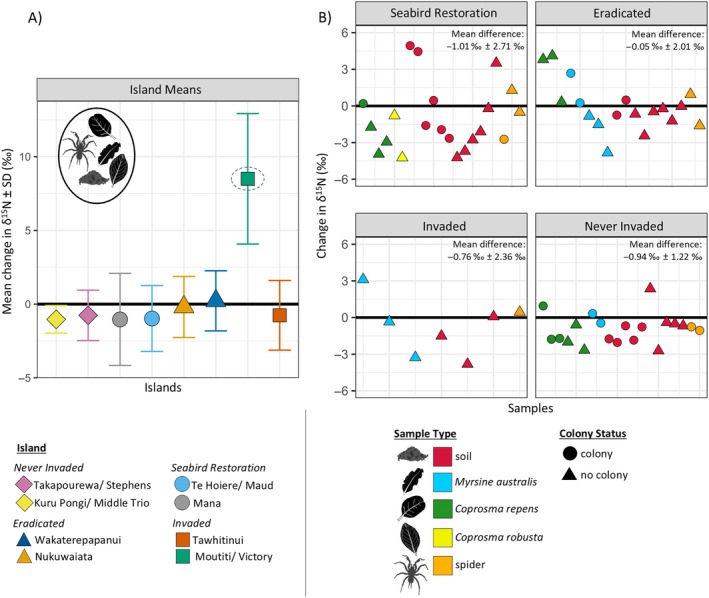
Invasive mammal eradications are commonplace in island conservation. However, post-eradication monitoring beyond the confirmation of target species removal is rarer. Seabirds are ecosystem engineers on islands and are negatively affected by invasive mammals. Following an invasive mammal eradication, the recovery of seabird populations can be necessary for wider ecosystem recovery. Seabirds fertilize islands with isotopically heavy nitrogen, which means that nitrogen stable isotope analysis (δ15N) could provide a useful means for assessing corresponding change in ecosystem function. We quantified decadal changes in δ15N on eight temperate New Zealand islands subject in pairs to distinct mammal invasion and seabird restoration histories: invaded, never-invaded, invader-eradicated, and undergoing active seabird restoration. First, we investigated long-term changes in δ15N values on individual islands. Second, we used a space-for-time analysis to determine whether δ15N levels on islands from which invaders had been removed eventually recovered to values typical of never-invaded islands. On each island, soil, plants (Coprosma repens, Coprosma robusta, and Myrsine australis), and spiders (Porrhothelidae) were sampled in 2006/2007 and 2022, allowing δ15N change on individual islands over 16 years to be assessed. Combined, the samples from invader-eradicated islands provided a 7- to32-year post-eradication dataset. Change in δ15N was only detected on one island across the study period, following the unexpected recolonization of seabirds to an invaded island. Invader-eradicated islands generally had higher δ15N values than invaded islands; however, they were still lower than never-invaded islands, and there was no trend in δ15N with time since eradication. This, and the measurable increase in δ15N following seabird recolonization on one island, may suggest that δ15N change occurs rapidly following invader eradication but then slows, with δ15N values staying relatively constant in the time period studied here. Isotope and seabird population studies need to be coupled to ascertain whether plateauing in δ15N reflects a slowing of seabird population growth and subsequent basal nutrient input or whether the baseline nutrients are entering the ecosystem but then not propagating up the food web.
Keywords: chronosequence; ecosystem function; ecosystem recovery; eradication; rodents; seabird islands.
© 2025 The Author(s). Ecological Applications published by Wiley Periodicals LLC on behalf of The Ecological Society of America.
Conflict of interest statement
The authors declare no conflicts of interest.
Figures



References
-
- Anderson, W. B. , and Polis G. A.. 1998. “Marine Subsidies of Island Communities in the Gulf of California: Evidence from Stable Carbon and Nitrogen Isotopes.” Oikos 81(1): 75–80. 10.2307/3546469. - DOI
-
- Bates, D. , Maechler M., Bolker B., and Walker S.. 2015. “Fitting Linear Mixed‐Effects Models Using lme4.” Journal of Statistical Software 67(1): 1–48. 10.18637/jss.v067.i01. - DOI
-
- Bell, M. , Bell B., and Bell E.. 2005. “Translocation of Fluttering Shearwater (Puffinusgavia) Chicks to Create a New Colony.” Notornis 52: 11–15.
-
- Bellingham, P. J. , Towns D. R., Cameron E. K., Davis J. J., Wardle D. A., Wilmshurst J. M., and Mulder C. P. H.. 2010. “New Zealand Island Restoration: Seabirds, Predators, and the Importance of History.” New Zealand Journal of Ecology 34: 115–136.
-
- Benkwitt, C. E. , Gunn R. L., Le Corre M., Carr P., and Graham N. A. J.. 2021. “Rat Eradication Restores Nutrient Subsidies from Seabirds across Terrestrial and Marine Ecosystems.” Current Biology 31: 2704–2711.e4. - PubMed
MeSH terms
Substances
Grants and funding
LinkOut - more resources
Full Text Sources
