. 2025 Jun 3;135(16):e191107.
doi: 10.1172/JCI191107. eCollection 2025 Aug 15.

Polygenic modifiers impact penetrance and expressivity in telomere biology disorders

Affiliations

Polygenic modifiers impact penetrance and expressivity in telomere biology disorders

Michael Poeschla et al. J Clin Invest. .

Abstract

BACKGROUNDTelomere biology disorders (TBDs) exhibit incomplete penetrance and variable expressivity, even among individuals harboring the same pathogenic variant. We assessed whether common genetic variants associated with telomere length combine with large-effect variants to impact penetrance and expressivity in TBDs.METHODSWe constructed polygenic scores (PGS) for telomere length in the UK Biobank to quantify common variant burden and assessed the PGS distribution across patient cohorts and biobanks to determine whether individuals with severe TBD presentations have increased polygenic burden causing short telomeres. We also characterized rare TBD variant carriers in the UK Biobank.RESULTSIndividuals with TBDs in cohorts enriched for severe pediatric presentations have polygenic scores predictive of short telomeres. In the UK Biobank, we identified carriers of pathogenic TBD variants who were enriched for adult-onset manifestations of TBDs. Unlike individuals in disease cohorts, the PGS of adult carriers did not show a common variant burden for shorter telomeres, consistent with the absence of childhood-onset disease. Notably, TBD variant carriers were enriched for idiopathic pulmonary fibrosis diagnoses and telomere length PGS stratified pulmonary fibrosis risk. Finally, common variants affecting telomere length were enriched in enhancers regulating known TBD genes.CONCLUSIONCommon genetic variants combined with large-effect causal variants to impact clinical manifestations in rare TBDs. These findings offer a framework for understanding phenotypic variability in other presumed monogenic disorders.FUNDINGThis work was supported by NIH grants R01DK103794, R01HL146500, R01CA265726, R01CA292941, and the Howard Hughes Medical Institute.

Keywords: Bone marrow; Genetics; Hematology; Hematopoietic stem cells; Stem cells; Telomeres.


Conflict of interest statement

Conflict of interest: VGS is an advisor to Ensoma, Cellarity, and Beam Therapeutics, unrelated to this work.

Figures

Figure 1
Figure 1. Flow Diagram of Study Design.
(A) Schematic of study design to assess polygenic variation affecting telomere length across biobank and cohort populations. Individuals with measured telomere length in the UK Biobank were randomly split into GWAS and PGS subsets. A GWAS for telomere length was conducted, and then the best polygenic predictors were identified in the other subset. The resulting PGS represents the common variant burden associated with telomere length. The best PGS was compared between biobank cohorts and disease cohorts. (B) Variant carrier ascertainment strategy in UK Biobank, and summary of mutation carriers for each gene in variant carrier groups. Pathogenic variants were alternately defined based on pathogenic prediction using VEP and AlphaMissense, or using ClinVar annotated variants.
Figure 2
Figure 2. Polygenic modification of TBD expressivity in disease cohorts.
(A) Illustration. TBD-associated germline variants affect genes involved in telomere length and integrity. Variable expressivity of TBD variants results in diverse phenotypic presentations and age of onset. (B) Schematic of distribution of TBD-case telomere length polygenic scores compared with biobanks, under different hypotheses. If common variation affecting telomere length contributes to TBD expressivity and disease cohort ascertainment, left-shifted (towards shorter TL) PGS distribution would be expected (top panel). The null hypothesis is that TBD high-impact variants overpower any effects of common variation (central panel). An alternative hypothesis is that common variation predisposing to long telomere length protects TBD variant carriers from severe phenotypes and mortality; under this model, a right-shifted PGS could be observed (bottom panel). (C) Distribution of telomere length PGS in NCI TBD cases compared to the UK Biobank (Welch’s 2-tailed t test, P = 1.037 × 10⁻⁴). (D) Odds ratio of case-control status versus telomere length PGS quintile, NCI TBD cases. (E) Comparison of meta-analysis of telomere length PGS distribution in NCI and DCR cases versus UK Biobank (Welch’s 2-tailed t test, P = 1.18 × 10⁻⁵). (F) Comparison of NCI non-TBD IBMFS case telomere length PGS versus UK Biobank (Welch’s 2-tailed t test, P = 0.5124).
Figure 3
Figure 3. Polygenic modification of TBD expressivity in the UK Biobank.
(A) Measured telomere length in UK Biobank noncarriers and carriers of pathogenic TBD variants (pairwise 1-sided t tests with Bonferroni multiple testing correction; noncarrier versus Predicted Pathogenic: P = 3.80 × 10⁻²⁰; noncarrier versus ClinVar Pathogenic: P = 3.46 × 10⁻²³; noncarrier versus ClinVar Dominant-Acting: P = 1.39E-3). (B) TL PGS in UK Biobank noncarriers and carriers of pathogenic TBD variants (pairwise 2-sided t test with Bonferroni multiple testing correction; non-carrier versus Predicted Pathogenic: P = 1; noncarrier versus ClinVar Pathogenic: P = 0.20; noncarrier versus ClinVar Dominant-Acting: P = 1). (C) TL PGS in NCI cases compared to UKB pathogenic variant carriers (pairwise 1-sided t test with Bonferroni multiple testing correction; TBD case versus Predicted Pathogenic: P = 0.00087; TBD case versus ClinVar Pathogenic: P = 0.041; TBD case versus ClinVar Dominant-Acting: P = 0.0896). (D) Odds ratios of aplastic anemia and idiopathic pulmonary fibrosis in carriers of pathogenic TBD variants compared with noncarriers (logistic regression adjusting for age and sex). (E) Blood cell counts in UK Biobank noncarriers and carriers of pathogenic TBD variants (pairwise t test with Bonferroni multiple testing correction). (F) Odds ratios of idiopathic pulmonary fibrosis in UK Biobank stratified by PGS tertile (top third, middle third, and lowest third) and ClinVar Path or Predicted Path variant-carrier status, using noncarrier intermediate group as the control group (logistic regression adjusting for age, sex and first 4 ancestry PCs).
Figure 4
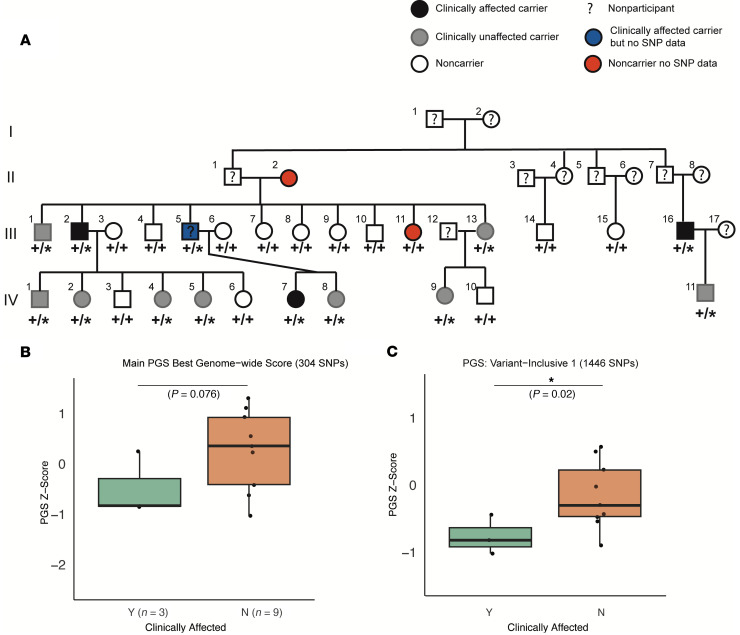
Figure 4. Polygenic modification of expressivity within a family.
(A) Pedigree depicting family with TERT variant. Black, case; gray, TERT noncase carrier; transparent, noncarrier; square, male; circle, female; ?, unknown status; diamond, unknown sex. (B) Telomere length PGS comparing cases with noncase TERT variant carriers using the same parameters as best genome-wide SNP score (linear mixed model with kinship matrix as random effect; see Methods). (C) Telomere length PGS comparing cases with noncase TERT variant carriers for Variant-inclusive PGS Score 1 (linear mixed model with kinship as random effect).
Figure 5
Figure 5. Common and rare genetic variation converges in telomere biology disorders.
Genes with mutations that cause TBDs show strong overlap with genes underpinning common-variant associations with telomere length (hypergeometric test). Causal genes associated with common SNPs in telomere length PGS overlaid with genes causally implicated in telomere biology disorders.

Comment in

References

    1. Kingdom R, Wright CF. Incomplete penetrance and variable expressivity: from clinical studies to population cohorts. Front Genet. 2022;13:920390. doi: 10.3389/fgene.2022.920390. - DOI - PMC - PubMed
    1. Cooper DN, et al. Where genotype is not predictive of phenotype: towards an understanding of the molecular basis of reduced penetrance in human inherited disease. Hum Genet. 2013;132(10):1077–1130. doi: 10.1007/s00439-013-1331-2. - DOI - PMC - PubMed
    1. Fahed AC, et al. Polygenic background modifies penetrance of monogenic variants for tier 1 genomic conditions. Nat Commun. 2020;11(1):3635. doi: 10.1038/s41467-020-17374-3. - DOI - PMC - PubMed
    1. Kingdom R, et al. Genetic modifiers of rare variants in monogenic developmental disorder loci. Nat Genet. 2024;56(5):861–868. doi: 10.1038/s41588-024-01710-0. - DOI - PMC - PubMed
    1. Milne RL, Antoniou AC. Genetic modifiers of cancer risk for BRCA1 and BRCA2 mutation carriers. Ann Oncol. 2011;22 Suppl 1(suppl 1):i11–i17. doi: 10.1093/annonc/mdq660. - DOI - PubMed

LinkOut - more resources