


Inequality in Utilization of Maternal Healthcare Services in Low‑ and Middle‑Income Countries: A Scoping Review of the Literature
- PMID: 40461773
- PMCID: PMC12206214
- DOI: 10.1007/s10995-025-04111-9
Inequality in Utilization of Maternal Healthcare Services in Low‑ and Middle‑Income Countries: A Scoping Review of the Literature
Abstract
Background: Inequality in maternal healthcare service (MHS) utilization is a significant global health challenge in low- and middle-income countries (LMICs). Recently, the literature on MHS inequality in LMICs has expanded. We conducted a scoping review to synthesize existing evidence and identify knowledge gaps.
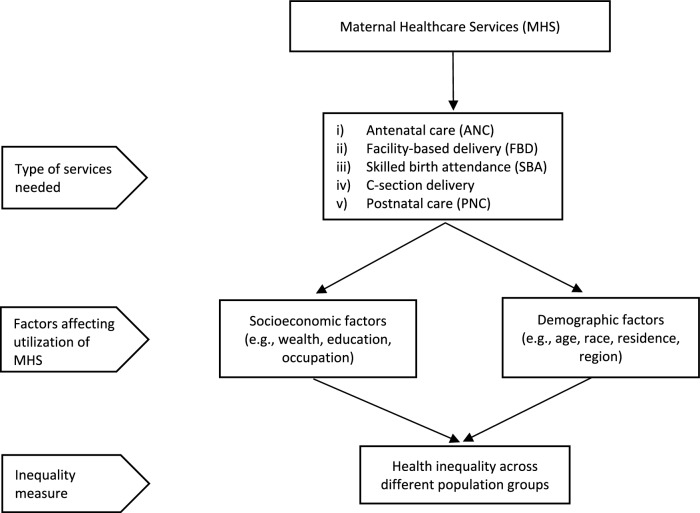
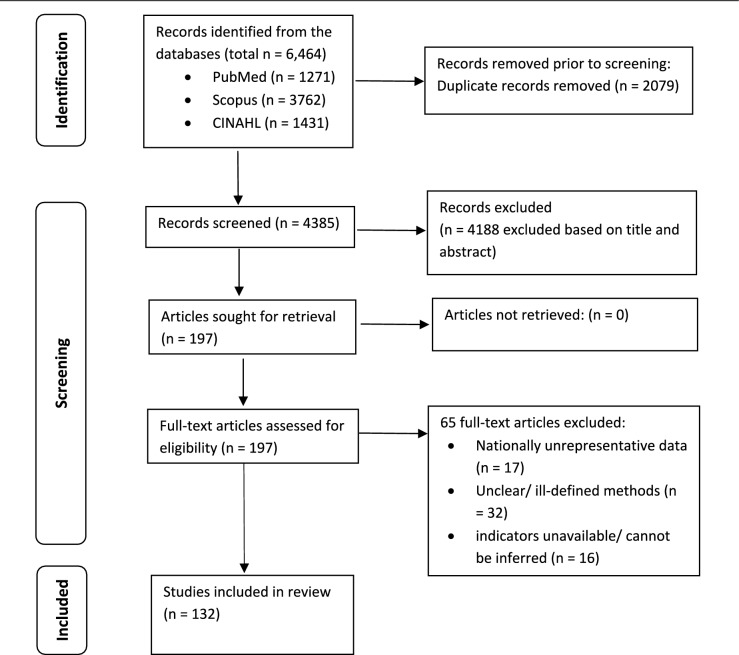
Methods: Following PRISMA-ScR guidelines, we systematically searched PubMed, Scopus, and CINAHL Ultimate in June 2023 for literature published since January 1, 2015. We included empirical studies using nationally representative data to measure inequality in at least one of five MHS indicators: antenatal care (ANC), skilled birth attendance (SBA), facility-based delivery (FBD), caesarean-section (C-section) delivery, and postnatal care (PNC). Our review encompassed 132 peer-reviewed articles on MHS inequality in LMICs.
Results: ANC, FBD, and SBA were more frequently analyzed indicators for inequality measurement compared to PNC and C-section delivery. None of the 132 studies assessed all five MHS indicators together. The concentration index was the most frequently used inequality measure across all MHS indicators. Included studies were predominantly focused on economic (wealth) and geographic (residence, region) inequalities, while sociocultural factors (e.g., religion, ethnicity) remain underexplored. Inequality was most pronounced in low-income (LICs) and lower-middle-income countries (LwMICs). The extant literature mainly concentrates on India and Ethiopia as research settings.
Conclusion: Our review highlights significant gaps in health inequality research, particularly in LICs and upper-middle-income countries (UMICs), with a heavy reliance on cross-sectional data, limited assessment of PNC and C-section delivery and lack of comprehensive analysis across all five common MHS indicators. Future research in LMICs should address the gaps identified in this review.
Keywords: Antenatal care; Inequality; Low- and middle-income countries; Maternal healthcare; Postnatal care.
© 2025. The Author(s).
Conflict of interest statement
Declarations. Conflict of interest: The authors declare no competing interests. Ethics Approval: Not applicable. Consent to Participate: Not applicable. Consent for Publication: Not applicable.
Figures
References
-
- Adusumilli, G., Pederson, J. M., Hardy, N., Kallmes, K. M., Hutchison, K., Kobeissi, H., Heiferman, D. M., Kallmes, D., Brinjikji, W., Albers, G. W., & Heit, J. J. (2022). Endovascular therapy versus medical therapy alone for basilar artery stroke: A systematic review and meta-analysis through nested knowledge. Stroke: Vascular and Interventional Neurology. 10.1161/SVIN.121.000147 - DOI
Publication types
MeSH terms
LinkOut - more resources
Full Text Sources
Medical
